We use Google Cloud Translation Services. Google requires we provide the following disclaimer relating to use of this service:
This service may contain translations powered by Google. Google disclaims all warranties related to the translations, expressed or implied, including any warranties of accuracy, reliability, and any implied warranties of merchantability, fitness for a particular purpose, and noninfringement.
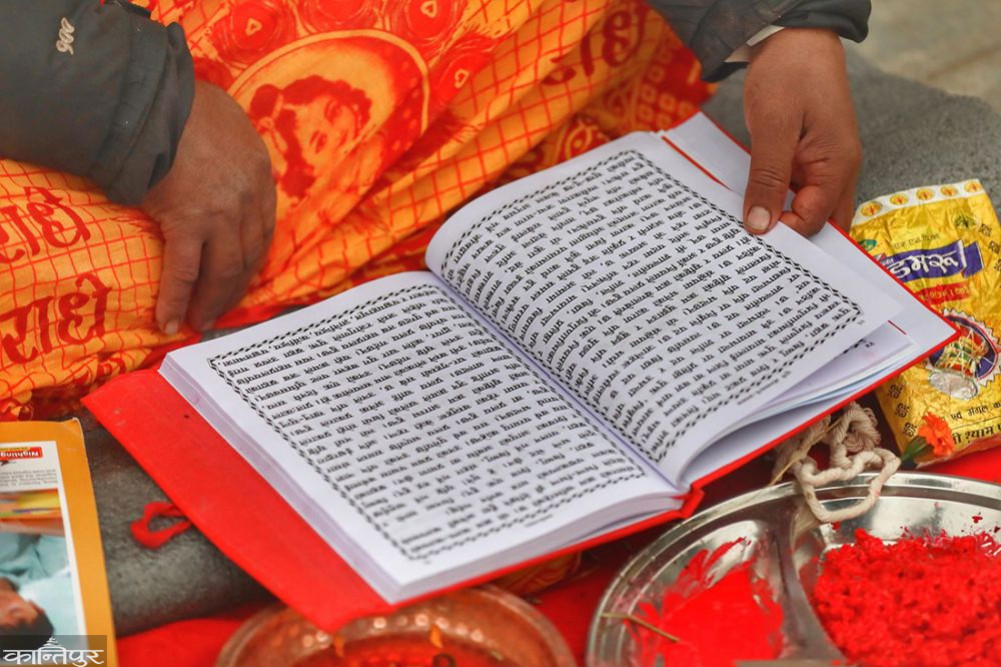
On the day of Magh Shukla Purnima, a month-long Swasthani fasting story is being concluded today. A month-long Swasthani fast started from house to house by Vedic Sanatan Hindus from Paush Shukla Purnima is going to be formally concluded today.
Devotees from all over the country, who have started the Swasthani fast from Paush Shukla Purnima and worshiped Mahadev along with Parvati daily at midday, are going to end the fast today. The work of telling and listening to the dialogue between Kumar and Agastya in the Magha Mahatmya of the Kedar section under the Skanda Purana, which was started on the same day, is also ending today.
On the full moon day of Magh Shukla, the people who have fasted for a month offer 108 betel nuts, 108 betel nuts, 108 betel nuts, 108 betel nuts, 108 roti, 108 akshata fruits, incense, lamps, offerings, srikhand, blood sandalwood, vermilion, cloth, and pray to Bhagwati that the wishes of the fast will be fulfilled. Out of all the offerings, eight to eight are given to the husband, if there is no husband, to the son, and if there is no son, to the deceased son, and if there is no deceased son, then there is a fasting method of floating the log in the nearby holy river.
A hundred loaves of bread are eaten and kept awake at night. During Jagrama, it is said to listen to the mahatmya of the goddess. There is a religious belief that if this is done, the wishes of the vartalu will be fulfilled. Swasthani literally means the goddess of the place where she lives. Worshiping the Goddess of one's place is healthy worship. Since the time after Uttarayana is suitable for meditation and yoga sadhana, it is also believed that practicing contact with one's soul is known as Swasthani. For this, the time from Paush Shukla Purnima to Magh Shukla Purnima is considered good.
The goddess with golden complexion, three eyes, happy posture, seated on a lotus and throne, with four arms is called Swasthani Devi. Among the four hands of Swasthani, it is mentioned in the Vratkatha that Goddess Swasthani is the one who holds the Neelkamal in the first hand, the Khadga in the second hand, the shield in the third hand and the Varadamudra in the fourth hand.
It is believed that if this goddess is fasted properly, the separated couple will be reunited. There is also a popular story that if you have a disease, you will be cured and if you wish for someone as a husband or wife, you will get it. The story of Parvati, the daughter of the Himalayan mountain in the Satya Yuga, fasted on Vishnu's orders to give Mahadev a husband, is described in Swasthani. The story mentions the reunification of Nagini who was separated after fasting.
Prakash Shrestha, a historian researching the historical, religious, archeological, cultural and touristic aspects of Sankhu, told the story of how a Goma Brahmin was freed from the loss of his son by following the fasting method taught by Saptarishi, and his son Navaraj Lavanya became the king of the current Sankhu region due to the influence of the fast.
This year's fast will be concluded in a healthy manner after ritually performing pooja at noon and concluding the fast at night, sitting awake at night on Thursday morning in Phulpati river, according to Prof. Dr. Devmani Bhattarai, head of the Department of Theology at Valmiki Vidyapeeth of Nepal Sanskrit University and a member of the Nepal Panchang Judiciary Development Committee.
The Madhavanarayan fast, which started on Paush Shukla Purnima in Shalinadi in the eastern part of the valley, will also be concluded today with the Ashwamedha yagna. Here, about two hundred men and women have observed a strict fast of Madhavanarayan for a month. Today, the Newar community celebrates this day as Si Punhika.