The shadow of the government remains in the council
We use Google Cloud Translation Services. Google requires we provide the following disclaimer relating to use of this service:
This service may contain translations powered by Google. Google disclaims all warranties related to the translations, expressed or implied, including any warranties of accuracy, reliability, and any implied warranties of merchantability, fitness for a particular purpose, and noninfringement.
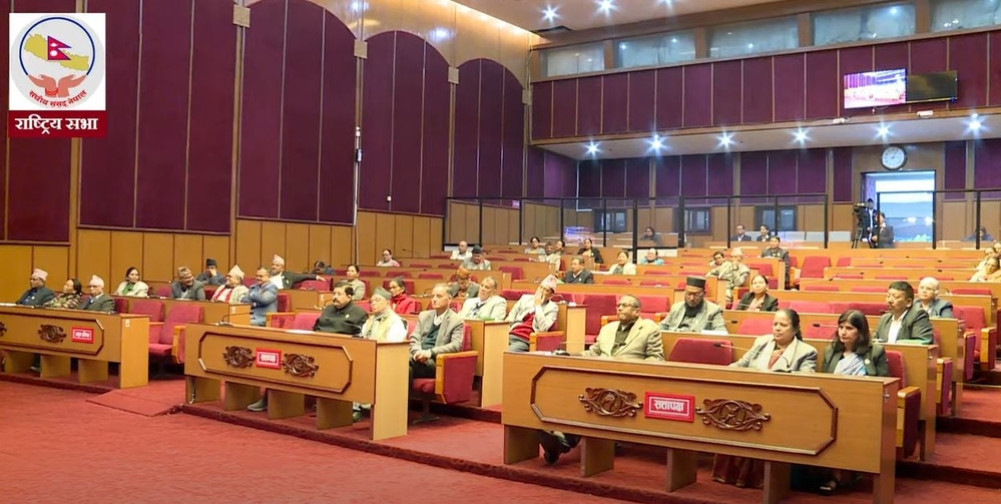
The National Assembly meeting on Monday passed the 'Media Council Bill 2081'. The National Assembly has approved the provision that the person appointed by the government will be the chairman of the council. The bill has been passed by the National Assembly so that the government will act as a shadow over the work of the council, keeping the original issue regarding the leadership of the council that has been raised by experts and stakeholders.
Rajendra Lakshmi Gayre, a member of the National Assembly, objected that such a bill should not be passed. Although he was of the opinion that the chairman of the council should be removed from the government's shadow, the appointment was passed by the majority. Minister of Communication and Information Technology Prithvisubba Gurung stated that there was sufficient discussion on the bill in the committee of the National Assembly and requested to pass the bill unanimously.
The National Assembly has approved a bill renaming the Press Council Nepal, the current regulatory body in the field of journalism, as the Media Council Nepal. Earlier, Tulsakumari Dahal, chairperson of the Legislation Management Committee of the National Assembly, submitted a report on the bill in the January 18 meeting. On Monday, Minister Gurung presented a proposal to discuss the report and pass the bill. The assembly passed the report and gave approval to make it a part of the bill.
The Media Council Bill has been heavily criticized by experts and stakeholders for trying to keep the press world under the control of the government. The legislative committee of the National Assembly discussed the bill prepared by the government to manage and regulate the media. Last June, after MPs, experts and stakeholders raised questions on the theoretical aspects of the bill, the committee also held discussions with the Minister of Communications, Secretary and high officials.
Clause (a) of Section 6 (1) of the Bill has been kept as it is and it is mentioned that the Chairman of the Council shall be a person appointed by the Government of Nepal . It has been proposed that the council will consist of gazetted first-class officers appointed by the ministry and the president of the Federation of Nepalese Journalists as members. The bill mentions that there will be a three-member recommendation committee including an expert member appointed by the government and a joint secretary of the ministry to recommend to the ministry for the appointment of the chairman and members of the council. It has been proposed that the qualifications for the chairman and members of the council should be the same as judges of the Supreme Court. It has been said about the necessary qualification of the president of
, "Has qualified to be a judge of the Supreme Court or has obtained at least a bachelor's degree from a recognized university and has made a special contribution to the field with at least 15 years of experience in the field of journalism." Raising questions about the provision that the secretary of the ministry recommends an official like a judge of the Supreme Court for the chairman of the council, they have expressed doubts about the fact that the secretary can recommend the judge of the Supreme Court.
When appointing members of the council, the Rashtra Sabha has added the sentence that 'the government of Nepal will do it on the basis of inclusive principles'. It has been suggested to keep seven members (three women should be women) representing legislative bodies from seven provinces and "three members including at least one woman" representing media readers, viewers, and listeners . In the
report, it is asked to add the word "independent" in sub-section 1 under "Council shall be a self-governing and organized body" in section 4 of the bill. As pointed out by the experts, the committee proposed that the Media Council should be an independent, self-governing and organized organization. The committee has also submitted an amendment proposal in clause (b) of sub-section 4 of section 20 of the bill. According to this, it is mentioned that media organizations, mass media and those involved in not following the decision or instructions of the council will keep the records of the journalists and publish the details in the annual report.
The government formed a committee headed by Suresh Acharya as the former president of the Federation of Nepalese Journalists to prepare the draft of the Media Council Bill. Acharya is currently the chief commissioner of the National Information Commission . He had previously responded to Kantipur that when the draft submitted by them reached the parliament, the original spirit was broken and it was moved forward. He said that their recommendation is that the council should be under the parliament rather than the government.
If the position of the council chairman is vacant, the provision to run the council by employees was also kept in the bill. By amending section 14 (2) of the bill, the committee has suggested that instead of the system of calling a meeting by a "gazetted first class officer designated by the ministry" as the acting chairman until the chairman is appointed, the words "senior member of the council until the acting chairman is appointed" should be kept. It was protested that the joint secretary of the ministry was trying to create a structure to run the council and that it was a violation of the constitution, journalistic practice and values. By removing section 15 of the bill, the committee has tried to clarify the provisions regarding the appointment of acting chairman. Likewise, the committee has asked to withdraw the provision of 'doing other tasks as specified' in the bill. It was criticized as giving support to the rights of the people.
The government also introduced the Media Council Bill in 2075. The proposed penalty was widely criticized at the time. By removing those arrangements, it is said that the council will initially try to reconcile the concerned media organizations, mass media or journalists and the complainant. If reconciliation is not possible, it is mentioned that media organizations, mass media or journalists who violate the code of conduct should be ordered to publish and broadcast a rebuttal on the number, time or page as determined by the council . The committee has suggested that journalists who do not follow the decisions and instructions of the council should be kept and published in the annual report.