Among the 6 ordinances, the main concern of JSP Nepal is the ordinance related to land, which can be supported in others but cannot be supported in this ordinance, according to the leaders of JSP Nepal.
We use Google Cloud Translation Services. Google requires we provide the following disclaimer relating to use of this service:
This service may contain translations powered by Google. Google disclaims all warranties related to the translations, expressed or implied, including any warranties of accuracy, reliability, and any implied warranties of merchantability, fitness for a particular purpose, and noninfringement.
At a time when the issue of whether the 6 ordinances brought by the government will be accepted by the federal parliament or not has reached a complicated stage, one side of the ruling Congress is expressing strong dissatisfaction with the latest land ordinance. While the Council of Ministers had recommended five ordinances on December 26, President Ramchandra Poudel also delayed and issued the ordinances related to land for a few days.
Among the 6 ordinances, JSPA Nepal is also mainly concerned with the ordinance related to land. Leaders of Jaspa Nepal say that other ordinances can be supported but the land ordinance cannot be supported. It is arithmetic that the ordinance can be accepted by the National Assembly only with the support of Jaspa Nepal, which has been supporting the government from outside. There is a constitutional provision that the ordinance must be approved by both houses of the federal parliament.
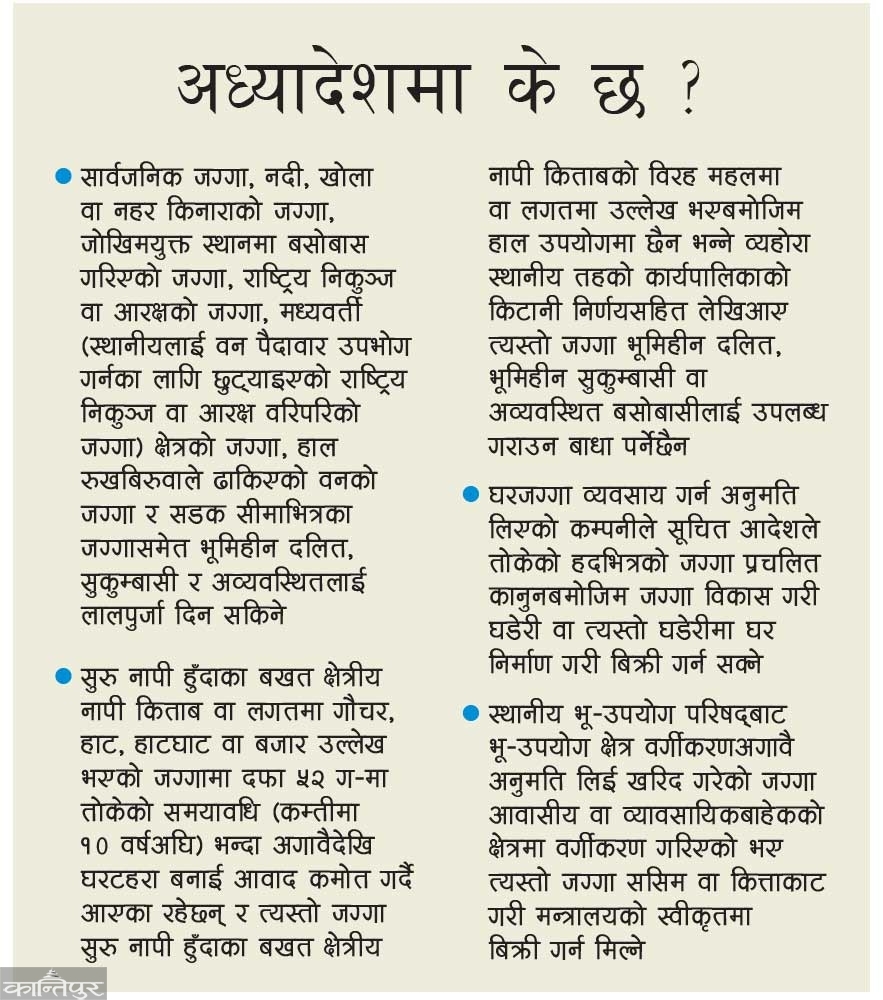
Five ordinances were issued on Jan. 29 and an ordinance amending some Nepalese laws related to land was issued on Jan. 2. Earlier, when Oli was the prime minister, the eighth amendment of the Land Act 2021 was made in 2076. At that time, Oli has been criticized for making a law so that more land can be leased and sold in the name of Giribandhu Tea Estate located in Jhapa. By further amending the Act through Ordinance, the issue of selling land in excess of the limit and giving landless Dalits, landless squatters and unorganized residents the subject of Lalpurza has been broadened.
The Eighth Amendment of the Land Act 2021 has completely amended the provision made in Section 52 'B' Sub-Section 4 (C) of the Ordinance to include public land, river, river or canal bank land, land in hazardous areas, national park or reserve land, intermediate (national park or reserve land set aside for locals to enjoy forest produce) area land, forest land currently covered with trees and within the road boundary. A provision has been made that Lalpurja can be given to landless Dalits, squatters and the unorganized. The Eighth Amendment provided that such land cannot be distributed.
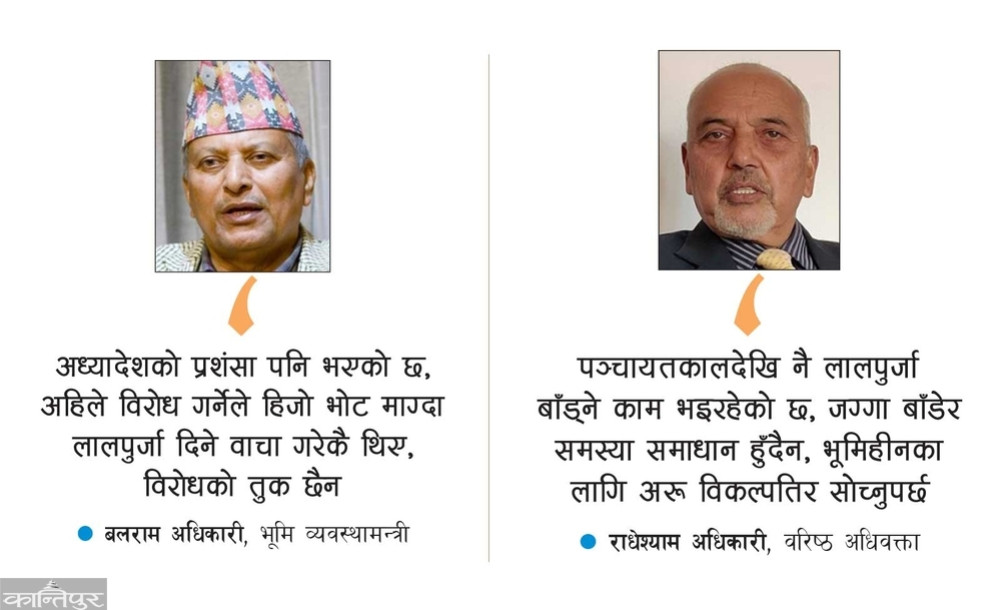
Senior advocate Radheshyam Adhikari also says that the problem will not be solved by dividing the land . "Lalpurja is being distributed since the Panchayat period. This has led to the shrinking of the government land, the pressure on the forest has increased," he says, "No matter how many times the law is amended and given red parts, the problem will not be solved. This adds to the problem. There is no solution from traditional thinking. To solve the problem of the landless, the official says that we need to lease land for a long time or think about other options to increase production.
Another advocate, Omprakash Aryal, says that the provisions of the ordinance to exempt land beyond the limit are serious. He also made a comment that it is indecent to introduce an ordinance while the Parliament is in session.
"It is objectionable for the government to go against the order given by the Supreme Court in the case of Giribandhu Tea Estate and bring an ordinance to allow the sale of land in excess of the delimitation," he said, "The court order clearly states that the land should be brought under the name of the government if it is not for that purpose." has done, which is against the decision of the Supreme Court according to Advocate Aryal. Mentioning that the ordinance has lifted some of the previous restrictions on giving parts to squatters and unorganized residents, he also expressed his suspicion that it could be widely misused. "When the executive changes the laws made by the Parliament, the consequences are not taken into account. It is not good for the executive to dominate the parliament, said Aryal.
According to Sanad Kumar Karki, the Central Spokesperson of the Land Problem Solution Commission, the number of households to be distributed is 11 lakh. Among them, 87 thousand are landless Dalits, 160 thousand are landless squatters. The rest are unorganized. Karki says that the ordinance will make it easier for them to distribute land. "We have prioritized the landless Dalits and squatters over the unorganized, and now it has become easier after the ordinance," he said. The
ordinance has made a flexible legal arrangement for the companies that have permission to do real estate business, to sell and distribute land in excess of the limit by plotting and housing. For that reason, there is suspicion at the political level about the transfer of ownership and purchase of limited land in various areas, including the Giribandhu Tea Estate. Advocate Aryal said that there is an increased risk of land being registered in the name of individuals along the banks of the river, forests and even within the reservation. There are more controversial issues in the land ordinance. The intention of the government can be questioned," he said.
Minister for Land Management, Cooperatives and Poverty Alleviation Balram Adhikari claims that there is not only opposition to the land ordinance but also praise. Those who are protesting now also promised to give Lalpurja yesterday when they asked for votes. They could not give Lalpurja when they were in government earlier. Therefore, there is no point in this protest," he said. "We are trying to give land to landless Dalits, squatters and unorganized residents."
In UML, there is not much disagreement in the decision-making process taken by Prime Minister and Party President KP Sharma Oli, but in Congress, leader Shekhar Koirala and his party leaders are more dissatisfied with the land ordinance. Leader Koirala says that this ordinance will increase the encroachment of government property rather than solving the problems of real landless Dalits, squatters and unorganized residents. He has also objected to the fact that Janata Samajwadi Party Nepal has started 'bargaining' for power in the name of getting the ordinance accepted by the Parliament.
It has not been decided whether to keep the agenda for submitting the ordinance for approval in the Parliament meeting on Sunday. For this, the ruling party is waiting for JSP Nepal's decision. Prime Minister Oli and Congress President Sher Bahadur Deuba are trying to convince JSP Nepal. "It is heard that power is being bargained in the name of passing an ordinance. If this is true, then there is nothing apolitical like this," said Congress leader Koirala. Even the land ordinance is still serious.'
Jaspa Nepal formed a working group under the leadership of first vice president Rajkishore Yadav to study all the 6 ordinances. "It is wrong to bring an ordinance when the Parliament is sitting, we have already submitted a detailed report to the party leadership. The decision to support the ordinance or not may be taken before the Parliament meeting on Sunday," said Yadav. He claims that it is not within the party to exchange power with the ordinance. "The matter of power bargaining has been brought to discredit us," said Yadav.
UML has also started seeking help from Maoists in the ordinance. UML General Secretary Shankar Pokharel called Maoist Deputy General Secretary Varshman Pun on Saturday morning to seek support for the ordinance. According to Deputy Secretary General Pun, Pokharel said that he is ready to make necessary improvements in the ordinance through the replacement bill.
He said the ordinance should be supported. I maintained that the government did not discuss with us before bringing the ordinance. We have opposed both the process and the content, I replied that how can we help in such a situation,' Pun said, 'If the law is necessary, bring back the ordinance according to the process and bring the bill, I said we will help to pass it on the fast track.'