Congress-UML's argument that the mechanism was formed to facilitate the government's work, the people's representative's statement that the mechanism is trying to create psychological pressure
We use Google Cloud Translation Services. Google requires we provide the following disclaimer relating to use of this service:
This service may contain translations powered by Google. Google disclaims all warranties related to the translations, expressed or implied, including any warranties of accuracy, reliability, and any implied warranties of merchantability, fitness for a particular purpose, and noninfringement.
In order to facilitate the functioning of the government, the ruling Congress and UML have expanded the political mechanism formed at the center three months ago to the state and district levels. Such mechanisms, which are not recognized by the constitution and laws, have been formed in seven provinces and various districts with the permission of Prime Minister KP Sharma Oli and Congress President Sher Bahadur Deuba. Congress and UML are preparing to form a two-party system at the municipal level as well.
The joint meeting of Congress and UML on November 15 decided to form a bipartisan mechanism from the center to the district level to make the work of the government effective. Oli and Deuba themselves have led the mechanism created immediately at the
center. The said mechanism of the center had worked from setting the agenda of the Prime Minister's visit to China to the homework of the 6 ordinances brought by the government. Congress and UML have started practicing parallel power by creating similar mechanisms in the provinces and municipalities.
The former chief minister in charge of Koshi province of UML Sherdhan Rai is the coordinator of the two-party mechanism of Koshi province. The committee consists of state president Ghanshyam Khatiwada and chief minister Hikmat Kumar Karki from UML, parliamentary party leader and state president Uddhav Thapa from Congress, physical infrastructure minister Bhupendra Rai and another general minister Umesh Thapa.
coordinator Rai had expressed in a press conference on December 14 that the current financial year's budget would be reviewed. Chief Minister Hikmat Kumar Karki expressed his displeasure with this expression and said, "We are not clear on how to review the budget." Member of the
mechanism, Congress Koshi General Minister and Physical Development Minister Bhupendra Rai held a press conference on December 7 and said that there is no possibility of reviewing the budget as it has already been implemented. The main opposition of the Koshi Pradesh Sabha, the Maoists, raised the issue in the House and closed the issue of budget review.
"Reviewing the budget is against parliamentary traditions, laws and laws," said Indra Bahadur Angbo, the leader of the Maoist Koshi Parliamentary Party, "We raised the issue in the House, but the issue has now been resolved after opposition from other parties."
"The mechanism is supposed to suggest the effective implementation of the government's policies, programs and activities, it cannot be pressured to implement the decision," said a member of the Congress, "the mechanism is only a suggester, it cannot become the executive."
In Madhesh province, where there is a four-party joint government, a two-party system has been formed at the state and district levels. There are 3-3 representatives from both the parties in the mechanism of the state and all the eight districts. State president Krishna Prasad Yadav from Congress is the coordinator of the state level mechanism. The members include Upendra Yadav, General Minister of the State Committee, and Janardan Singh Chhetri, Minister of the State Government. From UML, the coordinator is state in-charge Leelanath Shrestha and the members are state president Chandeshwar Mandal and state government minister Saroj Kumar Yadav.
Only one meeting has been held in about 3 months since the two-party political system was formed in Madhesh. According to the spirit of the alliance in the union, a two-party system has been formed in the state and district, said Santu Yadav, general secretary of the Congress Madhesh state office.
He said that if there is a problem between the representatives elected from the Congress and the UML at the local level, the mechanism will discuss and find a solution. "Somewhere there is a Congress mayor, somewhere else a UML deputy mayor. If there is a problem between the two in the municipality, the mechanism will find a solution,' said Yadav, 'The mechanism created at the district level has been given this task.' He said that since there is an alliance of four parties in Madhesh province, the two-party mechanism is not effective. Apart from Congress, UML, Janmaat Party and LOSPA are in government in Madhesh province. LOSPA state MP Upendra Mahato said that he had no information about the two-party system. "If something happens at the provincial level, the leaders of the four parties sit together and take a decision," he said.
Gandaki's state-level mechanism consists of the party's state president, secretary and parliamentary party leader on behalf of the Congress. State in-charges, presidents and parliamentary party leaders are members from UML. The first meeting of the mechanism was held three months ago under the concurrence and chairmanship of the Congress. The next meeting was said to be arranged by UML, but it has not been held yet.
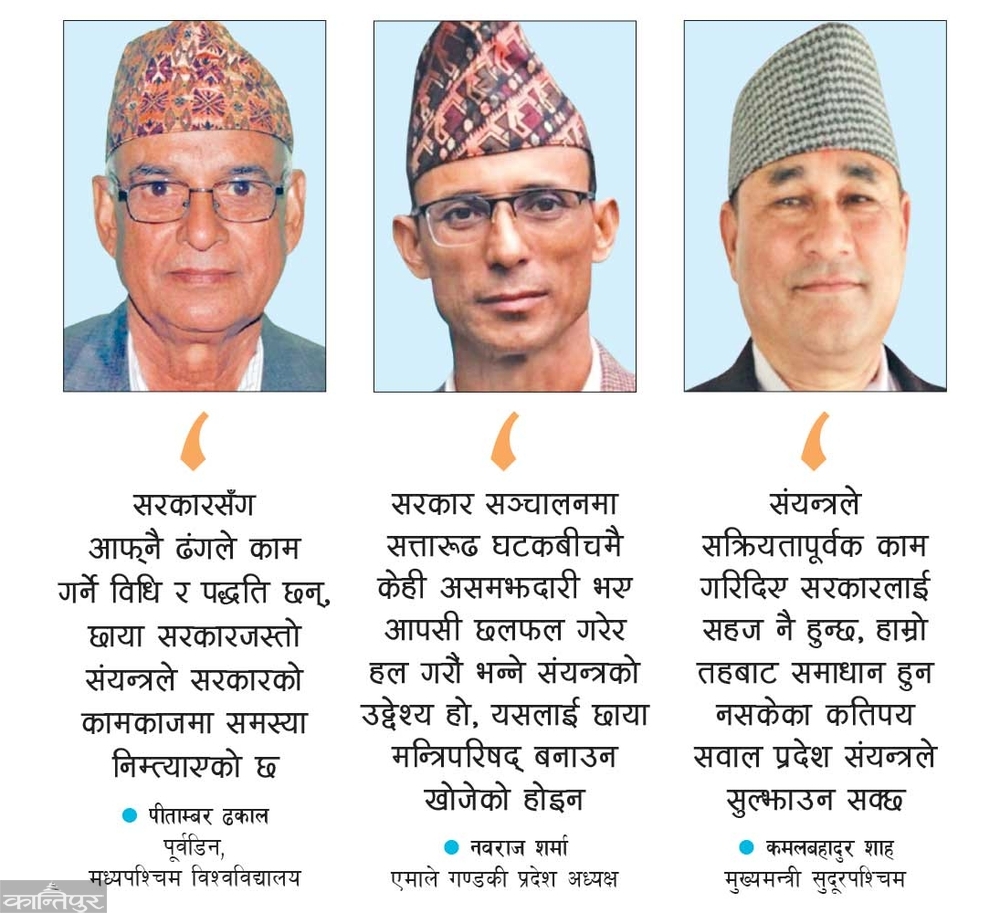
UML state president Navraj Sharma said that in the first meeting, there was an agreement to make general introductions, to help solve problems in the government, and to coordinate necessary to make the government effective. "The aim of the mechanism is to ensure that there is no disagreement between the ruling parties in the administration of the state's government and if there is any disagreement, let's resolve it through mutual discussion," he said. It is not even intended to make it a shadow cabinet.'
Chairman of Congress Gandaki Shukraraj Sharma said that the leaders of both the parties used to sit together to settle minor issues, but they could not hold more than one formal meeting.
'The government is doing its job. The problem has not come from anywhere," he said, "due to special circumstances, two parties have come together. Internally, both parties will sit down and draw the attention of the government. He said that it was not time to evaluate the effectiveness of the mechanism. Sharma said that although a circular was issued to start the work by creating a mechanism at the district level, it is not known in which district it has been formed.
Lumbini province's two-party mechanism has not been able to hold a regular meeting. The first meeting held in Butwal in the second week of November decided that the mechanism would be formed in all districts within the same month. The meeting was chaired by Padma Aryal, UML Lumbini Province in-charge. The second meeting of the
mechanism was held at Kapilvastu on January 13, in which all the Congress presidents of all 12 districts of Lumbini and the UML in-charge and president were present. According to Congress state president Amarsingh Pun, there was a 'briefing' about the problem in implementing the decision made by the Congress-UML mechanism in the elected municipality from the Maoists. The meeting also agreed to suggest the provincial government to work to instill hope in the people and to form a team with experts for technical advice and suggestions. The meeting of the
mechanism also decided to hold a meeting of the mechanism in the district within January, to request the state and the central government to solve the main problems in the state.
President Pun said that there were some problems in the implementation of decisions due to the leadership of parties outside the system at the local level. "Many of the decisions of the mechanism have not been implemented because the mechanism is on one side, the government at the local level and public opinion are on the other side," he said, "even those that have been implemented are not effective."
Malika Village Executive Committee of Gulmi proposed to inaugurate the building by Maoist Chairman Pushpa Kamal Dahal on February 1 on the occasion of 'People's War Day'. Congress and UML have a majority in the executive elected president from Maoist and vice president from Congress. People's representatives elected from Congress-UML under the guidance of the two-party system stood against the proposal. The municipal chairman and other people's representatives elected by the Maoists did not give up their stand to inaugurate from Dahal, so they retreated.
President of UML Gulmi Balsingh Kavoya said that there is an agreement that Congress and UML will move forward together in the municipality where there is a majority of people's representatives. "However, the decision of the mechanism has not been implemented in the municipality won by Maoist and Congress together," he said.
Jeevan Bahadur Shahi, the leader of the ruling Congress parliamentary party, gave a warning to leave the government in the meeting held on January 7 of the Karnali State Assembly. Shahi's displeasure was due to the non-implementation of the 8-point agreement reached last June when Karnali Chief Minister Yamlal Kandel was the leader of the opposition party. While speaking in Parliament, Shahi also asked for the resignation of the Minister of Physical Infrastructure and Urban Development.
Two days after that, a meeting of the ruling bipartisan mechanism was held at the office of the Congress State Committee in Birendranagar. The disagreement between UML and Congress ended in a meeting held with Chief Minister Yamlal Kandel. In the meeting that lasted for about 3 hours, an action plan was also made after reviewing the working of the current government.
The mechanism is headed by Congress state president Lalitjung Shahi, and central and state level leaders along with parliamentary party leaders of both parties participate in the mechanism's meetings. Shahi informed that the mechanism is operational in all the districts of Karnali. He also said that if necessary, a mechanism can be made even at the municipal level. UML standing committee member and Karnali province in-charge Gorakh Bahadur Bogti said that a mechanism is necessary to balance the functioning of the government.
The civic leader says that there is no justification for the mechanism. Pitambar Dhakal, the former dean of Midwest University, said that the government has its own method and method of working. "Constitution and laws also recognize this government to run the state," he said, "a mechanism like the shadow government has caused problems in the functioning of the government."
Thagendra Prakash Puri, President of Integrated Socialist Karnali Province, said that in some cases, the ministers have to work under the pressure of the leaders in the system. "A mechanism that is not recognized by the law has been formed to facilitate the implementation of the government's priorities, yesterday's mechanism also put unnecessary pressure on the government," he said.
The first meeting of the two-party mechanism of the Far West Provincial level on December 8th took three decisions, including not allowing the Provincial Assembly to be without 'business', and to end the vacant political appointments based on consensus as soon as possible. But the meeting of the State Assembly has been adjourned due to 'business' after sitting for two days in the second week of January. Even the parliamentary committees have not been able to get leadership due to the lack of allocation.
The first meeting of the mechanism chaired by UML Secretary and Far West Province in-charge Lekhraj Bhatt also decided to take initiatives for the relief and rehabilitation of the victims of the earthquake that occurred on December 6 through the disaster management committee through Gotri center of Jagannath Rural Municipality of Bajura. "But till now not a single cent of help has been received," said Kali Bahadur Shahi, Chairman of Jagannath Rural Municipality, "We reached Dhangadhi and rushed to all the ministries and submitted the documents to the district administration office. But nothing happened.' Another meeting of the
mechanism has not been held yet. Bir Bahadur Balayar, the leader of the Congress state president in the state system, claims that the system is working according to the purpose of facilitating the work of the government and making service delivery efficient. Some MPs of the ruling party have commented that the top leaders in the
mechanism are trying to put the government under psychological pressure. "The mechanism is doing the work of increasing disagreement between the government and the party leaders," said a Congress MP, "Due to this mechanism, the Chief Minister is under psychological pressure." "Some of the issues that could not be resolved at our level can be resolved by the meeting of the provincial system," he said.
Congress leader Balyar says that instead of putting pressure on the government, it is being facilitated through the mechanism to create a situation that will bring good results. He informed that there are preparations to expand the two-party system to the district and municipality levels. UML Sudurpaschim President Krishna Prasad Jaisi also claimed that the purpose of the two-party mechanism is only to facilitate the government.
'It is not a policy of any interference mechanism on the government,' he said, 'Two big parties have to run the government together. In that case, working in mutual understanding is easier. It should be taken positively.'
Although there is a mechanism at the state level, the situation remains that the Chief Minister has to take the guidance of the top leaders of the Center for important decisions. Congress Provincial Spokesperson Surat Bahadur Rawat says, 'Firstly, the issue of common concern should be settled by the leaders of both the parliamentary parties, if there is no agreement between them, it should be taken to the provincial level mechanism and if not even that, it should be discussed at the center.'

