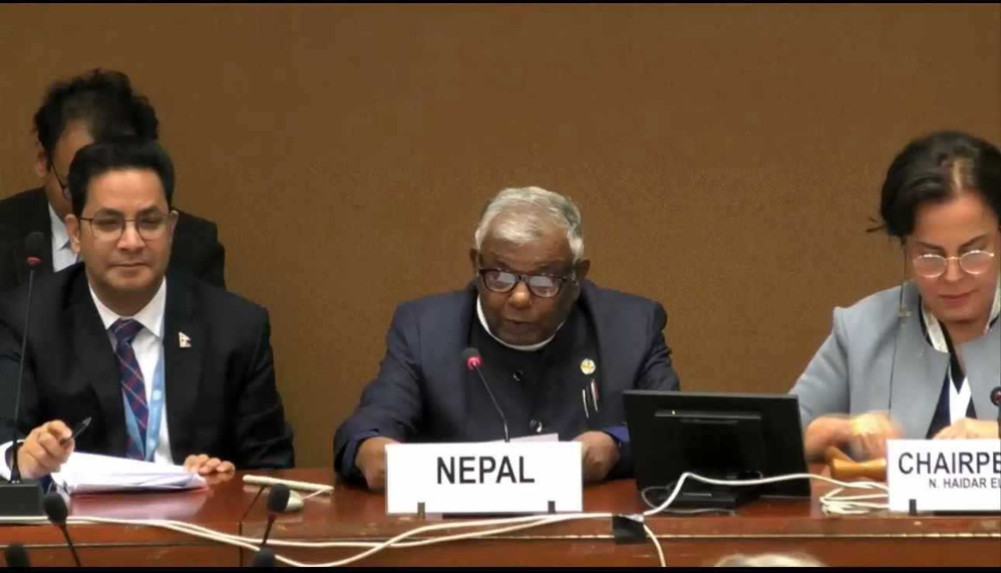
Presenting the seventh periodic report of Nepal on the Convention on the Elimination of All Forms of Discrimination against Women (CID).
We use Google Cloud Translation Services. Google requires we provide the following disclaimer relating to use of this service:
This service may contain translations powered by Google. Google disclaims all warranties related to the translations, expressed or implied, including any warranties of accuracy, reliability, and any implied warranties of merchantability, fitness for a particular purpose, and noninfringement.
The government has re-committed to providing equal opportunities, rights and legal protection to women. Nepal has reiterated this commitment in the United Nations Committee on the Convention on the Elimination of All Forms of Discrimination against Women (CED) 1979.
In the 90th session of the SID Committee held in Geneva, Switzerland, on behalf of Nepal, Minister of Women, Children and Senior Citizens Nawalkishore Sah made such a commitment while presenting the seventh progress report.
Nepal has been indicating that it is fully committed to the implementation of the convention as a party to the convention on the elimination of violence against women, and for that, it has been strengthening the legal and policy structure. Minister Sah said that the Nepal government has proceeded by making arrangements to guarantee equal opportunities, rights and legal protection within the constitutional framework.
'Although we have made significant progress in achieving gender equality, there are still challenges, especially in rural and marginalized communities,' the report presented by Nepal states, 'Nepal is determined to solve such challenges through targeted policies, programs, and collaboration with international partners, civil society, and women's rights organizations.' Minister Sah said that the
report covers both the progress and challenges in the journey of gender equality. Regarding the report, he said, 'Though the legal and policy structure has been improved, our main concern is to effectively implement those policies and laws. Therefore, we also expect important suggestions from the SID Committee on this report.' The
report states, 'Nepal has incorporated the recommendations from previous dialogues with the SID Committee into national policies. Our constitution has passed 16 laws ensuring the fundamental rights of women. In addition, citizenship and other civil laws have been amended according to the principles of equality.'
In the course of presenting a report on behalf of the National Human Rights Commission, Leeli Thapa said that although the constitution has guaranteed, there are still some gaps in the legal framework of Nepal and in particular, various forms of direct, indirect and existing discrimination persist.
She also said that there is a situation where the law is unable to address such differences. He said that although the Nepalese government has taken some active steps in law making, the implementation is still unorganized. She said that the government's commitment to establish regional offices and give legally binding powers to the National Women's Commission has not yet been fulfilled.
A shadow report prepared by Women and Law Development Forum was presented on behalf of Nepali civil society only on Monday in the SID Committee. On Tuesday, 6 people from civil society gave their presentations about Nepal in various categories.