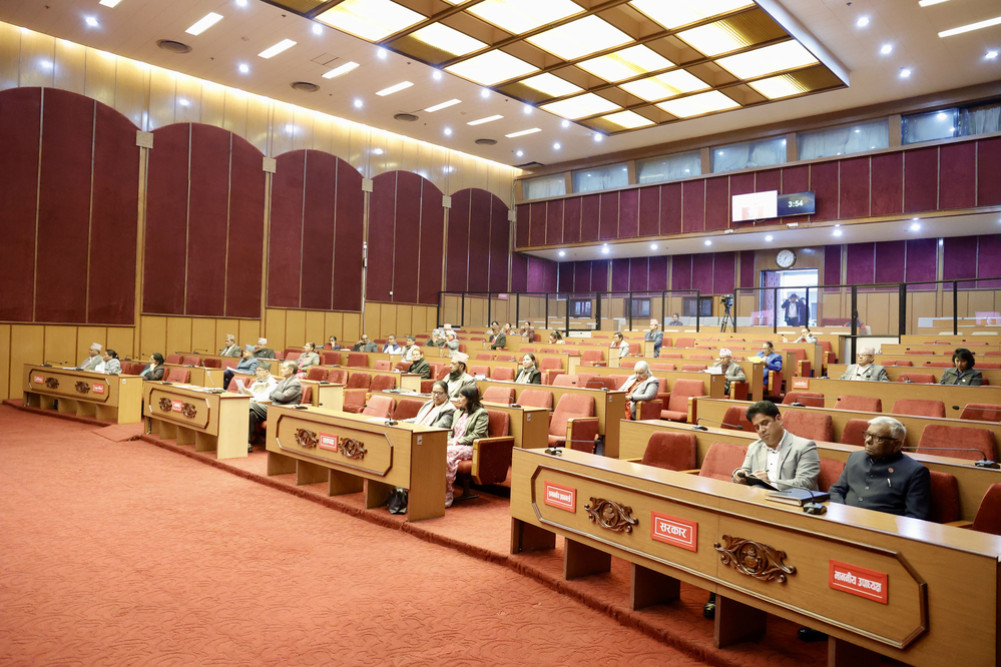
There are 59 parliamentarians in the National Assembly, at least 30 parliamentarians are required to accept the ordinance brought by the government, the ruling party has only 29 seats, the decisive Upendra Yadav's Jaspa Nepal
We use Google Cloud Translation Services. Google requires we provide the following disclaimer relating to use of this service:
This service may contain translations powered by Google. Google disclaims all warranties related to the translations, expressed or implied, including any warranties of accuracy, reliability, and any implied warranties of merchantability, fitness for a particular purpose, and noninfringement.
The future of 6 ordinances issued by President Ramchandra Paudel on the recommendation of the Council of Ministers seems to depend on the arithmetic of the National Assembly. Although the UML and Congress ruling coalition have a clear majority in the House of Representatives, they do not have a majority in the National Assembly. The support of 30 MPs is needed to form a majority in the 59-member National Assembly, including the Speaker.
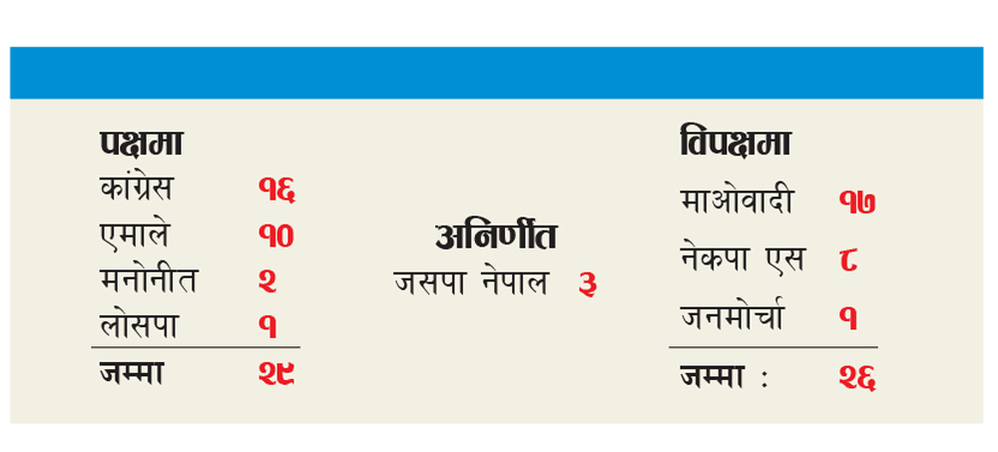
In the National Assembly, there are 29 MPs including 16 from Congress, 10 from UML, 2 nominated and 1 from LOSPA in favor of the Ordinance. In the opposition, there are 26 MPs including 17 from the Maoist, 8 from the United Socialist Party and 1 from the Rashtriya Janamorcha. Janata Samajwadi Party Nepal with 3 seats has been decisive in whether the life of the ordinance will be extended or terminated.
According to the constitutional provisions, the proposal to approve the ordinance must be presented in both houses. Only if the National Assembly and the House of Representatives approve the proposal, the remaining process of the Ordinance will proceed. Article 114 of the Constitution states that even if one of the two Houses rejects the Ordinance, it will become inoperative. If the Ordinance is approved, it will open the way for the government to introduce a replacement bill. There is a constitutional provision that the replacement bill must be passed by both houses and certified by the President within 60 days of the date of commencement of the Parliament session. However, if disapproved at the outset, the ordinance will automatically become inoperative. The winter session has already started from January 18.
Jaspa Nepal has formed an ordinance study working group under the coordination of Rajkishore Yadav, a member of the House of Representatives. Chairman Upendra Yadav informed that the central executive meeting of the party decided to form a working group for further study after discussing the ordinance. "We will make a decision according to the report and suggestions given by the working group," he said.
Coordinator Yadav informed that the task force will consult with experts about the ordinance and submit suggestions to the parliamentary party meeting on Tuesday. In the party meeting, the leaders were of the opinion that all ordinances should not be accepted without studying them. In the meeting, there was an opinion that 'all ordinances should be accepted and rejected'.
The leaders of Jaspa Nepal say that a decision should be taken whether to accept or reject the arrangements made in the ordinance based on merits and demerits only. We will reject if a legal provision is made through the ordinance that will have a negative impact in the long term. The ordinance cannot be accepted as a solo act,” said a Jaspa leader. The leaders of JSP Nepal have objected to the provisions made in the ordinance to amend some of Nepal's laws related to land.
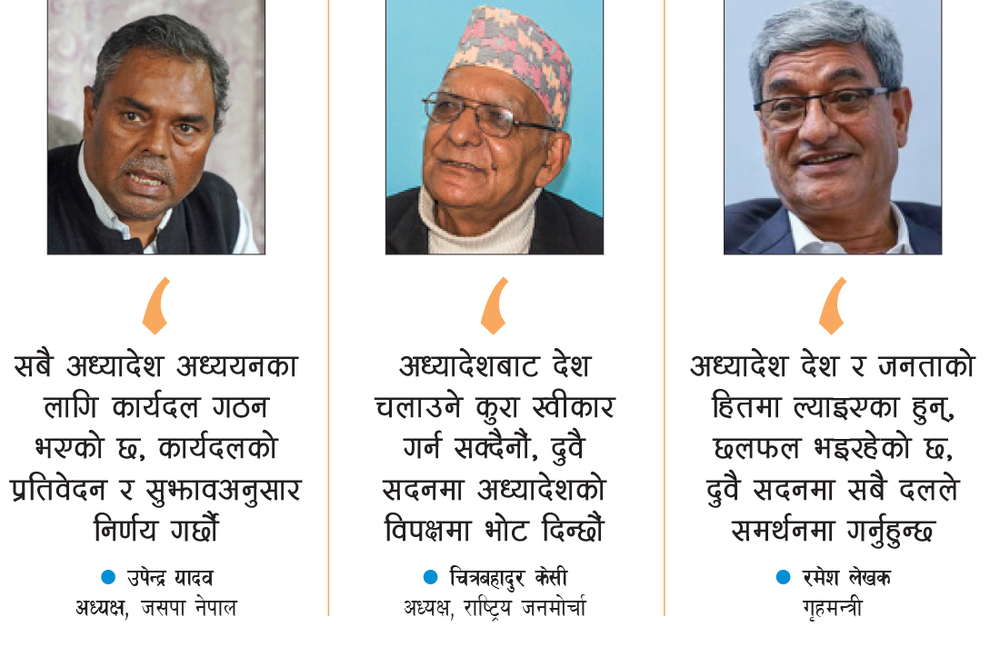
Home Minister Ramesh Akhtar said that the ordinance was brought in the interest of the country and the people and said that there is no need to have pros and cons in it. Everyone should be united on the issue of ordinance. All parties support it in both houses. Discussions are going on with the parties," he said.
There is a possibility that a proposal to 'accept the ordinance' will be submitted in the meeting of the National Assembly and the House of Representatives on January 24. In the same meeting, the rejected proposals registered by the MPs will also be presented for decision. If JSP Nepal decides to reject the ordinance, there will be equal votes for and against in the National Assembly. In such a situation, the Speaker of the National Assembly, Narayan Prasad Dahal, may have to cast a decisive vote, according to an official of the Parliament Secretariat. Although the decision will be made on the basis of voice vote on the proposal, if the chairman of the assembly feels that there is a tie vote or if any member of parliament asks for a split vote, he should proceed to the process of split vote.
The MPs of Maoist and United Socialists have filed a motion to reject 6 ordinances in the National Assembly. The Rashtriya Janamorcha, which has one MP in the National Assembly, also said it would reject the ordinance. The party's chairman Chitra Bahadur KC said that he could not accept that the country would be run by an ordinance. "I have already expressed my opposition to running the country through an ordinance," he said, "we cannot support the ordinance in both houses, we vote against it." In the opposition, the MPs have registered 50 rejection motions. The MPs collectively and individually filed motions to reject the ordinance. The most rejected proposal is related to 'an ordinance to amend some Nepal Acts related to cooperatives'. Twelve motions have been registered saying that this ordinance should be rejected. Some proposals are registered collectively and some individually. There are 14 MPs from RASWP, Maoist and NEMKIPA among the MPs who amended it.
9 MPs have individually filed a motion to reject the ordinance to amend some Nepal Acts related to the promotion of good governance and public service delivery. The number of parliamentarians who have rejected the ordinance to amend the Privatization Act 2050 is 7, while the proposal of 7 parliamentarians has also been registered to reject the economic procedure and financial responsibility ordinance.
6 MPs have filed a proposal to reject the ordinance to amend some Nepal Acts related to economic and business environment improvement and investment promotion. Collectively and individually, 9 proposals have been registered to reject the ordinance to amend some of Nepal's laws related to land.
In the National Assembly, the MPs of Maoist and United Socialists have filed a rejection motion. 4 rejection proposals have been registered in the Financial Procedures and Financial Responsibility Ordinance and the Land Ordinance. In the remaining four ordinances, 2-2 rejection motions were registered.
Since the end of the budget session of the Federal Parliament on August 31, 6 ordinances were issued before the winter session on January 18. On the recommendation of the Council of Ministers, President Paudel issued those ordinances three times. The Ordinance on Cooperatives was issued on January 14, the Ordinance on Promotion of Good Governance and Public Service Delivery, the Ordinance on Economic Procedure and Financial Responsibility, the Ordinance on Privatization, and the Ordinance on Improving the Economic and Business Environment and Enhancing Investments on January 29. An ordinance to amend some Nepalese laws related to land was issued on January 2.
Although the last five ordinances were recommended at once, President Paudel stopped the land ordinance. It was issued by President Paudel after Prime Minister KP Sharma Oli promised to correct the shortcomings of the ordinance when the replacement bill is taken to the parliament.
In the Ordinance on Promotion of Good Governance and Public Service Delivery, it was arranged that a decision should be made within 7 days on the services to be provided by the government to the people, otherwise the employees will be punished. A legal arrangement has been made that the members can appoint acting mayors and deputy mayors if they become vacant at the same time. According to these ordinances, the legal system of making national identity card mandatory for social security allowance and the compensation that the victim of crime will receive in case of his death, will be given to the family. Laws that allow loans to be taken by securing fixed assets or contract mortgages other than land were amended through the Ordinance, and the law that provides a 90% discount on fines imposed on companies due to non-disclosure was also brought through the Ordinance.
The government claims that the ordinance has been introduced to improve public services and improve the economic and business environment and investment. The government said that 11 laws have been amended to improve the economic and business environment and increase investment. The government informed that 13 laws have been changed from the Ordinance on Promotion of Good Governance and Public Services. The legal arrangement that allows foreign investors to withdraw their investment money was also made through an ordinance, while information technology (IT) industries that are unable to invest in countries other than Nepal can open branches or contact offices in other countries.
In the land ordinance, there is a legal provision that even the land of parks and forest areas can be given to individuals, which President Paudel also suspected. There is public interest in this Ordinance as it covers issues such as real estate transactions, apartments, housing etc. Similarly, the bill in the Finance Committee of the House of Representatives was not withdrawn and the ordinance was introduced. "Economic Procedures and Fiscal Responsibility (First Amendment) Bill, 2081" was pending in the Finance Committee and the government brought the "Economic Procedures and Fiscal Responsibility (First Amendment) Ordinance, 2081". The government was criticized for introducing laws through ordinances to create a
method and questionable legal arrangements. In response to that, Prime Minister KP Sharma Oli claimed that he brought an ordinance to improve economic and government services from the rostrum of the House of Representatives.