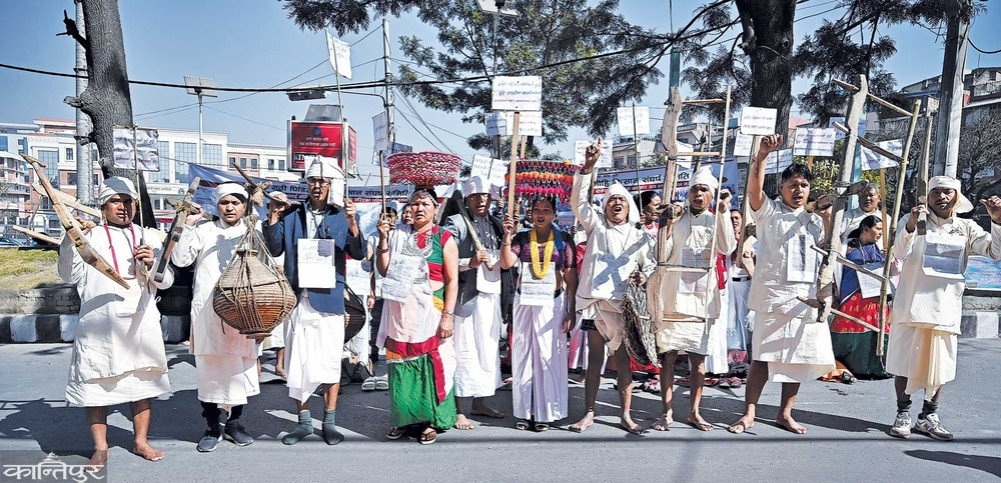
The 3,000 families of Dang, who have been plowing thousands of bighas of Swargadwari Guthi land for generations, did not get the right.
We use Google Cloud Translation Services. Google requires we provide the following disclaimer relating to use of this service:
This service may contain translations powered by Google. Google disclaims all warranties related to the translations, expressed or implied, including any warranties of accuracy, reliability, and any implied warranties of merchantability, fitness for a particular purpose, and noninfringement.
Some men and women are sitting on the cold streets of Maitighar. These farmers have arrived in Kathmandu carrying their goods from Dang. There are 22 men and 17 women in the group. They have come to tell the story to the government in their own Tharu clothes. White choubandi, jhuluwa, pagiya and angucha. Women also wear silver mangaya and taunk.
All of them are hanging around their necks - certificates of Mohiani rights to the land plowed by their ancestors.
is his slogan –
Rakat Pasna Bagaili, Walker Sataha Ka Paili
(We shed blood and sweat, what did we get in return?) story break
(Do gods rejoice in the sweat of the poor?)
Mohi farmer of Swargadwari Guthi says - 'In the name of God, we are very well.'
In 12 mauzas (villages) of Dang there are 3 thousand 5 families of Swargadwari Guthi Mohi. He is cultivating 1,500 bighas of land. But the ownership of that land is in the name of Swargadwari Guthi. Those farmers have been protesting for decades that they should own the land they tilled and sweated.
They have Mohiani parts. However, after the cancellation of that part by the Supreme Court on 14th Chait 2062, they are more angry. The Supreme Court had ordered that 'Swargadwari Guthi is a private Guthi of a special nature so that the land of the Ashram cannot be fragmented'.
After the order of the Supreme Court, farmers are demanding justice with evidence of Mohipurja. "We farmed on that land, our ancestors lived for generations," says Basuram Chaudhary (71), who came to Kathmandu to protest He said that he had come.
Farmers who were plowing the land under Swargadwari Guthi had started a district-centered movement since 2045. In the current movement, they have 3 demands - that the land cultivated by Mohi farmers should be legalized in the name of Mohi, that the rights of the evicted Mohi of Guthi land, which is said to be private, should be restored and that the farmers should be paid through the Tiro Ward for Raitani.
The definition of Guthi in Section 2 of the Guthi Institutes Act, point 'C', 'Guthi means any temple, temple, temple, temple, temple, temple, temple, temple, temple or temple for any religious or charitable work. Pauwa, well, pond, pond, stream, stream, path, ghat, bridge, square, goucharan, garden, forest, library, school, dispensary, hospital house, In order to build, operate or protect a building or institution, a donor should remember the Guthi who has given up his right to his movable property or any other property or money that comes to him. After a month, the protest was ended by an agreement with the government. We approached the Prime Minister, the Minister of Land Management, the former Prime Minister and complained, but they did not fulfill their promises,' says Praveen Dahit (25) of Ghorahi-14, Secretary of Swargadwari Guthipidit Mohi Kisan Sangharsh Samiti Dang. '
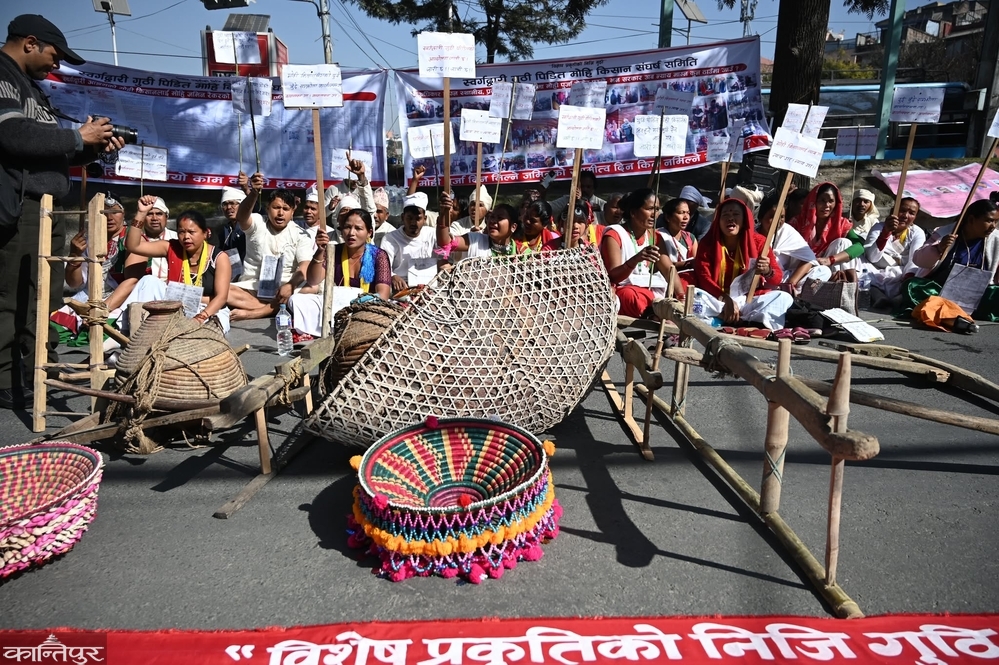
There is no permanent place for them to live or eat during their indefinite stay in Kathmandu. Dharamshala in Gaushala has given permission to stay for a few days. Then where to go? Where to live? They don't know. But they know that they have to sit in the corner of Maitighar for a long time to raise their demands and until their demands are fulfilled. They have entered the city carrying salted oil, rice, vegetables and spices that reach their group since Dang.
They came to Maitighar on Sunday by walking along the road from Gaushala. He carried in his hands, the agricultural tools he used - plough, spade, hoe, dhakia, bahinga, sango, farua and sikahar. As old as the history of Dang is, the history of Tharu is as old. She is tribal. But they have to hand over the land that they cultivate to Swargadwari's Ashram in Dang.
Let's listen to the story of the ancestors of Praveen Dahit of Ghorahi-14. How was a large part of the land that was being cultivated by his ancestors distributed? He has kept the account of it correctly, as if he had memorized the time-line, "Our ancestral land came into the possession of Ananta Giri (disciple of Prahaprabhu Hansananda of Swargadwari Guthi) in 1980."
Then it was registered in the name of Swargadwari Ashram in 2030,' he says, 'Mohi was established in the name of our grandfather Dhabbu Tharu in 2024 in the name of Anant Giri zamindari and my father Churalal Choudhary's Mohi was established in 2047 in the name of Swargadwari Ashram.'
One question always plays in his mind – 'Why don't we own the land that our forefathers have been mining for hundreds of years?' "We don't have a single piece of land in the name of ancestral property," Praveen said. 17 kathas in his father's name and 4 bighas in his grandfather's name, which are owned by Swargadwari Guthi. There are 43 dependents of their joint family on that land.
- Soma Chaudhary (27) has come to Kathmandu for the first time from Rampur-2 Ghorahi to participate in the Guthi movement. He has high hopes for this city. "But, it is cold, there is no place to eat and live, I am also sad because of this," she said. She and her husband mine 6 kattha of Guthi's land in Swargadwari - they grow corn, mustard, wheat, lentils, but half of the grain grown must be given to Guthi. Soma left her mother-in-law with her 7-year-old daughter and went on a protest so that she doesn't have to pay that money anymore. She says, "There is sorrow in life, but after the government fulfills our demand, it becomes happy." Bharatmani Chaudhary (52) has come from Lamhi Municipality-3, Mazgaon to participate in the
movement. Since he was a child, he used to walk from Dang to Swargadwari, Pyuthan, carrying a dog. The weight of salt, couscous, oil, paddy, and mustard was huge. Carrying heavy loads, he traveled long distances, crossed river banks, and climbed mountains. After
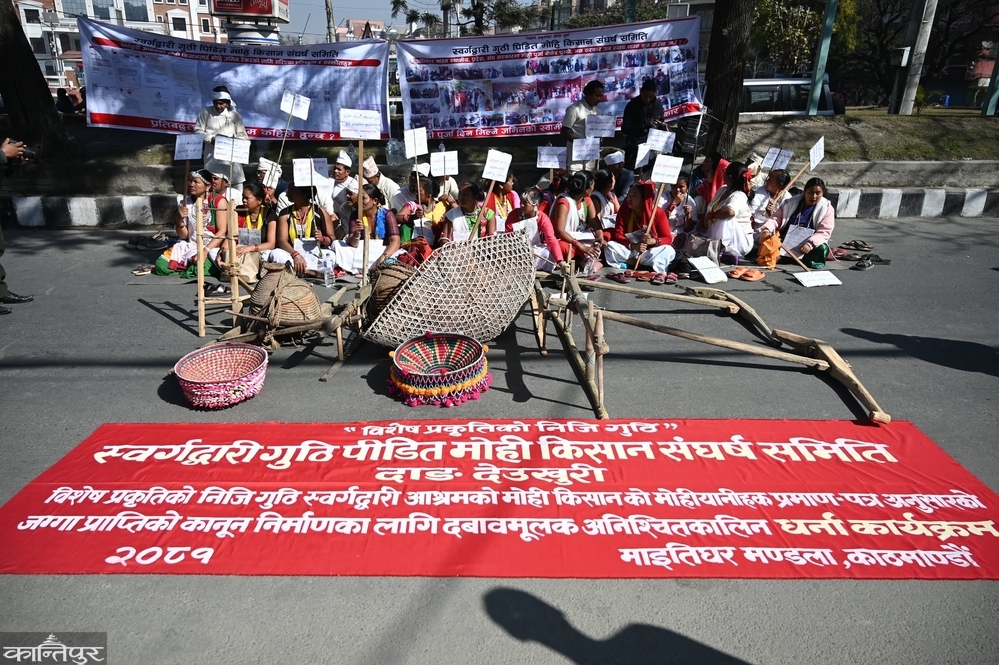
, his father-grandfather went on a horse to pay a visit to Swargadwari Guthi. "We have been plowing three and a half bigha of land under Guthi since I found out in my childhood. Grandfather's life ended like this. It is not possible to build a house on that land, there is no electricity or water even if it is built,' says Bharatmani, 'We have come to Kathmandu to ask for rights. We will not return without going back.'
Basuram Choudhary was sitting on the cold floor of the house. He comes from Ghorahi-2, Rampur in Dang. His family is also sweating on the land under Guthi. "He does not have a single piece of land in his name. I have come to Kathmandu to see if I can get Lalpurja,' said Basuram, 'I have accommodation in Dharamshala, it is difficult to stay because of the cold. But we will stay here until the government listens to us.'
This old man's heart is very pained by the pain of not being able to get fertilizer, not getting a loan from the bank, and not being able to sell land because he does not have Lalpurja in his name. Paying the contract or educating the children? It is not enough to eat from the plowed land,' he says, 'Our life has become like this, now I have come to Kathmandu to make my son's life better.'
Sugharmanaya Choudhary (46) is a silver-haired girl. After showing the documents related to Mohiani, he hopes that the government will give the land mined by the government. Pointing to the sign of Mohiani Haq hanging around his neck, she said, 'Dang will return with Mohi Haq.' We are plowing the land but I don't have a single piece of land in my name. On the contrary, we are paying the contract to Swargadwari Ashram," he said. We will continue to protest until the government makes a law in our favor.'
Ramlal Chaudhary, father of Sunita Chaudhary (29) of Dang, Tulsipur-10, continued to cultivate 4 bighas of Guthi land. She has come to Kathmandu to maintain the ownership of that land. "We have come with ration water, we will stay on the streets until the government fulfills our demands."
Ghorahi-14, Jhigoura Ashakumari Chaudhary (51) has come to Kathmandu 3 times for land rights. His family is cultivating 1 bigha of Swargadwari Guthi. She said that even though there was very little growth in the cultivated land, the grief of having to pay Guthi never left her. The stress of having to pay even in non-growing years has added to the misery. "The government only makes agreements, it does not implement them," she said, "The government gave pain until it was given."
Article 290 of the constitution states that "The federal parliament will make the necessary laws regarding the rights of farmers and landowners who are entitled to land." In Article 51 of the Constitution, sub-clause 'E', it is written - in the policy system related to agriculture and land reform, to end dual ownership of land, to improve land by giving priority to farmers, and to discourage absentee land ownership. It also mentions 'increasing agricultural production and productivity while protecting the rights and interests of farmers'.
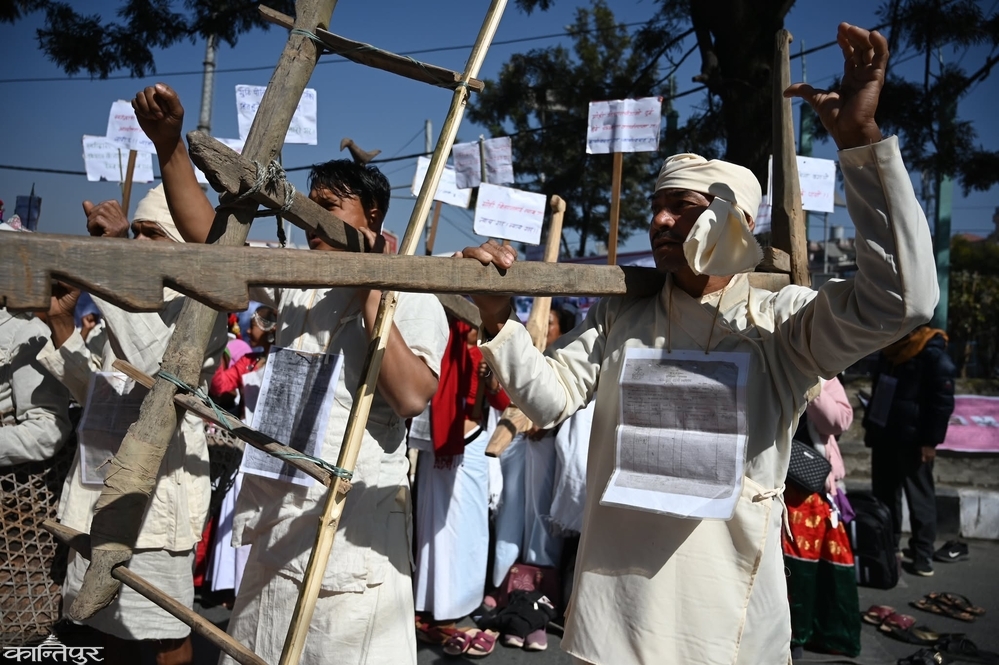
"All these arrangements have instructed the government to make necessary legal arrangements to give ownership of land to the farmers who have tilled land," says Praveen Dahit, "but the government did not listen to us." Until our demands are met, we will continue to protest on this road.'