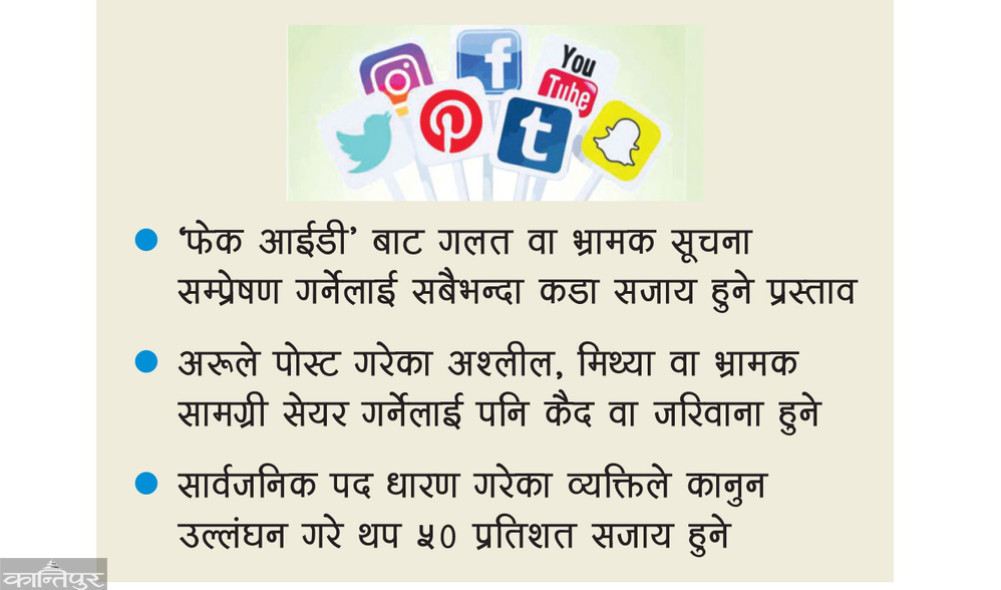
Proposals for the most severe punishment for those who transmit false or misleading information through 'fake ID', those who share obscene, false or misleading content posted by others will also be jailed or fined.
We use Google Cloud Translation Services. Google requires we provide the following disclaimer relating to use of this service:
This service may contain translations powered by Google. Google disclaims all warranties related to the translations, expressed or implied, including any warranties of accuracy, reliability, and any implied warranties of merchantability, fitness for a particular purpose, and noninfringement.
The public debate has started after the bill prepared by the government to prevent the misuse of social media and to regulate the platform has reached the parliament. In the bill registered in the National Assembly on Tuesday, there is a provision of up to 1 million fines for social media platforms if they do not comply with the conditions, and 5 years imprisonment and a fine of up to 1.5 million for users who transmit misleading information 'in a way that is detrimental to the national interest'.
In the 'Bill made to regulate the operation, use and regulation of social networks', the platform must provide 'user details' for investigation to the 'relevant body' under the condition that the licensee must comply, the platform must be used only after revealing the identity, content that is against the law must not be posted. Provisions have been made to develop technology.
It is proposed that the platform will be fined from 2.5 million to 1 million rupees if it does not comply with the specified conditions. In terms of users, the definition of dozens of offenses has been defined in the bill.
Among them, those who transmit false or misleading information through fake ID are offered the most severe imprisonment of up to 5 years and a fine of up to 1.5 million rupees. "No one shall open false, permanent or temporary group, page or any other type of ID on the platform individually or collectively and transmit false or misleading information in such a way as to disturb Nepal's sovereignty, geographical integrity or adversely affect the national interest," it is stated in Section 27 of the Bill. , 'If the person who commits this offense is punished according to the prevailing law, and if the punishment is not mentioned in the prevailing law, imprisonment up to five years or a fine up to 15 lakh rupees or Both will be punished.
The person who posts or shares content on social media that disturbs the sovereignty, geographical integrity, national unity and security of Nepal has been proposed to be imprisoned for up to 5 years or fined up to 5 lakh rupees or both. If the bill is passed by Parliament, those who create fake IDs, pages, groups and post or share content on social media, share content of others, comment or call will be imprisoned for three months or fined up to 50,000 rupees or both.
Using social media to harass, torment, threaten, embarrass, insult, dehumanize or spread rumors and imitating someone's voice as 'cyber bullying', the bill says that the person who commits such an offense will be imprisoned for up to 2 years or fined up to 3 lakh rupees. It is proposed that anyone who 'hacks' someone's social media account will be imprisoned for up to 3 years and fined up to Rs.15 lakh. The bill also mentions that those who steal personal information through 'phishing' or 'imposter scam' will be punished the same.
It is proposed that those who make 'deepfake' videos using artificial intelligence (AI) and spread them on social media will be jailed for up to 2 years or fined up to Rs 3 lakh. Provision has also been made in the bill for those who spread obscene, false or misleading content to be imprisoned for up to 2 years or fined up to 3 lakh rupees.
Section 23 states that 'sextortion' and 'extortion' should not be committed and if such an offense is committed, the punishment will be imprisonment up to 3 years or a fine up to 15 lakh rupees or both. The Bill defines as 'Sextortion' as 'Sextortion' and as 'Extortion' as 'Extortion' as 'Extortion' as 'Sextortion' by threatening to publish private photos, audio or video of someone. The bill provides for an additional imprisonment of up to one year if a crime is committed using children. An additional 50 percent punishment has been proposed if a person holding a public position violates the law.
There is a provision in the bill that any company, firm or organization that wants to operate any social network platform in Nepal must obtain a license. There is a provision that the currently operating platforms such as Facebook, Instagram, X, WhatsApp, Viber, YouTube, and LinkedIn should obtain a license within three months after this bill is passed by the Parliament.
In Section 9, it is proposed that platforms that have not received a license or whose license has been canceled will be banned from operating within Nepal. "In order to stop the operation of such a platform, the information technology department will have to send a letter to the Nepal Telecommunication Authority," the bill says, "the authority will have to instruct the internet service provider to stop the operation of such a platform." Certificates, Articles of Association and Regulations, Copy of Permanent Account Number Certificate, If foreign investors have invested in shares, details of the management committee, Confidentiality There is a provision to apply to the department by attaching documents such as policy, data usage policy, data security policy. They have to renew the license every two years. It has also been proposed that an application for renewal should be submitted 15 days before the expiry of the license with a fee, and that the license will be revoked if the social network operating from outside Nepal does not arrange a contact point in Nepal. Proposal to give instructions to remove
content Article 13 of the
bill provides that the Department of Information Technology under the Ministry of Communication can give instructions to social media platforms to remove content that violates the law. "If information, complaints or complaints are received from the platform that content contrary to this Act or prevailing laws is received, the department will investigate such information, complaints or complaints," the bill says, "During the investigation, if it is found necessary to remove such content from the platform, temporarily or permanently or partially or The concerned permit holder or the contact point of the permit holder in Nepal will be instructed to remove the post or content immediately There is an offer.
The abstract ban on social media content and the system of content removal will restrict freedom of expression and increase the risk of 'censorship', experts said. Earlier, when the draft of the bill was published for opinions and suggestions, digital rights activists and information technology experts said that when opening a social media account, a person should not be forced to reveal his or her real identity, and a provision should be made to require an order from the court or other independent body to remove content or block access.
'In the bill, there is provision to remove content identified as problematic or prohibited content in the notification system,' Digital Rights Nepal and the International Center for Not-for-Profit Law said in the advocacy letter prepared on this bill, 'from this, government officials They can unilaterally determine that a content violates the law and the platform not only has to remove such content, but can also create and implement a system and policy to actively remove illegal content.' The advocacy paper said that such an arrangement would create a situation of widespread censorship as platforms would widely remove even legitimate content to avoid legal risks. The letter also mentions that it will restrict the free flow of information and freedom of expression online. It is mentioned in the bill that the
social media platform should arrange a point of contact in Nepal as well as an effective mechanism including a rapid response group (rapid response team) for managing user complaints. In addition, it is proposed that the Information Technology Department, related agencies and platforms should conduct awareness programs for the benefit and safety of users.
In terms of the operation and use of the platform to prevent the misuse of social networks, there is a bill envisioning two structures, namely the information technology department and related agencies. Related agencies include Nepal Police, Telecommunication Authority, Press Council, Information and Broadcasting Department, Advertising Board and other agencies designated by the government by publishing notices in the gazette.
The Ministry of Communication and Information Technology has submitted the Social Media Bill to the Federal Parliament. The cabinet meeting on January 7 gave approval to submit the bill to the parliament. Spokesman of the Ministry Gajendra Kumar Thakur said that this bill, which has become a matter of interest to all, will now be submitted to the Federal Parliament and will be discussed in the House. Experts expect the parliament to improve the bill, which is intended to make users more responsible than social media platforms.