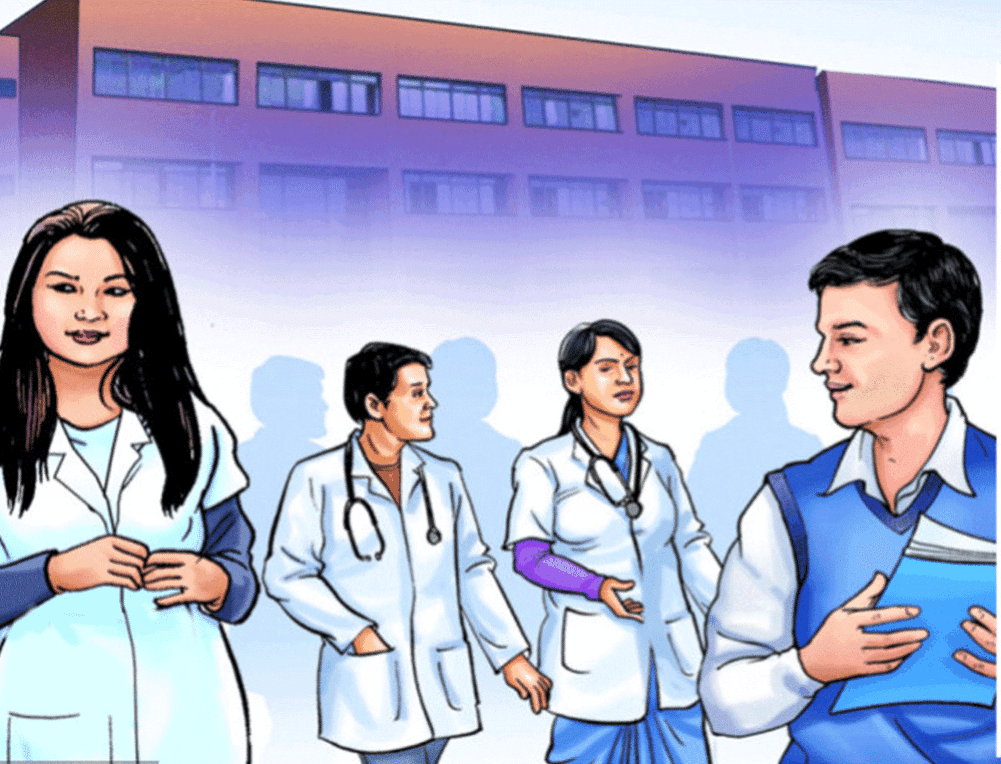
Physicians with specialization in cardiac surgery, cancer, liver and forensics are rare.
We use Google Cloud Translation Services. Google requires we provide the following disclaimer relating to use of this service:
This service may contain translations powered by Google. Google disclaims all warranties related to the translations, expressed or implied, including any warranties of accuracy, reliability, and any implied warranties of merchantability, fitness for a particular purpose, and noninfringement.
According to the Medical Education Commission, last year, 34 percent seats were vacant in the highest degree/subspecialties (DM/MCH) level of medical studies. In that level, 32 percent of seats were vacant in 2023 and 34 percent in 2022.
As the rate of migration of doctors to foreign countries is increasing every year, it is seen that the interest of those living in Nepal to become specialist doctors is decreasing. Last year, 129 seats were allocated for the admission of students in medical specialties, surgical specialties, arthrology, critical care, emergency medicine.
in which only 85 doctors have been admitted, the commission said. Before that, in 2023, 76 people enrolled and participated in the study when it was fixed at 112 seats. In 2022, when admission was opened for 117 seats, only 73 people were admitted. Sujanbabu Marhatta, director of the Directorate of Planning, Coordination and Academic Development of the commission, said that according to the number of seats, doctors could not be recruited at the level above master's degree.
"Only 60 to 70 percent are admitted," he said, "Before admission, doctors look at the possibilities." They are enrolled in subjects with a good future. Other seats are empty.'
Analyzing the data of doctor recruitment, the number of doctors who are specialized in heart, cancer and liver related subjects is rarely found. Likewise, there is a shortage in the number of specialist doctors involved in the treatment of kidney, neuro (head) and newborns.
Among them, not a single doctor has been admitted to the Cardiac Surgery Specialties program in the past 3 academic sessions. 23 seats remained vacant in Cardiothoracic and Vascular Anesthesiology and Cardiothoracic and Vascular Surgery in three academic sessions. Even in cardiology, which is related to the heart, students are being admitted less than the number of seats.
In cardiology, in 2080, 9 people were admitted in 14 seats and in 2079, only 12 people were admitted in 16 seats out of 15 seats. Cardiologist Rajendra Koju said that although there is potential in cardiology, doctors are not attracted as there are few opportunities in surgery.
'For DM/MCH you have to study for three more years. "Doctors will see what the benefits are after investing more time and investment," he said. He said that doctors want to acquire subspecialty qualifications in areas where the service area will expand and there are opportunities. "Specialized heart surgery is not possible anywhere else except Gangalal and Manmohan Cardiology of Teaching Hospital," he said. Doctors are not interested in doing it either. In Oncology, only 1 student was admitted in 2 seats in 2023, and the admission in 2024 remained zero. According to the data of the commission, the enrollment rate in diabetology has been zero since 2022. Hepatology had 2 students in 2022. Since then, physicians have not been enrolled for the study.
Koju, who is also the former dean of Kathmandu University School of Medical Sciences, said that after becoming a DM, the service area will be expanded, opportunities will be provided and the interest of doctors will increase. "After completing MD, MS, you will be too old when you join DM," he said, "After studying, you will gain efficiency." If the same thing can be obtained through training, why spend time and money to study?''
The work place is the same whether you do DM or not. Why study when the services are the same? Dr. Koju questioned. He also complained that the government has not taken a policy to increase the number of posts for doctors with more expertise and also to increase service facilities. With the increase in health institutions, the number of students will increase due to expenses and effort. Koju said.
The number of doctors specializing in kidney nephrology, head neurosurgery, neonatology for newborns up to 1 year is also less. In three academic sessions, only 16 people have been admitted while calling for admission to 28 seats in neurosurgery.
Similarly in neonatology last year only 2 people were admitted while there were 7 seats. In 2079, 2 doctors were recruited in 4 seats. While maintaining 8 seats in Nephrology, 2 people were admitted in 2080 and the admission rate was zero in 2079. In the study of subjects related to the post-partum of the deceased, the seats are vacant even from the MD (post-graduate) level.
former professor of the Institute of Medicine Studies (IOM). Harihar Vasti said that there are always vacancies in forensic subjects. "Doctors are paying money to study subjects where there are no admissions, but they are going out," he said, "Why stay here?" The feeling of why to read is increasing. He pointed out that doctors are not interested in reading about vacant seats because they don't see the possibility.
'For 30 years, not a single post is added in the health institution, the state does not invest in public health, even if it works, nothing is found. You have to work for 24 hours to 48 hours for low wages,' he said, 'There is disorder everywhere, why study?' He said that the state should pay attention to the production and employment of expert-level manpower.
Doctors point out that there may be a shortage of specialists at some point if health workers cannot be produced after analyzing the manpower requirements. Wasti said that the state and politicians are not interested in it. "Those in the government are not paying attention to improving health services and producing quality human resources," he asked, "Why should only one person teach specialist doctors?" You should stay here and study. Who taught you to work?'
According to the data of Nepal Medical Council, 6,300 doctors have migrated abroad in the last 4 years. During this period, 8,600 new doctors were registered with the Council in Nepal. From the data, it is seen that 74 percent of doctors registered in Nepal went abroad for further study and job search.
They complain that they have to go abroad due to low salary facilities, lack of study-research and professional development, lack of sophisticated health institutions. Only 2700 new doctors were registered in 2024, 23 people took certificates to go abroad. Vice Chancellor of Karnali Institute of Health Sciences, Jumla. Mangal Rawal said that the doctors were forced to leave due to the weak social security situation in Nepal.