We use Google Cloud Translation Services. Google requires we provide the following disclaimer relating to use of this service:
This service may contain translations powered by Google. Google disclaims all warranties related to the translations, expressed or implied, including any warranties of accuracy, reliability, and any implied warranties of merchantability, fitness for a particular purpose, and noninfringement.
The National Disaster Risk Reduction and Management Authority has organized a discussion with the municipalities of Kathmandu Valley to reduce disaster risk.
On Friday, the Authority has organized the 'Disaster Risk Strengthening Project for the Upliftment of Kathmandu Valley' (REKV) program with the aim of localizing the disaster risk reduction and management and assisting in its effectiveness.
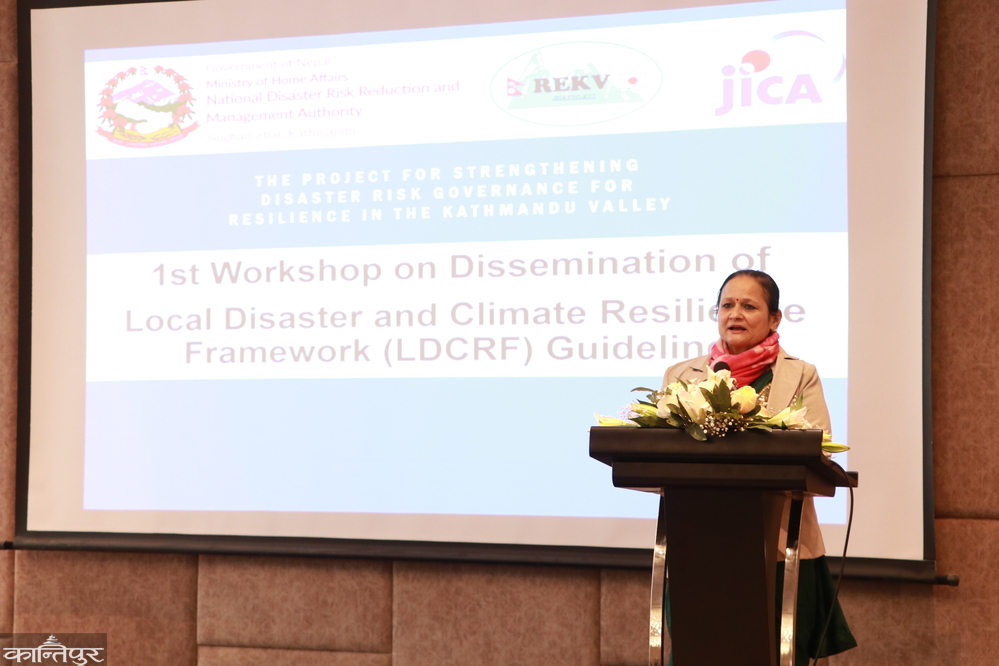 For this purpose, the Authority has recently introduced the "Direction for Designing Local Disaster and Climate Resilience Framework 2081" . Although approved by the Council of Ministers and implemented from 21st Baisakh, 2081, the vision was made available to the public through this program. In the same context, the authority has organized this program to get suggestions from the municipality of Kathmandu Valley to facilitate the implementation of the directive. In the
program, Sudeep Vikram Bhatt, the deputy secretary of the authority, gave a presentation about the need for this direction. He said that this vision is necessary because Nepal is at risk of disasters and helps to be alert and aware.
"According to the concept of risk assessment, Nepal ranks 4th in terms of climate change risk, 11th in terms of earthquake risk, 20th in multi-disaster countries and 30th in flood risk," he said. So we have to go for mitigation.' He clarified that the directive has been prepared to reduce these risks. He said that the building should be made earthquake resistant not only to make it look good, but also to reduce the damage from the construction of the building. In the
discussion, representatives and development partner organizations of Kathmandu and Lalitpur Metropolitan City, Bhaktapur, Suryavinayak, Madhyapur Thimi, Changunarayan, Tarakeshwar, Tokha, Shankharapur, Kirtipur Dakshinkali, Godavari, Gokarneshwar, Mahalakshmi, Nargajun and Chandragiri municipalities participated.
Similarly, Anita Lama, deputy head of Budhanilkanth Municipality, complained that while the framework or guidelines were being made, the local level was shown at the level of implementation but was not supported in the budget.
Basanti Tamang Dangol, deputy head of Dakshinakali municipality, said that she received little help from the association during the calamity. Addressing the issue raised in the
discussion, Arjun Kumar Bam, the joint secretary of the authority, said that it is the local level that responds immediately to the disaster and will join forces with the local level for its preparation. He also accepted that resources are limited. Katsu Kato, Deputy Chief Advisor of the Disaster Risk Strengthening Project for the Resilience of Kathmandu Valley, Japan International Cooperation Agency (JICA), Nepal, which is a partner in the
program, presented the 'Local Disaster and Climate Resilience Framework'. He informed that the duration of the project will be from January 2021 to September 2025.

