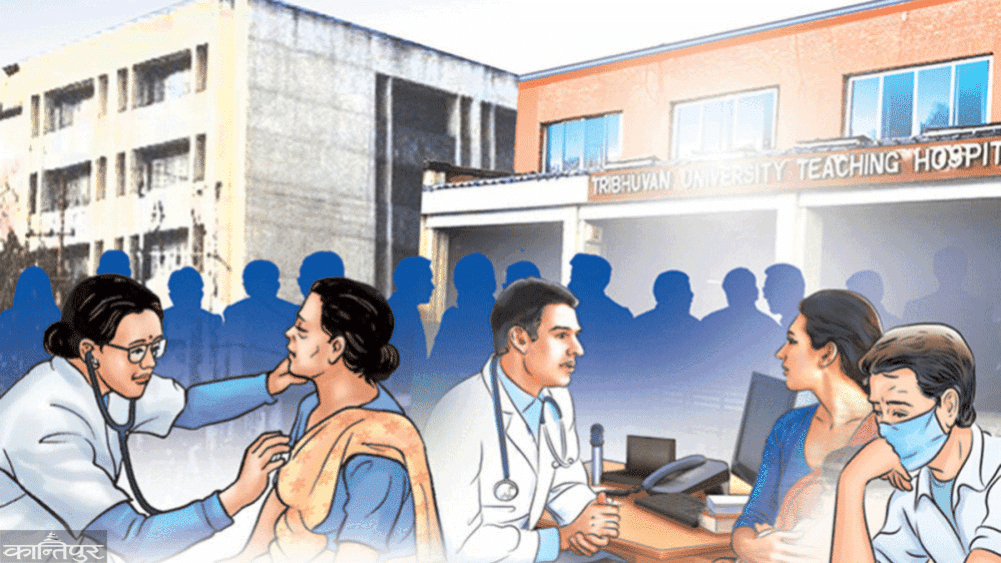
It is suggested that the government employees and the employees working in the private organized sector pay 1 percent of their annual salary to the health insurance fund by the employees themselves and an equal amount by the employer.
We use Google Cloud Translation Services. Google requires we provide the following disclaimer relating to use of this service:
This service may contain translations powered by Google. Google disclaims all warranties related to the translations, expressed or implied, including any warranties of accuracy, reliability, and any implied warranties of merchantability, fitness for a particular purpose, and noninfringement.
The Health Insurance Reform Suggestion Task Force has suggested to increase the benefit of up to one lakh rupees to five lakh rupees. The working group concluded that the amount received from insurance should be increased to five lakhs as the current facility of one lakh has not provided much support in the treatment of the citizens suffering from incurable and serious diseases.
The working group has submitted a report to the Ministry of Health and Population with a request to implement the recommendations through immediate, short-term, medium-term and long-term action plans. In order to increase the effectiveness of health insurance and make it accessible to all citizens, Minister of Health and Population Pradeep Paudel, a Nepali expert working in the World Health Organization, Dr. Under the leadership of Shambhu Acharya, an 8-member working group was formed on October 13th. Dr. in the
task force. Shambhu Acharya as well as development economist and former vice chairman of Policy and Planning Commission of Gandaki Province. Raghuraj Kafle along with senior heart surgeon Prada. Bhagwan Koirala was a member. Similarly, the Ministry of Finance, the Ministry of Labor, Employment and Social Security and the Joint Secretary of the National Planning Commission will be members. Executive Director of Health Insurance Board, Joint Secretary of the Ministry of Health. Saroj Sharma was a member of the committee.
The working group has also suggested to restructure all the related parties so that all health services provided by the government, including basic and emergency, will be provided through health insurance.
"Providing basic health services to all citizens free of charge and establishing a facilitation room so that each client can be listed in the health insurance program at the point of receiving basic health services," the suggestion says, "arrange an arrangement that does not charge any fee for registration." In order to receive all health services above the basic level, it is necessary to pay the prescribed health insurance premium and take a policy to increase the involvement of the state and local level to make such participation universal. The conclusion of the working group is that the amount received from insurance should be increased to five lakhs, saying that they could not provide support. Similarly, the task force also says that the health insurance program should be restructured so that it can provide all the health facilities needed by citizens in the long run by making it independent, sustainable and organized. The
working group has also suggested to amend the laws to make the health insurance program a success and to implement a system where health insurance is the only means of providing health care support in Nepal. The task force has concluded that the health insurance program cannot run in the long term in the current financial situation and has suggested to improve it as well. In order to make the
insurance program sustainable, all the citizens should be made to contribute based on their ability and the services they receive should be modified accordingly in the report.
'Making arrangements that all citizens must be covered by health insurance. Integrating the programs under various headings of health treatment concessions and grants under the health insurance system. Effective implementation of the co-payment system,” the report states, “Co-payment can be classified into three levels. 1 percent for those who have paid premiums designated by the government as a target group, and determining co-payments for others based on the level of service they receive and the physical facilities they want to use. The co-payment will usually be 20 percent, but this 20 percent should be based on the amount of the premium and the total benefits that they will receive. It has also suggested to increase the facilities. The working group has also analyzed and suggested in point-by-point the issues that can be improved in order to make the current insurance facility five lakhs. In order to increase the
insurance amount to five lakhs, the most important thing is that the currently collected insurance premiums should be progressively increased to seven thousand to fifteen thousand. In addition to this, it is also suggested that the employees in all types of government services and the employees working in the private organized sector pay 1 percent of their annual salary and the employer pays the same amount to the health insurance fund. As suggested by the
working group, the insurance program will receive about 15 billion rupees only by integrating the health care assistance and subsidy programs that are scattered in Nepal. In addition, the amount of contribution received from the provincial government and local level is around 5 billion.
'It seems that around 1 trillion will be collected every year by ensuring the involvement of all families and determining the progressive premium,' it is said in the suggestion. The
task force has also suggested to make the National Health Insurance Board fully autonomous and expand the structure to all seven provinces to make the insurance program successful and effective. In addition, the task force suggests that the delivery system needs to be improved in order to make the insurance program successful.
Similarly, the working group has suggested to create an environment where health institutions that provide services under health insurance receive timely payment after providing services. "Claims will be paid within 6 weeks, but if the validity of such claims is checked, action will be taken," the report states, "regular monitoring and supervision of service providers will be arranged." Take necessary initiatives to ensure quality health services.' The task force also suggests that the entire information system should be digitized to discourage unfair insurance claims and manage claim payments.