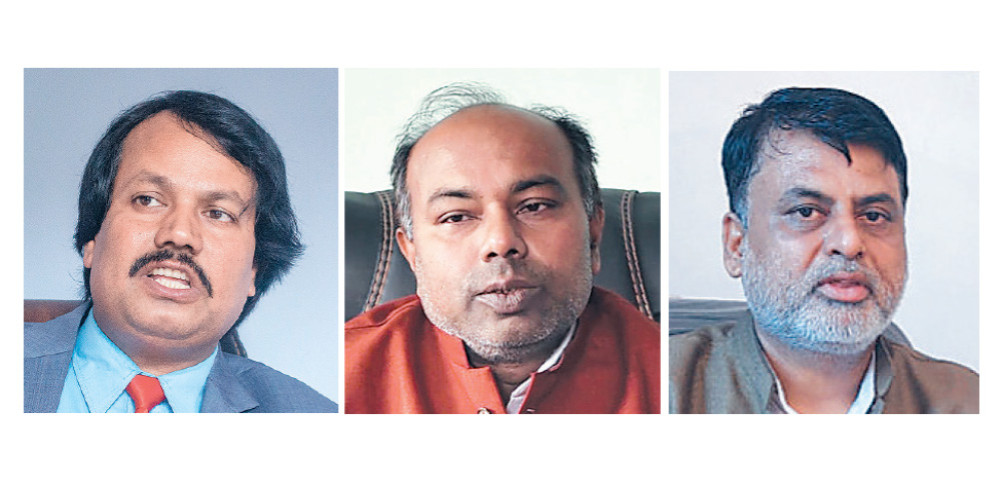
Comment of Madhesh-centered parties that increasing the minimum number of votes required for proportional seats is against the essence of federalism and multi-party system.
We use Google Cloud Translation Services. Google requires we provide the following disclaimer relating to use of this service:
This service may contain translations powered by Google. Google disclaims all warranties related to the translations, expressed or implied, including any warranties of accuracy, reliability, and any implied warranties of merchantability, fitness for a particular purpose, and noninfringement.
The Madhesh-centric party has objected to the government's preparation to increase the minimum vote percentage (threshold) required for representation in the House of Representatives and the Provincial Assembly towards a proportional election system. They have warned that if the 'threshold' is increased, they will start a struggle.
In the proportional election system, the government has already started the homework to amend the legal system that only the political parties that get at least 3 percent of the votes in the House of Representatives and 1.5 percent in the Provincial Assembly will get seats.
In the draft of the election management bill, a provision of 5 percent for the House of Representatives and 3 percent for the State Assembly has been made. In the draft submitted by the Election Commission to the House, the limit of 'threshold' was already there.
The amendment made by the House in the draft, which has legal recognition, reduces the chances of small parties getting seats proportionally and it benefits the big parties. The number of nationally recognized parties in the parliament may also be less.
Janmat Party President CK Raut said that raising the 'threshold' is not acceptable. He wrote on the social network Facebook on Thursday, 'In a religiously, linguistically, culturally, geographically and ethnically diverse country like Nepal, the voices of even the smallest groups should be represented in the House so that they can at least put their problems in the House. can tell On the other hand, the provision of the threshold of 6-7 lakhs to cancel the votes of tens of millions (30-40 lakhs) of the people and to add that portion from Chorbato to the big party cannot be acceptable to the common people. Nepal does not want a two-party dictatorship.' Raut said that they are ready to fight against the government's move to increase the 'threshold'.
Deepak Kumar Sah, the vice president of the Janmat Party, commented that the 'threshold' was being tried to prevent the Madhesh and minority communities. "Since the threshold is 3 percent, we have succeeded in getting the first representation of the Santhal caste in the parliament," he told Kantipur ;
Jitendra Sonal, the senior vice-president of another Madhesh-centric party, the Democratic Samajwadi Party, said that the issue of increasing the 'threshold' is against the essence and spirit of federalism. He said that the presence of various parties in the House is also needed to express regional problems.
``Making a law with the intention of trying to stop it is something that the party will object to in the party system,'' he said, ``There should not be a threshold. If it has to be kept, it has been accepted in practice and the minimum percentage proposed by the Election Commission should be maintained.
The spokesperson of Janata Samajwadi Party Nepal, Manish Suman, pointed out that the country had already entered into a multi-party system of government in 2046 and responded that now they are trying to impose a two-party system. "They are trying to audacity to destroy the multi-party system, this can never be acceptable," he said. It is also very unreasonable to try to stop it.'