In the draft of the bill prepared by the Election Commission, the Ministry of Home Affairs revised and increased the 'threshold', preparing to take it to the Council of Ministers after the approval of the Ministry of Law.
We use Google Cloud Translation Services. Google requires we provide the following disclaimer relating to use of this service:
This service may contain translations powered by Google. Google disclaims all warranties related to the translations, expressed or implied, including any warranties of accuracy, reliability, and any implied warranties of merchantability, fitness for a particular purpose, and noninfringement.
The Congress-UML coalition government has prepared to increase the minimum vote percentage (threshold) required for representation in the House of Representatives or the Provincial Assembly through the proportional election system.
In order to get proportional seats, the government has started the process of amending the law by providing that the political parties must get at least five percent of the votes in the House of Representatives and three percent of the votes in the Provincial Assembly.
The government is about to amend the current legal provision that the political party that gets at least three percent of the votes in the House of Representatives and 1.5 percent in the Provincial Assembly will get a seat proportionally. It is stated in section 126 (10) of the draft bill, 'Despite what is written elsewhere in this section, in the case of the election of a member of the House of Representatives in the election of the proportional system, at least five percent of the total votes cast and in the case of the election of a member of the Provincial Assembly at least three percent of the total votes cast on behalf of the political party. Only the candidate will be elected. The draft of the
bill has been sent by the Ministry of Home Affairs to the Ministry of Law, Justice and Parliamentary Affairs for approval. In the draft of the bill sent to the Ministry of Home Affairs, the 'threshold' towards proportionality was kept unchanged. But the House has increased the percentage of the 'threshold' while revising the draft.
In the seven-point agreement reached by Congress and UML on June 17 for power sharing, it is mentioned that 'necessary amendments to the constitution for political stability and the creation of appropriate laws will be prioritized'. According to the same agreement, the 'threshold' of the proportional election system has been increased, said a home official.
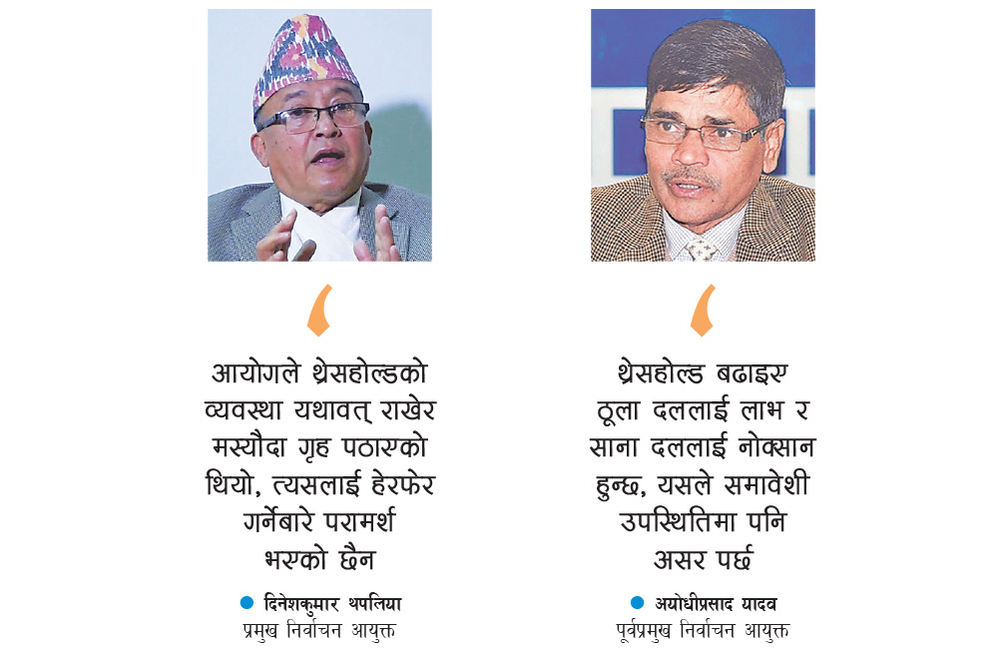
Chief Election Commissioner Dinesh Kumar Thapalia said that there was no consultation with the Commission regarding the change of rules related to 'threshold'. "The Commission sent the draft to the House keeping the threshold arrangement intact," he said. The Commission had prepared a draft of the 'Election Management Bill' and sent it home after integrating the 7 scattered laws related to elections.
The draft of the bill, which was prepared by integrating 7 Acts including voter list, election (crime and punishment), local level election, House of Representative member election, State House member election, President and Vice President election and National Assembly member election, was delayed for almost one and a half years.
After amending it, Home has sent it to the Ministry of Law just a few days ago. A law ministry official said the draft of the bill would be finalized soon. After returning from the law, the draft will be taken to the Cabinet. After being passed by the Council of Ministers, it will be submitted to the Parliament as a bill.
In the House of Representatives Election Act 2074, there is a provision for the election of candidates only on behalf of the party that receives three percent or more of the total votes for the proportional election system. According to the arrangement, there are seven political parties in the House of Representatives in the 2079 election through the proportional election system.
In the election of 2079, UML got 30.69 percent, Congress 29.29 percent, Maoist 12.68 percent, Rashtriya Swatantra Party 12.19 percent, and Rashtriya Prajatantra Party 6.35 percent.
Similarly, Janata Samajwadi Party got 4.54 percent and Janmat Party got 4.26 percent. According to the proportional election system, UML got 34 seats, Congress 32, Maoists 14, National Independent Party 13, RPP 7, Jaspa 5 and Janmat 5 seats in the 110 seats of the House of Representatives.
United Samajwadi Party led by Madhav Nepal which won 10 seats directly and Democratic Samajwadi Party led by Mahanth Thakur which won 4 seats did not get seats proportionally because they could not cut the three percent 'threshold'. 18 thousand 411 votes for the "threshold" of the unified socialists did not reach.
Civilian Liberation Party which won 3 seats and Nepal Labor Farmers Party and Rashtriya Janamorcha which won 1 seat each could not cross the 'threshold'. On the other hand, Janmat Party, which won only one seat directly, got 5 seats in the House of Representatives when the 'threshold' was cut. If the 'threshold' of 5 percent had been kept in the 2079 elections, JSP and Janmat would not have got proportional seats. Their 10 seats were allotted to the parties that cut the 'threshold'.
Former Chief Election Commissioner Ayodhi Prasad Yadav says that increasing the 'threshold' will benefit big parties and cause losses to small parties. He says that this may reduce the representation of political parties in the parliament and also affect the inclusive presence. In many countries that have institutionalized democracy, the 5 percent threshold has been kept. But in our case, the current practice is fine," he said. "If the threshold is raised, the inclusive representation in the parliament through small parties will be lost."
In the 2074 election, there were five parties that cut the threshold proportionally in the House of Representatives. At that time, UML got 33.24%, Congress 32.77%, Maoist 13.65%, Rashtriya Janata Party made up of 6 Madhesh-centric parties 4.94% and Federal Socialist Forum Nepal 4.92%. At that time, if the 5 percent 'threshold' had been kept, the RJPA and the Forum would have been deprived of getting proportional seats. 6-6 seats won by that party were distributed to big parties.
In the Constituent Assembly elections, the party that got 0.22 percent i.e. 21,000 votes got seats proportionally because no threshold was set. Therefore, more than two dozen parties were represented in the Constituent Assembly of 2064 and 2070.
The status of the national party in the parliament is also determined by the 'threshold'. The Act on Political Parties 2074 stipulates that only the party that gets at least three percent of the votes in the proportional election system and one seat in the first-come, first-served election system will be recognized as a national party. If the 'threshold' for proportionality reaches five percent, the criteria for recognition of the national party will also be the same.

