The anti-corruption bill sent by the disagreement sub-committee of Oli and Deuba has been accepted and passed by the state system committee on December 18, but the decision on the authority bill has not yet been made.
We use Google Cloud Translation Services. Google requires we provide the following disclaimer relating to use of this service:
This service may contain translations powered by Google. Google disclaims all warranties related to the translations, expressed or implied, including any warranties of accuracy, reliability, and any implied warranties of merchantability, fitness for a particular purpose, and noninfringement.
Due to the disagreement of the Prime Minister and UML President KP Sharma Oli and former Prime Minister and Congress Chairman Sher Bahadur Deuba regarding the issue that the Authority can investigate in the decision of the Council of Ministers, the Commission for Investigation of Abuse of Authority Third Amendment Bill has stalled.
The leadership of the ruling party disagreed with the report submitted by the sub-committee formed under the State Order and Good Governance Committee to define the policy decisions made by the Council of Ministers on the bill and which ones are not.
The sub-committee submitted the consensus report to the full committee on December 4 after reconciling the disputed issues of the Anti-Corruption First Amendment Bill and the Commission for Investigation of Abuse of Authority Third Amendment Bill. The anti-corruption bill has been accepted and passed by the committee on December 18. But the committee has not been able to make a decision regarding the bill related to authority. Some MPs claim that the authority bill was stopped due to pressure from top leaders. One of the leaders said that the report passed by the sub-committee chaired by
committee member Hridayram Thani, and the report passed by the sub-committee under the chairmanship of the bill, would make the authority a 'superpower' and exercise 'parallel power' in the future. A minister says that he is not in favor of accepting the report brought by the sub-committee to shrink the jurisdiction of Prime Minister Oli and Congress President Deuba. He claims that the report was not brought to the full meeting of the committee for that reason.
In a meeting called on a separate agenda on Monday, there was a "nokjhonk" between the chairperson of the State Order and Good Governance Committee, Ramhari Khatiwada, and the coordinator of the sub-committee, Hridayram Thani, over the issue of the stalled bill.
Sub-committee members including the coordinator Thani have been objecting to the two bills related to corruption that were passed unanimously by the sub-committee by accepting one and blocking the other. A meeting of the committee was held on Monday regarding redressal of the complaints received by the committee. But sub-committee coordinator Thani raised the issue of the bill itself. When Thani objected by diverting the meeting of the committee saying that the authority bill was 'delivered to the ICU', the chairman of the committee Khatiwada said, 'Talk about the complaint today, the authority bill has not been sent to the ICU', and accusations/counter-accusations continued between the two people.
According to the existing provisions of the Act on Abuse of Authority, the decision of the Federal Council of Ministers does not fall under the authority's investigation. In the bill sent to the committee by the National Assembly, that scope has been further widened. In section 3 (b) of the bill, it is proposed, 'In relation to the proceedings or decisions taken at the meeting of the Federal Parliament, the Provincial Assembly or the committee under it or any act spoken or done by any member in such meeting or the Government of Nepal, the Council of Ministers or any committee thereof or the Provincial Government, the Council of Ministers. No investigation, investigation or any other action will be taken by the commission under this Act in relation to any policy decision made by any committee or the judicial functioning of the court. The sub-committee has prepared a report by adding three points to clarify the definition of policy decisions in the bill saying that this system will spread political corruption from the center to the local level. There has been an increase in the trend of adding political issues to the major corruption and financial scandals that have been made public recently. On the other hand, when public procurement, contracts, projects of national pride and plans of strategic importance are given by Tajbiji decision, the stakeholders have been expressing concern that there is an increased tendency to take them to the Council of Ministers in the name of policy decisions by 'catch the thief's way' for fear of being investigated.
The subcommittee concluded that corruption is rampant because the existing law does not allow investigating the decisions of the Council of Ministers.
In which, firstly, according to the law, it has been mentioned that any decision made in relation to public procurement is not policy-related, except in cases where the Cabinet of Ministers of Nepal has to decide. Secondly, it is said that any decision that enters into the authority of such an officer or agency or exceeds the jurisdiction of such an officer or agency is not policy-related. In the third, there is a clear provision that any decision made to benefit, facilitate or benefit only a particular person or organization is not a policy, except for those that are equally applicable to the general public according to the law.
The top leaders of the ruling party are against it, saying that if this arrangement is included in the bill, the authority will become a 'superpower' over the executive head. Another minister of the government said that Congress President Deuba, a five-time prime minister, and Oli, a three-time prime minister, are not in favor of amending the law to allow the authority to enter into the decision of the cabinet. The minister said that due to the reluctance of the top leadership, the authority bill was stuck when the anti-corruption bill was passed.
Of the three points proposed by the sub-committee, the top leaders of the ruling party are more concerned with the third one. Leaders are of the opinion that if any decision made for the benefit, convenience or interest of a particular person or institution is not policy-oriented, all doors will be closed, from medical expenses given by the Council of Ministers and the Ministry of Home Affairs to expenses distributed to leaders and workers.
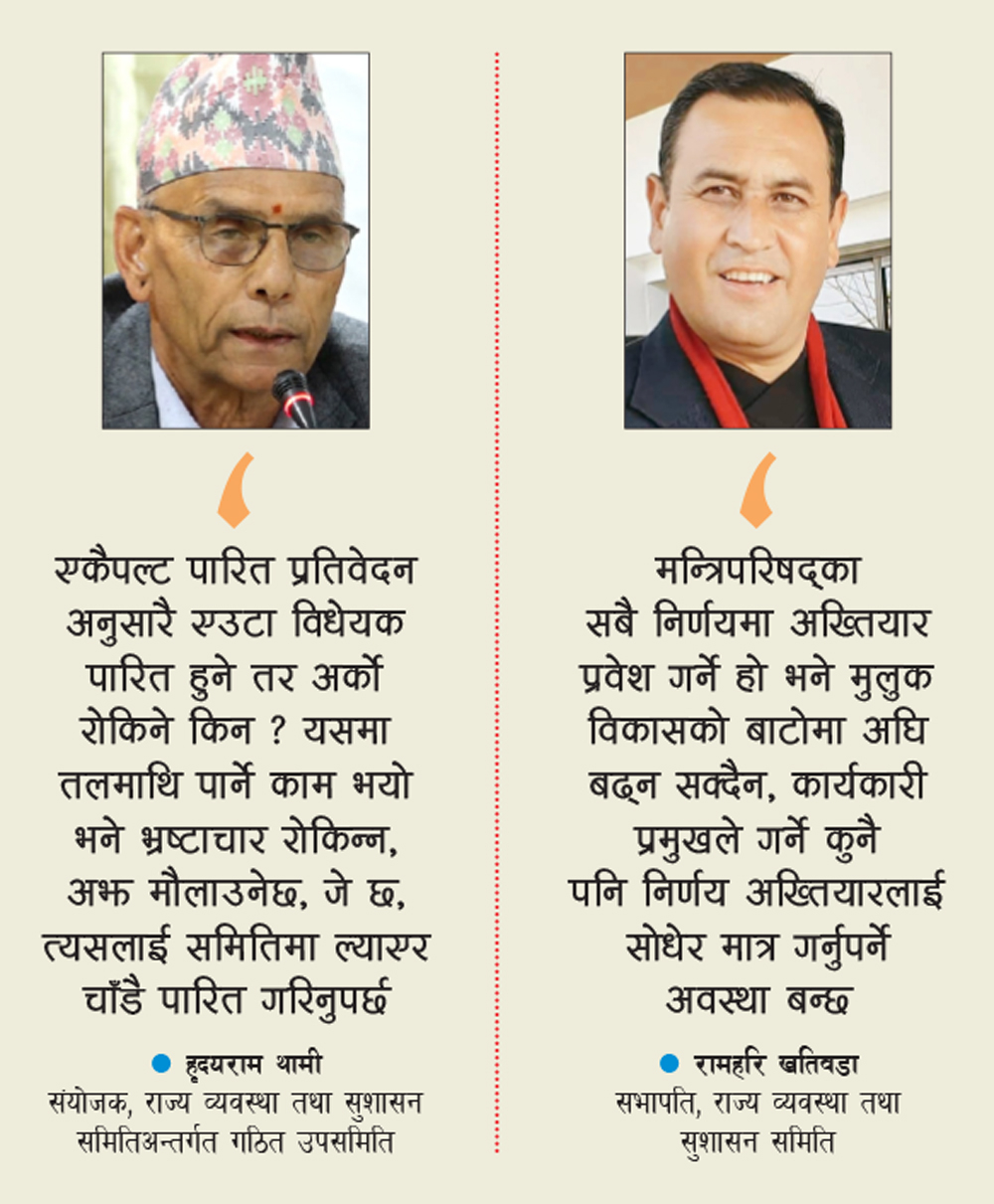
Chairman of the committee Khatiwada argues that in the report submitted by the sub-committee, more discussion is needed regarding the issue of political corruption, the deadline for filing cases with the authorities and anonymous complaints. The Council of Ministers should be able to make policy decisions other than those made by ministers, secretaries, joint secretaries and other bodies. If the authority enters into that too, development work may be halted. If the authority enters into all the decisions of the Council of Ministers, from which parliamentarian, which minister ate, what he brought, the country cannot move forward on the path of development, any decision made by the executive head will be made only by asking the authority," said Khatiwada. We should also pay attention to the impact it will have.'
Chairman Khatiwada says that it is not only a matter of policy, but the authority should be controlled by placing a sword on the person's head and exercising the right to prosecute the case at any time. Claiming that the Authority has been harassing people for years by not prosecuting cases in the name of investigation, and the mental stress of the same has led to suicides, he said that there is also a debate on the issue of setting a deadline so that the case can be registered within three or five years of the complaint.
sub-committee coordinator Thani alleged that the bill passed by the sub-committee was carried out to the ICU. He said that since various researches and researches have pointed out that the corruption caused by policy decisions is the most in Nepal, there is a need to make it clear about the policy decisions of the Council of Ministers.
After the fact that major corruption is caused by the decision of the Cabinet including the Lalita Niwas land case, Giribandhu Tea Estate, Widebody Case became public, international organizations working in the field of good governance, the Commission for Investigation of Abuse of Authority and the Court are drawing the attention of the Parliament saying that what decisions of the Council of Ministers are policy and which are not. have come A survey conducted by the Authority in 2075 on the 'state of corruption and good governance in Nepal' pointed out that there is more corruption at the policy level. 30.4 percent of the participants in the study pointed out that political corruption occurs, while 27.2 percent believed that corruption occurs due to procedural decisions. 10 percent pointed out corruption on a small scale and 6.9 percent on institutional corruption.
'The sub-committee has prepared the report after a long discussion on the issues that have been drawn attention by the court, various agencies and good governance experts, my main question is why the report which was unanimously passed by the sub-committee having representatives of all parties has been stopped today,' said Thani, 'in this Corruption will not stop if it is done from the bottom up. Will grow more. Whatever it is, it should be brought to the committee and passed soon.'
While two types of opinions are coming out about the report of the sub-committee within the ruling party, the opposition party including the main opposition Maoists are preparing to make the report of the sub-committee a 'bottom line'. A member of the sub-committee, Hitraj Pandey, who is also the chief whip of the Maoists, said that the report given by the sub-committee was the official 'position' of his party. "Based on the report given by the sub-committee, we think that the authority bill will be passed as the corruption bill was unanimously passed by the committee," Pandey said. What was unanimously passed in the subcommittee is our position. It can't go down. We will not allow it.'
UML MP and member of the sub-committee Raghuji Pant said that the opinion of the government will be known after the report of the sub-committee comes to the committee. What is the opinion of the government in the report given by the sub-committee, I have not been able to understand. The Home Minister should take the view of the government," he said.

