As the suggestions and decisions given by the political working group cannot be accepted by the general public, the suggestion of the constitutionalists is that a commission should be formed under the leadership of the former chief justice or judge.
We use Google Cloud Translation Services. Google requires we provide the following disclaimer relating to use of this service:
This service may contain translations powered by Google. Google disclaims all warranties related to the translations, expressed or implied, including any warranties of accuracy, reliability, and any implied warranties of merchantability, fitness for a particular purpose, and noninfringement.
Congress and UML have decided to form a task force to do the homework of amending the constitution four months after the formation of the government. The question has arisen whether the constitution issued by the Constituent Assembly on October 3, 2072 can be amended based on the suggestions given by the working group of the political parties.
Constitutionalists emphasize that since there is a need to amend the inconsistencies seen in all the 3 parts of the state from the structural framework of the constitution, a commission with a legal status that is acceptable to all should be formed. They suggest that a commission should be formed under the leadership of the Chief Justice or a judge as the suggestions given by the political working group of the ruling party cannot be accepted by the general public.
According to the Minister of Home Affairs, Ramesh Akhtar, the working group formed between the two parties will review the implementation of the constitution and discuss with other parties where there are obstacles and obstacles in the constitution. While the two major parties are forming the working group for the amendment of the constitution, they are not able to clarify which issues require amendment. Within the Congress and UML, there is more discussion about the electoral system and the 'threshold'. Since the provision of three percent 'threshold' is only in the law related to political parties, there is an internal discussion going on within the two parties about increasing it and providing it in the constitution.
Constitutionalists say that there is a need for amendment in the structures of the executive, legislature and judiciary because there are many inconsistent issues. Senior advocate Radheshyam Adhikari, who played an active role in the drafting of the constitution, believes that not only the electoral system but many other issues need to be amended.
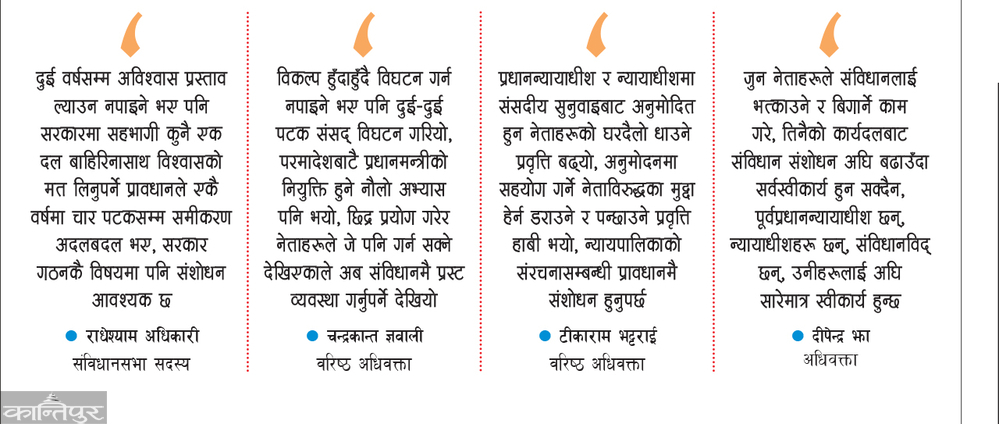
At the time of constitution making, in order to seek stability of the government, a provision was made in the constitution that a motion of no confidence cannot be brought for two years after the appointment of the prime minister. But since there is a constitutionally binding provision that the prime minister must take a vote of confidence within 30 days without any party participating in the government, the provision that no no-confidence motion against the prime minister for two years has not worked, according to the senior advocate officer. "There have been many times of government formation and reorganization by forcing the Prime Minister to take a vote of confidence," he says, "there have been four changes of equations in one year, so it seems that the constitution should be amended."
Another constitutionalist Chandrakant Gyawali He says that the biggest problem in the implementation of the constitution is in the formation of the government. According to him, although there is no problem in the formation of the government for the first time after the election, there is a political dispute about which stream will be used to form the government.
Four months ago, Prime Minister KP Sharma Oli had put forward the argument that the appointment under Article 76 (2) of the Constitution was unconstitutional by Maoists and some parties.
After not getting a vote of confidence under Article 76 (2) of the Constitution, some parties, including the Maoists, were of the opinion that the formation of the government should go according to Article 76 (3) of the Constitution.
'Political events ranging from which article to form the government to whether or not the prime minister can dissolve the parliament have led to constitutional complications many times in the meantime, the dispute that arose at the political level reached the court,' says Gyawali, 'The constitution forbids the prime minister to dissolve the parliament as long as the government has an option. Attempts to dissolve the parliament were made two times in the meantime, the appointment of the prime minister to solve the complications of government formation, and the beginning of the new practice of mandate.
He is of the opinion that everything should be made clear in the constitution through amendment because there is a crisis in the political culture, constitutional ethics, democratic conduct and practice of the leaders rather than the constitution. He says, 'Since it seems that the leaders can do anything by using the loopholes in the constitution, now it seems that there is a need for a clear provision in the constitution.' According to senior advocate Tikaram Bhattarai, the Bar has already passed the 2081 National Conference for the reform of the Judiciary to remove the injustice in the justice sector and has even suggested points to the government. The bar has put forward points including that the Chief Justice and judges should be separated from parliamentary hearings for the fairness of the judiciary and the independent justice system, the High Court should be made a court of record, the High Court should be empowered to examine the legality of laws made by the state and local levels, and the Chief Justice should not be placed in the Constitutional Council.
The Bar put forward the demand for the amendment of the constitution after the work of finding a share in the appointment of the officers of the constitutional bodies from the former Chief Justice Cholendrashamsher Jabara. In addition to playing a role in making his relative Gajendra Hamal the Minister of Industry, Commerce and Supply in the then Prime Minister Sher Bahadur Deuba's Council of Ministers, Prime Minister KP Sharma Oli also actively participated in the partition when 52 constitutional officers were appointed. Jabara forced Hamal to resign after he became a shareholder of the cabinet. Senior advocate Bhattarai says that the Nepal Bar Association, for the first time, brought forward the issue of constitutional amendment with the conclusion that the role of the Chief Justice in the Constitutional Council should be reduced, and without separating the Chief Justice and judges from the parliamentary hearings, there will be no reform of the judicial sector.
The court could not be independent after the Chief Justice, the Prime Minister and the leader of the opposition parties sat and shared the positions of state power. For example, for three years, the writ of dispute regarding the appointment of constitutional officers is still pending in the constitutional bench, the decision has not been reached,' says Bhattarai, 'on the other hand, with the system of hearing the Chief Justice and judges, the judges started running to the houses of the leaders to pass the parliamentary hearing, afraid to see the case against the leader who will be passed in the hearing. And the tendency to set aside has prevailed, so the conclusion is that the structure of the judiciary should be amended.
Constitutionalist Officer 10 Years of practice and experience have shown that the constitution should be used in every field. He suggested that amendments should be made not only at the executive level, but also at the legislative level. "As soon as the House of Representatives sends a bill to the National Assembly, if it is not sent to the House of Representatives within 60 days, provision was made in the constitution that it will be automatically enforced, but the bill that was sent to the National Assembly has been retained by the House of Representatives even within the five-year term," he says. It has been 9 years and 3 months since the implementation of the constitution. Article 265 of Part 27 of the Constitution provides for review after 10 years of implementation. Constitutionalist says that even though the provision is aimed at inclusive commission, its purpose is to review the constitution every ten years and amend it if necessary.
Senior Advocate Mukti Pradhan, who is also a former Attorney General, says that the debate being conducted by the two parties by making the National Assembly only proportional and inclusive is regressive. "It seems that the constitution amendment agenda that is currently being discussed comes from political interests and the purpose of prolonging the alliance," he said. No formal agenda has come up in the meeting. It seems that the issue of amending the constitution is raised only to increase the life of the government.'
Advocate Dipendra Jha disagrees with the current process of constitutional amendment. He argues that the amendment of the constitution cannot be accepted by the working group of the leaders who destroyed and damaged the constitution. He says that the home work of amending the constitution should be started by keeping independent people under the leadership of the former chief justice or judge. "Political parties will put their suggestions in the parliament, but if they proceed with the suggestions of the working group of the ruling party, more problems will arise," he said. Not only the Congress and UML, but also other parties including the Maoists have their own interests and concerns in the constitution. Parties including Maoists have been suspecting that Congress and UML are trying to move the country towards a two-party system through constitutional amendment. In response to that, the Maoists have been publicizing 'counter proposals', including the need to further increase inclusive and proportional representation, to go to a direct presidential system. Upendra Yadav-led Jaspa Nepal has also supported the issue of presidential system. RPP's interest is focused on removing secularism. The issue of secularism has also been seen within the Congress.
Constitutionalist officials say that amending the basic issues of the constitution such as republicanism, federalism, secularism, etc., may lead to the failure of the constitution itself. Another constitutionalist, Bhattarai thinks that it is necessary to make the constituency inclusive by keeping the system of proportional and inclusive representation in the electoral system.
Bhattarai suggests that a provision should be added in the constitutional provisions regarding political parties that the same person cannot be the executive head more than twice. He thinks that such an arrangement is also necessary for the development of leadership within every political party. "The process of transfer of political leadership has been slow, distaste has spread over the federal democratic system and the republic itself, so Article 269 of the Constitution should be amended," he said It is seen that the rights of provinces, provinces and local levels should be made more clear. Gyawali, another constitutionalist, believes that it is necessary to reform the provincial structure not only in terms of the list of rights but also in principle. According to him, the structure should be changed so that there is a local level under the province. "Political, administrative and economic powers should be concentrated in the provinces, there is no need for the center to keep other than eight/ten powers, 25 ministries are not necessary at the center," he says, "even if the number of provinces is reduced, they should all be kept under the provinces." The provincial structure was not even like a quasi-judicial body. It has been limited only to formal structures made to manage political conflicts.'
According to Gyawali, the province has been given the right to collect taxes in eight areas. Five of them belong to the local level. It also has the right to levy taxes in four separate areas. "What this shows is that the local level collects 100 percent of the taxes and gives 40 percent to the province and keeps 60 percent," he says, "In such a situation, the province is not in a position to run economically. The discussion should be carried forward in such a way that all its details are discussed.
The lawyer suggested that the ruling party should carefully adopt the revision homework so as to make the constitution acceptable to all Terai, Madhes and Pahads. The Madhesh-centric party still considers the Constitution Day of October 3 as a 'black day'. After the promulgation of the constitution, 20 people have died during the protest against it. The Madhesh-centric party is still demanding that the constitution should be amended on the issues of inclusion, proportionality, state structure, citizenship, language, etc.
The constitution has been amended twice since it was promulgated on October 3, 2072. To address the demands of Madhesh-centric parties, the then Sushil Koirala-led government made the first amendment within four months of the promulgation of the constitution. These included accepting the principle of proportionality and inclusiveness, determining constituencies based on population and geography. The Madhesh-centric party was not satisfied with that. Claiming that the amendment is not sufficient, they have been raising demands for amendments in matters such as demarcation of provincial structure, language, citizenship and representation in the National Assembly.
Before going to the parliamentary elections in 2074, the Congress and Maoist coalition government moved the amendment bill for the second time. It included the issue of demarcation of Lumbini province, language, citizens and representation in the National Assembly. However, the amendment bill was rejected when UML, which was the main opposition at that time, stood in opposition. The second amendment was to be amended to include the dragging of the new map of Lampyodra and Kalapani area in the time of the then Oli Leader government.
-BREAK has been making the case of the constitution to power, which the Madhesian parties have been able to rule over power. However, after the parties stay out of government and after receiving the government, the demand for amendment the constitution has been overshadowed. Some of the cases raised by the Advocate Jha, Madhesians say that there are still resting and some have become irrelevant. "We need to make authority to federalism. Weaknesses should be improved but options of the proportional arrangement and NBSP; not acceptable. Now the constitutional Israel has not been able to work. & NBSP; The Story-BREA Parliament Provisions Failed & Nbsp; argues, "Jha has not used to use the policies of the Constituent Constitution Political Histone. The people's life system should be connected to modify. That's & Nbsp; For Independent One's Leader & Nbsp; working tasks. '

