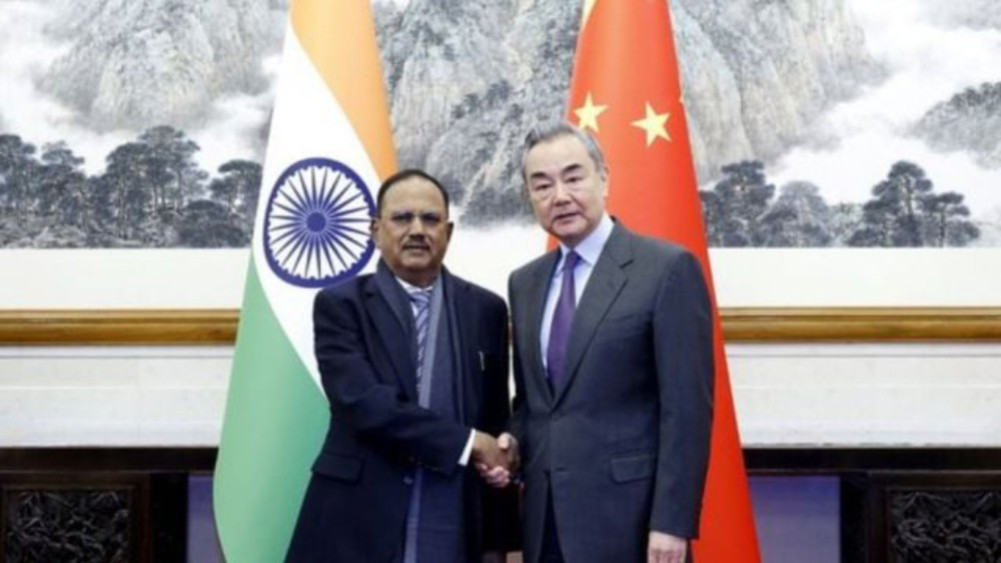
According to stakeholders, the Nepal government should be interested in the agreement reached between India and China to resume the Mansarovar Yatra, which was stopped due to the covid epidemic.
We use Google Cloud Translation Services. Google requires we provide the following disclaimer relating to use of this service:
This service may contain translations powered by Google. Google disclaims all warranties related to the translations, expressed or implied, including any warranties of accuracy, reliability, and any implied warranties of merchantability, fitness for a particular purpose, and noninfringement.
The agreement between India and China to resume the Kailash Mansarovar Yatra for Indian pilgrims has shocked Nepal. In 2015, Prime Ministers of India and China agreed to trade through the Lipulek Pass, which is 56 km from Limpiyadhura, the western border of Nepal.
With the latest agreement to re-operate the Mansarovar Yatra, which was stopped due to the Covid epidemic, the concern about the Chuche map of Nepal has been awakened again.
When Indian Prime Minister Narendra Modi visited China on May 14, 2015, an agreement was reached with his counterpart Li Keqiang to increase bilateral trade through the Lipulek border crossing. The agreement was mentioned in point 28 of the joint statement issued on May 15. Nepal immediately sent a diplomatic note to both countries objecting to that agreement.
If India ignores it, China says that the agreement can be amended if there is a credible document. Now again, Nepal was not informed about the re-operation of the Mansarovar Yatra during the talks held between the Indian National Security Advisor Ajit Doval and the Chinese Foreign Minister Wang Yi in Beijing.
India's National Security Adviser Doval visited China last week. The route to be used for the Mansarovar Yatra has not been disclosed in the agreement reached during that time. India has made a road from Pithoragarh to Lipulek and has announced plans to allow pilgrims to visit Kailash Mansarovar through the same route.
For that reason, border expert Buddhinarayan Shrestha says that Nepal's diplomatic activity is necessary for the latest agreement between India and China. "We are naturally concerned about the use of Nepal's land, be it business or the movement of pilgrims," he said, "The Nepal government should ask for information on this matter."
After the spread of the Covid epidemic, China banned the Mansarovar Yatra from 2020. Although China has allowed Nepali and other nationals to travel to Mansarovar, it has not given permission to Indian citizens due to strained relations after the Galwan clash. India has been trying to open the Mansarovar Yatra. It is mentioned that the Kailash Mansarovar Yatra will be restarted in point 6 of the 8-point joint statement released after Doval's visit to China.
Randhir Jaiswal, the spokesperson of the Indian Ministry of External Affairs, has said that positive talks are underway with the Chinese government regarding the opening of the Kailash Mansarovar Yatra for Indian pilgrims. He said to Kantipur, 'Further progress in that matter will come out gradually.' To Kantipur's question about which route is intended to be used for the Kailash Mansarovar Yatra, he said, 'It should be the route that travelers used to take earlier. There is nothing more to it now.'
Indian passengers go to Mansarovar through Nathula in Sikkim, Rasuwagadhi in Nepal, Tatopani, Humla and Kalapani-Lipulek. While India has speeded up the construction of a road connecting Nepal to the border with China, former ambassador Nilambar Acharya for India should understand its intentions and conditions after the bilateral agreement came out. tells
Acharya says that India and China are likely to return to the pre-2020 situation. They are trying to normalize the situation. At the same time, there must have been talk of opening the Kailash Yatra, which was stopped," he said. "It should be understood whether the opening of the Yatra is only a theoretical agreement or is also a matter of the route. Our interest should be there.'
Since Lipulek is a part of Nepal, Acharya says that if there is an agreement to bring Indian passengers to Kailash Mansarovar without Nepal's consent, it will be Nepal's concern. "No, if it is a matter of convenience including visas to allow passengers to go easily, that is their matter," he added.
Nepali tourism businessmen are both excited and skeptical about the re-opening of the Kailash Mansarovar Yatra to Indian pilgrims. President of Nepal Association of Tour and Travel Agents (NATA) Kumarmani Thapalia said that although it is known that there has been an agreement to open the Kailash Mansarovar Yatra for Indian pilgrims, he is waiting for the details. According to him, 4/5 lakh Indian pilgrims are waiting to go to Kailash Mansarovar as the journey has been stopped for 4 years.
'If there is a situation where they can be brought to Kailash Darshan through Nepal, it is a great opportunity for us,' he said. break According to him, 95 percent of the pilgrims going to Kailash Mansarovar Yatra from India use the Nepalese route including Humla, Rasuwagadhi. That's why on the eve of Prime Minister KP Sharma Oli's visit to China, Thapalia informed that they have requested to open the Kailash Yatra for Indian travelers through the Ministry of Tourism.
Kailash Mansarovar Yatra Vasu Adhikari, owner of Touch Kailash Travels and Tours, says that the opening of Kailash Mansarovar Yatra for Indian pilgrims is good news for Nepal's tourism sector. However, he says that the Nepal government should be interested in the agreement that has come out.
'India is building a road from Uttarakhand through the territory of Nepal, if travel is going to be opened through that road, we should object to it,' he said, 'Now Indian passengers have to use Nepal's road to go to Kailash Mansarovar. It was different if it was not a matter of a fixed route, but a mere agreement to allow passengers. Nepal's route is easy for them. It will support Nepal's tourism business.'
The movement of Indian pilgrims has decreased in Nepal due to the suspension of the Kailash Yatra. Nata President Thapalia claims that before the Covid epidemic, 60,000 pilgrims used to go on the Kailash Yatra through Hilsa Naka in Nepal. According to him, Nepalgunj-Simikot-Hilsa-Mansarobar route is considered easy and less expensive.
Nepalgunj is a major gateway for Indian pilgrims. Aiming at that, a large investment has also been made in the hotel sector in Nepalgunj. Thapalia says, "Indians traveling through Nepal to Kailash Darshan spend half of their time in Nepal and half of their expenses are also spent here, so opening the tourism sector in Nepal will benefit from this."
The Ministry of Foreign Affairs of Nepal has not given a formal opinion on the agreement reached between India and China regarding the reopening of the Kailash Mansarovar Yatra. Krishna Prasad Dhakal, spokesperson of the ministry, said that it can be said only after understanding more about this matter.
Frontier expert Shrestha says that India has crossed the border and China has not recognized Nepal's Chuchche map in the map released last year, so Nepal should take serious interest in the developments between the two countries.
In the new map released by India in the first week of November 2019, Kalapani and Lipulek areas were placed within the Indian border. After that, the Ministry of Foreign Affairs sent a diplomatic note to India clarifying that the Kalapani region is part of Nepal. After India did not respond to it, the Nepal government issued a map up to Limpiyadhura in May 2077.
Border expert Shrestha says that due to Nepal's lax diplomacy and weakness, India has been controlling Nepal's territory for years. The Sugauli Treaty between British India and Nepal in 1816, the maps of 1819, 1827 and 1856 consider Limpiyadhura as the western border of Nepal.
China is well aware of the reality of Nepal's western border point. On August 18, 2056, the then Chinese ambassador Zeng Suyong said that Kalapani belonged to Nepal when Nepal and China demarcated in 1961/62. He said, "The ambassador's speech is China's, so Nepal should also remind China of the fact."