Twice the number of people resigning than those who are required to retire when they reach the age, financial lack is the main reason, those who leave low-level jobs are often employed abroad.
We use Google Cloud Translation Services. Google requires we provide the following disclaimer relating to use of this service:
This service may contain translations powered by Google. Google disclaims all warranties related to the translations, expressed or implied, including any warranties of accuracy, reliability, and any implied warranties of merchantability, fitness for a particular purpose, and noninfringement.
Kumar Paudel from Butwal was recruited as a soldier in Nepal Police in 2067. In between he was promoted to Assistant Constable. But within 12 years of joining the service, he resigned from the police and went abroad. He is currently in Portugal on foreign employment.
It became difficult to run a family with the police job. It became impossible to save,' said Paudel, 31 years old, 'Working for two hours in Portugal is equivalent to working for eight hours in Nepal.' "One had to be physically able, diet alone was not enough with ration allowance. In 18 months, only two pairs of clothes and boots were available. I quit my job after finding it difficult to save my salary,” he said.
At the time of his resignation, his salary was 24,000 rupees. Ghimire is currently working as a CCTV camera operator and security guard in Abu Dhabi, the capital of the United Arab Emirates (UAE). He said that he is happy now that he is able to send money home regularly.
Like Paudel and Ghimire, more than 10,000 people from the army, police and armed police have left their jobs in the last five years alone. This number is almost twice the number of compulsory retirements during the same period. Nepal Police has the highest number of job leavers.
The state spends 5 to 8 lakh rupees on a jawan from recruitment to field deployment. But the state is at a loss when the manpower who should be employed in the service after being trained and experienced leaves the job in the middle. In this way, no effective initiative has been taken by the government to stop the wave of job loss. Recently, preparations have been made to amend the law to provide some relief to the lower level employees of the police and armed forces.
According to the Nepal Police Headquarters, 4,703 people left their jobs from the financial year 2076/077 to 2080/2081. The number of compulsory retirement during this period is 2 thousand 467. In the current financial year, 509 people left the Nepal Police service till October, while 248 people got compulsory retirement.
The difference between those who resign from the armed police force and opt for compulsory retirement is seen to be almost 11 times in 5 years. From the financial year 2076/77 to 2080/2081, the number of compulsory retirement was 266 when 2,815 people quit their jobs. Armed Police Force spokesperson DIG Kumar Neupane informed that 449 people have resigned since the beginning of the current financial year. According to him, 25 people have taken compulsory retirement during this period.
2 thousand 697 people have resigned from the Nepali Army between 2076 and 2080. The number of people leaving the army for other reasons including compulsory retirement is 2 thousand 563.
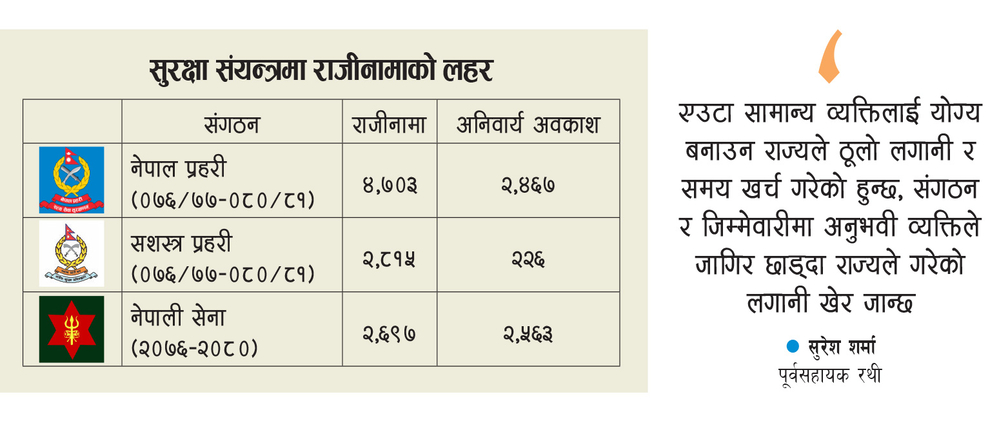
In 11 years, 7 thousand 942 people have resigned from the army job without getting pension. At the same time, the number of people leaving the Nepali Army due to various reasons, including compulsory retirement, is 6,597. During the period of 5 years, 10 thousand 215 people have resigned from Nepal Army, Nepal Police and Armed Police. The total number of compulsory retirement during this period is 5 thousand 256.
Constable is among the most resigned in Nepal Police. In five years, 1,964 constables have resigned. The number of resignations from assistant inspectors is 988. The others who resigned include 698 police constables, 398 deputy inspectors, 277 senior constables, 222 assistant constables, 229 office assistants, 43 inspectors and 36 senior deputy inspectors. Similarly, 15 Deputy Superintendents of Police, 6 Senior Superintendents of Police, 4 Superintendents of Police and 2 Deputy Inspector Generals of Police have also resigned in the meantime.
The maximum number of 1,365 senior constables in the armed police force has left the job. Similarly, 490 jawans and 236 police sub-inspectors have resigned in the last 5 years. Among others who resigned, 206 assistant constables, 154 constables, 143 police assistants, 27 inspectors, 13 deputy superintendents, 11 senior deputy inspectors and 6 superintendents of police have resigned. The Nepali Army did not provide detailed information.
In addition to mandatory retirement and resignation, some soldiers, police and armed police are separated from service due to cancellation of appointment, dismissal from service, disability retirement, death, etc. The number of resignations is much more than others. There are about 96,000 posts in the Nepal Army, about 80,000 in the Nepal Police and about 37,000 in the Armed Police.
Low-level police, armed forces and soldiers are more likely to leave jobs. They almost all have the same complaint – financial security. They say that it is difficult to support the family with the salary received amid rising inflation. Some people go for alternatives because of having to bear pressure from higher level officials, not getting leave easily when they want. There are also those who resign due to dissatisfaction with overtime duties and performance appraisals.
This is the reason why Krishna Lamichhane of Chitwan, who joined the police force in the year 2064, quit his job in the middle. I was a low-level employee. Sr. Hepthe. It was difficult to get leave when I needed it,” he said. Lamichhane left the police service and went abroad. Returning after two years, he is running a microbus business on the Kathmandu-Chitwan route. I am happy now. I got to be active in social work," he said.
Kumar Paudel, who is currently in Portugal after leaving the police job, says that he also left the job because of the state's neglect of the police. "The ordinary employees of the ward also get bikes and transport facilities, but there are not even good chairs in the office for the police," he said. 20-25 people have to sleep like sheep and goats in one room.
He said that he could not sleep for many nights because of the fear of floods during the rainy season. Although the job of the police is good, he feels that the respect for the profession is decreasing. "Economic needs and the search for a more dignified life also prompted me to fly abroad," said Paudel.
Although there is no government data, it has been found that people who quit their jobs from the lower levels of the army, police and armed forces often go for foreign employment. They are often recruited as security guards and police in various companies in Dubai, Afghanistan, Iraq, Singapore. Some have quit their jobs after winning the DV lottery.
At the upper level, the number of people resigning mostly due to 'reputation' is more. The then Deputy Inspector General of Police (DIG) Ramesh Kharel, who was angry after the appointment of Sarbendra Khanal as the Inspector General of Nepal Police, resigned in March 2074. Kharel was an inspector general aspirant.
Before that, in October 2074, another DIG Navraj Silwal also resigned due to age limit. His dissatisfaction was similar to Kharel's. Silwal was a candidate for Inspector General. After the government promoted Prakash Aryal, he gave Rajni.
Bam Bahadur Bhandari, the former AIG of Nepal Police, says that the number of people leaving the service has increased due to low salary/allowances, concerns about economic and social insecurity after retirement. "The salary and pension that comes from serving at the lower level does not provide financial security. Therefore, it is natural to leave this profession when there is a good opportunity," he said, "those who have trained here and served abroad are given priority." Spokesman of Nepal Police, Senior Superintendent of Police Vishwa Adhikari, some people consider it a normal process to resign in the middle. "When people get a good opportunity, they go after it," he said.
An internal circular was issued to stop the increase in the number of people quitting their jobs in the police force. In the letter, it was asked to identify the problem and create a working environment within the organization and to tighten the distribution of experience certificates, but it was not effective, police officials say.
Rathi Suresh Sharma, a former adjutant of the Nepali Army, says that the increase in the number of job losses has caused a huge loss to the organization and the state. The state spends a lot of time and investment to make a common person qualified. If a person who has experience in organization and responsibility leaves the job, it will have a big impact, the state's investment on him will be wasted," said Sharma.
In Nepal Police, recruitment was opened for 20 thousand 426 people for police constables and office assistants 5 times from 2075 to 2081 August 28. There were 323 thousand 663 applications. 44 thousand 161 people applied while 3 thousand 382 people applied for the technical group. 1 lakh 7 thousand 658 people applied out of 2 thousand 735 requests for district group.
From the financial year 2076/2077, there was a demand for 8 thousand 354 people including assistant inspectors, soldiers and attendants. 186 thousand 396 people applied for it. 29 thousand 969 applications were received out of 1 thousand 567 requests for authorized cadets from Nepali Army since 2076. 35 thousand 335 people were requested for the military, 37 thousand 19 people applied.

