Experts emphasize that Nepal-India relations should be strengthened not only economically but also socially and culturally
We use Google Cloud Translation Services. Google requires we provide the following disclaimer relating to use of this service:
This service may contain translations powered by Google. Google disclaims all warranties related to the translations, expressed or implied, including any warranties of accuracy, reliability, and any implied warranties of merchantability, fitness for a particular purpose, and noninfringement.
Experts have pointed out that it is essential to increase the partnership between India and Nepal in the economic development of the South Asian region. They emphasized on the need to make cooperation more effective in the fields of hydropower, tourism, information technology, fintech etc. to achieve the goal of sustainable development through a strong partnership between the two countries.
The speakers of the 'Nepal-India Economic Conference' held on Friday in the capital of India, New Delhi, said that concrete steps should be taken to implement the bilateral partnership in practice while making the South Asian regional cooperation more active.
In a conference jointly organized by Nepal Contemporary Studies Center under Kathmandu University and India's Foundation for Economic Growth and Welfare (Agro Foundation), experts emphasized that Nepal-India relations should be strengthened not only economically but also socially and culturally. It is said that the
conference will identify the possibilities of educational and regional cooperation between Nepal and India. Experts said that using studies and data from the educational sector can contribute to policy cooperation.
They say that Nepal-India relations should be developed as an exemplary concept for regional cooperation in South Asia. They emphasized that the economic, social and cultural relations between the two countries should be further strengthened as the India-Nepal Economic Conference provided an opportunity to deepen the cooperation between the two countries. The speakers have a common opinion that both countries should contribute equally to strengthen regional cooperation.
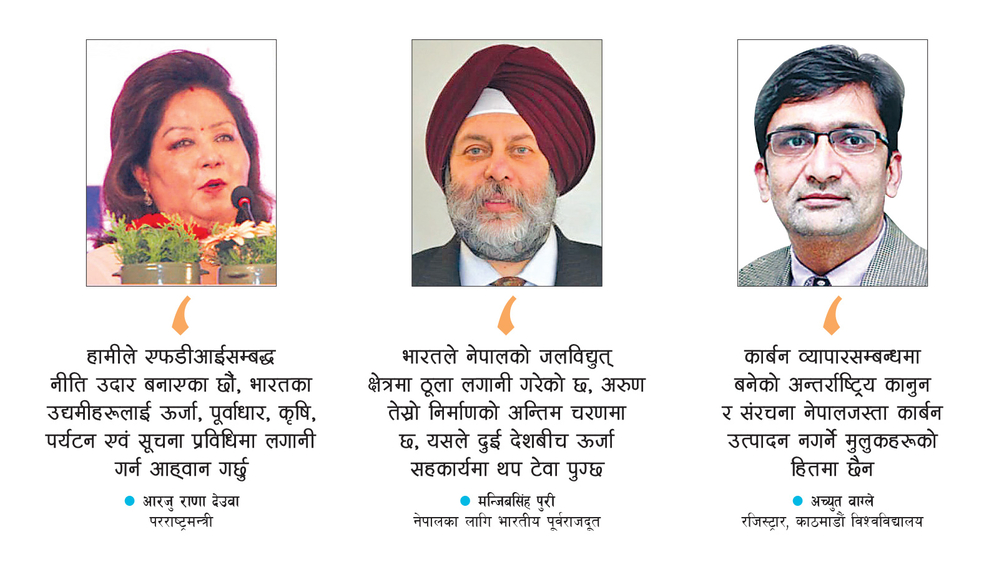
Foreign Minister Arju Rana Deuba urged Indian investors to expand investment in Nepal. Among the foreign direct investment (FDI) in Nepal, India has the largest number and she requested to expand more investment. He said that there is political stability in Nepal and the investment-friendly environment has improved, so it is easy to expand investment.
Nepal has liberalized its policy for foreign investment. I call on Indian entrepreneurs to invest in energy production, infrastructure development, agriculture, tourism and information technology,' said Foreign Minister Rana, 'I want to assure that investment in Nepal will be safe and it will give high returns.' She stated that she has implemented an incentive policy for domestic and foreign investment.
India's former ambassador to Nepal Lokraj Baral says that South Asian regional cooperation has decreased and regional organizations have become weak. SAARC is not able to achieve any concrete achievement. Even BIMSTEC has not made much progress. Although some projects have been identified under BIMSTEC, there is a situation where they have not been able to move forward," he said. "Nepal and India should promote regional cooperation."
Former Indian Ambassador to Nepal Manjib Singh Puri stressed that the cooperation between the two countries should go beyond politics and focus on economic and cultural partnership.
'Religious tourist sites of Nepal - such as Pashupatinath and Muktinath can become centers of attraction for religious tourists from India. But Nepal has not been able to advance it in a systematic manner," he said. "India is investing heavily in Nepal's hydropower sector. Arun third hydroelectric project is in the final stage of construction. This will further support the energy cooperation between the two countries.
He pointed out that both countries need to cooperate for climate change mitigation and green development.
Director of Egro Foundation of India Dr. Ashok Visandas said that this conference is important to promote regional unity and cooperation and not just limited to academic achievement. He claims that the role of the conference will be to provide suggestions on cooperation at the policy level for sustainable and inclusive development.
He expects important conclusions to be drawn about the possibility of cooperation in the fields of bilateral investment, infrastructure construction, trade, and tourism.
Egro's chief executive Dr. Charan Singh also mentioned that the economic conference between the two countries was organized for the first time and emphasized that priority should be given to cooperation, learning and teaching practices with the neighboring countries. He believes that the conference can play an important role in cooperation in the field of educational research.
India's finance ministry advisor Chanchal C. Sarkar says that there should be cooperation in the development of international payment systems and digital infrastructure. "There is a lot of potential for cooperation between the two countries for financial inclusion, startups and fintech," he said. Collaboration is essential especially for building digital infrastructure. There is considerable potential for collaboration in the areas of innovation (startups) and fintech. India is always ready for cooperation.'
For countries like Nepal, carbon trading is just a deception of developed countries, said Achyut Wagle, registrar of Kathmandu University. He claims that the international laws and structures created in relation to carbon trade are not in the interest of non-carbon producing countries like Nepal.
'Currently, the international rules and regulations of carbon trading are such that countries with developed and industrial structures are continuously polluting and only serving their interests of economic growth,' he said, 'developed countries should follow the international legal structure and calculation formula of carbon trading. It should be radically changed, a country like Nepal should not get caught in the trap of carbon trading.'
Professor Mahendra P Lama says that the same production and market structure between Nepal and India should be made the basis of cooperation. Pointing out the need to develop a joint transmission system by linking hydropower development to the regional market, he emphasized on the identification and development of new economic corridors. The young generation of Nepal-India is making progress in the field of information technology. It can be further promoted, said Lama.
Hydropower, information technology and religious tourism sectors have been identified but there is not enough investment in those sectors, said Pradyumna Prasad Upadhyay, joint secretary of the Investment Board of Nepal. He pointed out the possibility of attracting Indian investors in the construction of hotels and other infrastructure for the promotion of religious tourism.
He said that there is a possibility that Indian investors can invest in hotels and other infrastructure in the areas of Nepal that have good potential for religious tourism. He said that the Indian investment projects including Arun III, Lower Arun, Paschim Seti and SR Six, Upper Karnali, Dabur Nepal have progressed in Nepal.
Professor Rakesh Mohan Joshi, vice chancellor of the Indian Institute of Foreign Trade emphasized that a supply chain should be prepared from Mount Everest to Sagar. He says that both the countries should give importance to issues such as creation of value addition of goods, easy market access, removal of non-tax barriers.
After the beginning of federalism in Nepal, a formula-based financial transfer system was implemented in Nepal, according to Sushil Bhatt, the former chief executive officer of Investment Board Nepal.
In the initial stage, it was a challenging situation to effectively manage the grants down to the grassroots level. He said that in addition to preparing a web-based project registration system and regional development strategy, the process of creating a project bank is also challenging.
Bhatt mentioned that great preparations have been made to develop the project through the public-private partnership concept in Nepal. "Dhalkebar-Muzaffarpur transmission line has proved to be an important infrastructure for electricity trade between the two countries," he said, "construction of necessary infrastructure in the border area, development of international economic corridor and construction of Dodhara-Chandni dry port should be given priority."
The Chief Executive Officer of Nepal Tourism Board, Deepak Raj Joshi, said that although the private sector cooperation between Nepal and India is very good in relation to investment in Nepal's tourism sector, the cooperation between the two governments should be made more effective and effective.
'For the development and expansion of the tourism sector, a fruitful cooperation between Nepal and India is necessary to promote creativity and innovation,' he said, 'Nepal can become an excellent destination for adventure activities and weddings. Both countries can benefit from promoting tourism through a joint package including Lumbini, Karnali and Sudurpaschim of Nepal and five national parks of Uttar Pradesh and Ukhtarakhand Uddhav Pyakurel, associate professor of Kathmandu University, said that it is being looked at in connection with customs.
Raising the issue of illegal trade of betel nuts and bananas, he said that it is sad that such issues could be controlled through the cooperation of both countries. "Security challenges can be managed if people-to-people relations can be promoted between the two countries," he said.

