Saudi Arabia plans to hire three times as many workers by 2025
We use Google Cloud Translation Services. Google requires we provide the following disclaimer relating to use of this service:
This service may contain translations powered by Google. Google disclaims all warranties related to the translations, expressed or implied, including any warranties of accuracy, reliability, and any implied warranties of merchantability, fitness for a particular purpose, and noninfringement.
Saudi Arabia, the main destination of Nepali workers, has been given the responsibility by FIFA to host the Men's Football World Cup-2034 tournament to be held after 10 years. In a vote held at FIFA headquarters on Wednesday, Saudi Arabia alone was given the responsibility of hosting the World Cup.
FIFA's announcement that Saudi Arabia has been given responsibility for hosting the World Cup has not only brought joy to the citizens of that country. In that happiness, 1 crore 3.4 million immigrants who are working hard in the development of Saudi
workers are also connected. This number of migrant workers is 42 percent of the total population of Saudi Arabia, including 400,000 Nepali workers.
The World Cup is linked to Prime Minister Mohammed bin Salman's 2030 goal of establishing Saudi Arabia as the 'investment center of the world'. Commenting on this responsibility and opportunity as a historic achievement, Saudi Arabia has said that it will invest only 10 billion dollars for this project. In the assessment published by FIFA two weeks ago, Saudi Arabia's bid to host the World Cup was rated 4.2 out of 5, the highest in history. Regarding Saudi's proposal, FIFA said, 'This is a unique, innovative and ambitious approach for the next century.' Nepal should be able to take maximum advantage of this World Cup.
In the last 10 years, 1.3 million 52 thousand 800 Nepalis have worked in Saudi Arabia, including 1 million 11 thousand women. Even when the opportunities for foreign employment are decreasing after the covid, Saudi gave more opportunities and has been giving them. Last year alone, 148,000 Nepali workers, including 800 women, went to Saudi Arabia.
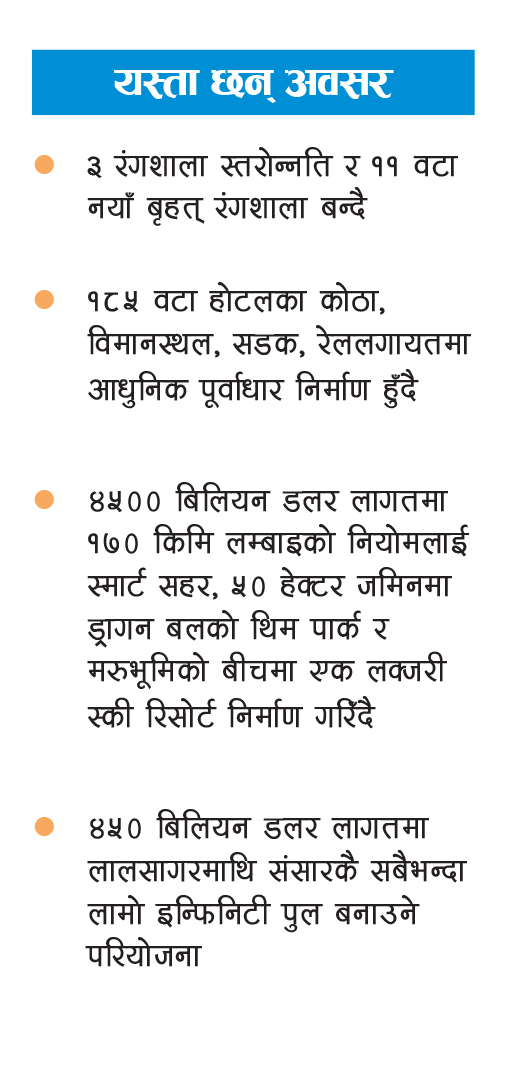
For the World Cup, Saudi Arabia has put forward a plan to upgrade three stadiums in its main cities, Riyadh, Jeddah, Al Khowar, Abha and Neom, and build 11 new large stadiums. Similarly, 185 hotel rooms, airports, roads, railways and other projects related to modern infrastructure have been announced.
Work has already begun on a massive national project aimed at the World Cup, including the construction of a 170-kilometer-long Neom smart city at a cost of $450 billion, a 50-hectare Dragon Ball theme park and a luxury ski resort in the middle of the desert.
Similarly, the project of building the world's longest infinity bridge over the Red Sea at a cost of 450 billion dollars has been launched. It is said that three times more workers will be hired for this project before 2025 than currently employed.
International human rights organizations have strongly criticized Saudi Arabia and FIFA for being given the responsibility of hosting the World Cup without meaningfully addressing issues related to the poor human rights and defense of migrant workers working in Saudi Arabia. Amnesty International, Human Rights Watch, Equidem, Fair Square and other organizations have said that the seriousness of human rights has been ignored.
'Before deciding on the World Cup host, FIFA should have carefully assessed the human rights situation in that country and the rights of workers working on the World Cup project and ensured a complete system of labor protection,' said Rameshwar Nepal, head of Equidem's research department, to Kantipur.  ; According to
workers, after entering Saudi Arabia, it is very difficult to return to the country unless the employer's permission is obtained. Saudi Arabia has not set a minimum wage for migrant workers. The minimum wage fixed at the time of hiring the worker and the salary coming into the account are different. Some employers are not providing proper salary and service facilities. Similarly, the workers are forced to go into debt as they have to bear all the costs of going to Saudi Arabia themselves. It is not easy for workers to not like the employer, want to leave, and have to return home. You need a 'release paper' to change the company according to your skills and abilities. Workers cannot change companies whenever they want.
Resham Chaudhary working in Dammam, Saudi Arabia, said that he had paid 150,000 rupees and reached Saudi Arabia. He was sent to a five-star hotel as a waiter, and here he was forced to labor outside in the sun. The minimum monthly salary was 1200 riyals and 300 riyals for food. Here, they only give 800 riyals for salary and 200 riyals for food," he said. "They didn't even work for the first three months. We eat in the mess, the food is not good.'
Saudi does not seem to take action against employers who do not produce identity cards. The employer company is not questioned as to why the notification that the laborer has run away i.e. 'Hurup' has been imposed. On the contrary, the workers are 'deported' by making them undocumented. It is very difficult to get an 'exit visa' for workers who are stamped, unstamped, identity cards not made and not renewed. It is difficult for unpaid workers to sit in the company's camp and fight a case against the company. "We don't have a visa, it's been 10 months since the expiry date. I have applied to the Nepalese embassy many times to get an exit permit to go to Nepal, but nothing has come yet," said Umesh Alye from Saptari, "We have gone to the labor court 16 times to get an exit permit. Not out yet. We are confused.
Human Rights Watch's latest report shows that the deceased workers and their families are not receiving compensation. According to the Foreign Employment Board, 3,793 Nepalis have died in Saudi Arabia in the last 16 years. Due to lack of insurance facilities, the families of 200 of them have not received compensation. Only about 100 people who have accidents at the workplace have received compensation through Gosi.
After continuous intervention by international human rights organizations, Qatar improved its labor sector until it was able to host the World Cup. Qatar has seen a series of improvements since the former ambassador to Qatar, Nardanath Bharadwaj, arrived on the eve of the World Cup. "Qatar has set a minimum wage for the first time in the Gulf, removed the requirement for an exit permit, made provision for changing employers," he said.
According to him, labor reforms can also be expected from Saudi Arabia. In Saudi Arabia, like in Qatar, there is pressure to ensure workers' rights as soon as possible. "The faster the laws are improved for the welfare of the workers, the easier it will be for the Saudi workers," he said.
According to Human Rights Watch's latest report, human rights organizations have suggested that Saudi Arabia remove the kafala system, determine the minimum wage for migrant workers, give them the opportunity to change employers, pay all the costs of workers, and arrange 24-hour insurance for workers.