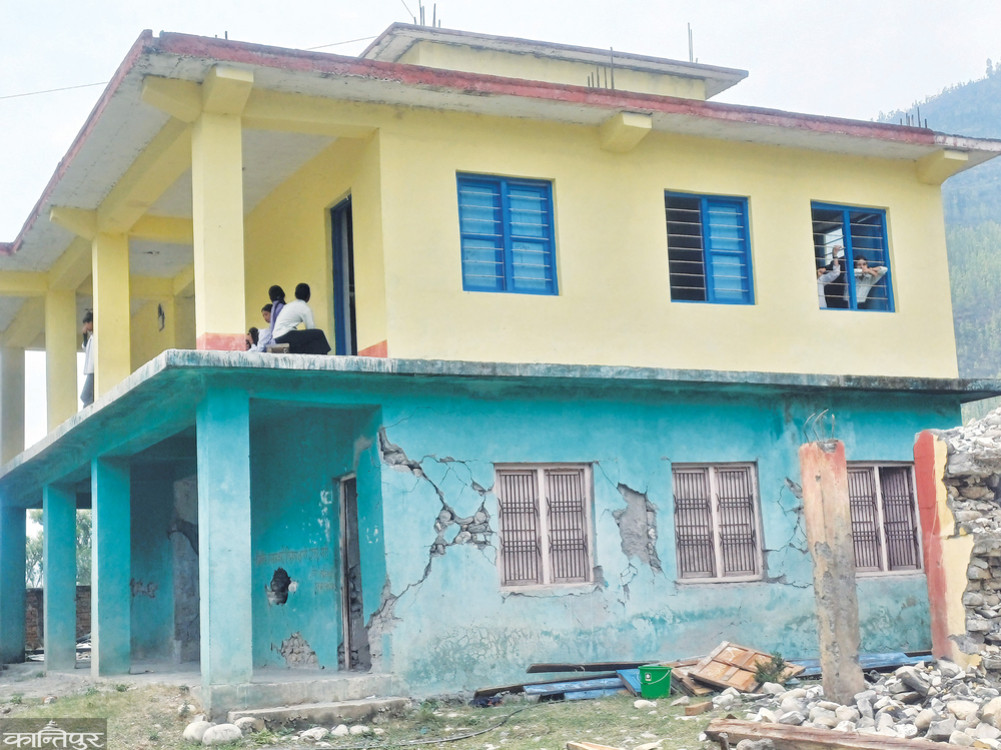
In Jajarkot, 143 schools were completely damaged and 296 were partially damaged, 192 schools were completely damaged and 509 were partially damaged in Rukum West and 42 schools were partially damaged in Salyan.
We use Google Cloud Translation Services. Google requires we provide the following disclaimer relating to use of this service:
This service may contain translations powered by Google. Google disclaims all warranties related to the translations, expressed or implied, including any warranties of accuracy, reliability, and any implied warranties of merchantability, fitness for a particular purpose, and noninfringement.
Last year on October 17, 2 buildings of Janapriya Basic School in Saniveri Rural Municipality-1 Bhandarwan in Rukum West were damaged due to the earthquake that passed through Ramidanda in Jajarkot. After the classrooms collapsed, a temporary tower was constructed there.
After the storm damaged the tower built for classes after the earthquake, the students have returned to the cracked building.
The principal of the school, La Rana Magar, says that he has to teach in a cracked room due to lack of classrooms. Students of four classes of the school are now studying in the cracked building. He said that the temporary roof will not work due to the wind.
Both students and teachers are uncomfortable while studying in a noisy room. For some time, the students were reluctant to enter the classroom. Now they have got used to it, but they still have a fear of earthquakes," said Principal Magar.
He told that since there is no place to hold all the students in the concrete building with only 6 rooms, they have to take the risk and teach in the rooms that are cracked. Even now, one class is being conducted in a temporary tower, Magar said. There are 182 students in this school, which teaches from Kindergarten to 8th grade.
4th grade students of Shankar Bhawan Mavi Bahunthan located in Bheri Municipality-2 of Jajarkot are also studying in the same building. Prof. Bhim Bahadur Chand said that the students of classes 9 and 10 and 1 and child development classes are sitting in crowded rooms due to lack of classrooms.
According to him, classes were conducted for some time in a two-room temporary structure built by volunteers from an organization in Kathmandu. However, he said that he returned to the cracked building as he could not live in the summer.
'The temporary learning center was made of tin. During the summer, the students started sweating profusely. Unable to live, we moved to a cracked building. Now we have made to store school supplies there," he said. A temporary learning center was constructed after 2 out of 3 buildings of this school were destroyed by the earthquake.
Prof. Chand said that other buildings were also damaged by the earthquake. Ganga Wali, who is studying class 9 at Shankar Bhavan Mavi Bahunthan, said she had to sit in the classroom in a wheelchair. "Whenever an earthquake comes, there is concern about whether it will collapse. The fear of the house collapsing has not gone away," she said. "The walls of the classroom are cracked. There is fear that it will collapse even with a small push.'
In Jajarkot, Rukum West and Salyan, the students of earthquake-affected areas are studying in cracked buildings. The temporary structures built by various organizations are dilapidated and there is no chance of rebuilding the building. Students of Rukum Paschim Saniveri-1 Sheetal Mavi in Pakraiya are also now back in the cracked rooms. Prof. Ved Kumar again says that it is not possible to build a new building.
'Initially, a temporary learning center was built out of plastic. Some time ago, the municipality has made it habitable by spending a little, he said, only 2 classes of students can be accommodated there. That's why we have been teaching from the cracked building.
He said that now the students of 5 classes have to be kept in the cracked building. He said that learning will not be effective as students will be mentally disturbed while living in cracked buildings. He said that 4 of the 6 buildings of the school were damaged by the earthquake.
According to the Ministry of Social Development of Karnali Province, 143 schools in Jajarkot have been completely damaged and 296 partially damaged due to the earthquake. Similarly, 192 schools in Rukum West have been completely damaged and 509 partially damaged. According to the ministry's data, 42 schools in Salyan have been partially damaged.
Prof. Sheetal Mavika Pun complains that the mood of the students as well as the teachers is scared when they have to teach in cracked buildings and classrooms. He said that due to the lack of classrooms, he had to take risks to teach. "There is no immediate resource to build a new building, the city has assured that it will be built by next year," Prof. Pun said, "until then, there is confusion as to how to conduct education."
Many classes have to be held in the same room in schools in earthquake-affected areas. Jayapradha Wali, a teacher, said that since most of the rooms were damaged in the earthquake, two/three classes had to be conducted in one room at Vishnu Basic School in Darneta, Jajarkot. According to him, classes from 3rd to 5th grade are being held in one room for a year.
Pragati Basic School at Saniveri-1 in Rukum West is also forced to run multiple classes. According to the school, students from 1 to 3 had to be kept in one room due to lack of classrooms. Even in Sheetal Mavi, teachers say that sometimes they are teaching from 1 to 3 and sometimes from 3 to 5 in one room.
When many classes are conducted in one room, students' attention is being focused on another class instead of studying. This is affecting learning, said teacher Wali.
The Karnali state government has just started the work of rebuilding the community schools and health institutions that were damaged by the earthquake. The Ministry of Physical and Urban Development of the state government allocated Rs 50 crore for the construction of schools and health institutions in Jajarkot, Rukum West and Salyan to be completed in the current financial year.
The Council of Ministers meeting held last October has also approved the Building Reconstruction Program (Operation and Management) Procedure, 2081 of earthquake-damaged schools and health institutions.
A provision has been made that the projects recommended by the Ministry and its subordinate Infrastructure Development Office at the local level will be implemented based on the recommendations of the district.
The members of the recommendation committee under the coordination of the district coordination committee chief are the chief district officer, head of education development and coordination unit, head of social development office, head of health unit office, head of housing and building branch.
The said committee has already submitted the data of schools and health buildings that need to be rebuilt to the ministry. Ministry spokesperson Senior Division Engineer Ramesh Subedi said that the ministry is working on it.
According to him, a proposal came from Salyan for the construction of 42 structures including health institutions and schools. The recommendation committee has selected 5 names based on priority. Out of 120 names of organizations proposed from Rukum West, the committee has selected only 33.
Out of 46 proposals received from Jajarkot, the committee selected 39 and submitted them to the ministry. Spokesman Subedi said that due to the lack of buildings, regular education and health services have been hindered, and schools and health institutions identified by the District Disaster Management Committee as needing reconstruction, have been selected from the respective districts for the reconstruction of schools and health institutions.
The cost of the proposed project should be equal to a maximum of Rs. 75 lakh in the case of schools and Rs. 50 lakh in the case of health. In which 25 crores have been allocated for Jajarkot, 220 crores for Rukum West and 30 crores for Salyan.
The Ministry of Education, Science and Technology has also said that it will work on the basis of priority after looking at the condition of the school structure. A central project implementation unit has been formed under the ministry for building construction. Although some donor agencies have signed an agreement to build school buildings, the construction work has not progressed.