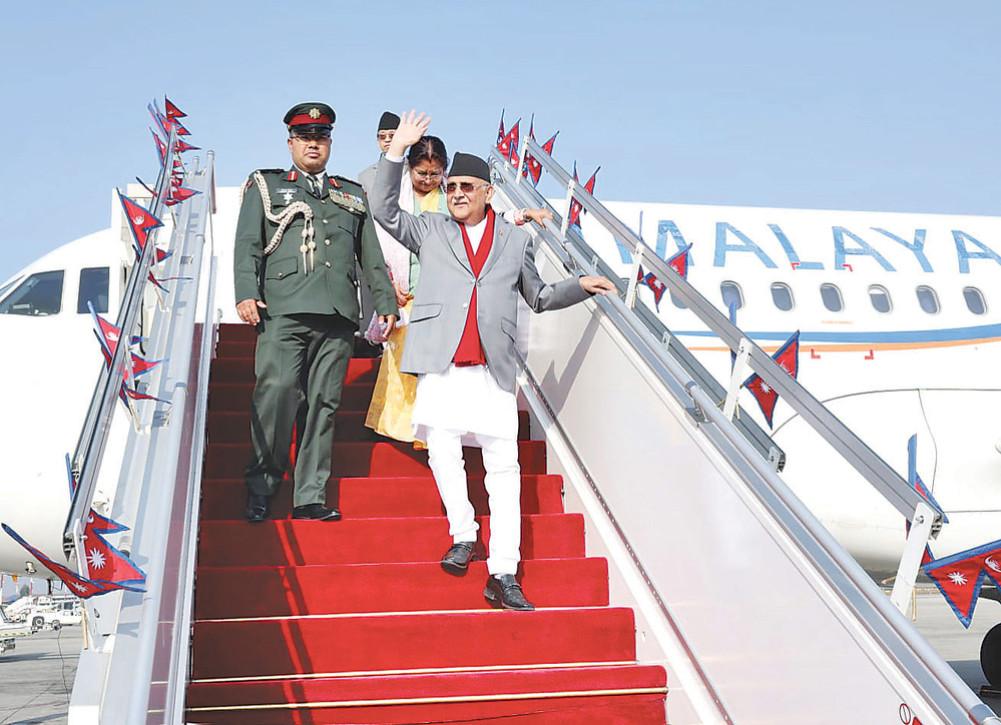
The Prime Minister says: There is no loan agreement, all the grants Nepal gets under BRI.
We use Google Cloud Translation Services. Google requires we provide the following disclaimer relating to use of this service:
This service may contain translations powered by Google. Google disclaims all warranties related to the translations, expressed or implied, including any warranties of accuracy, reliability, and any implied warranties of merchantability, fitness for a particular purpose, and noninfringement.
Prime Minister KP Sharma Oli, who was excited about his visit to China, has returned with a load of doubts and mistrust. Commentary on the BRI agreement with China has already started during the visit.
That's why Prime Minister Oli, upon landing at Tribhuvan International Airport on Thursday, made a statement that there was no mention of debt in the agreement with China.
There has been a ripple within the ruling Congress over the 'Belt and Road Cooperation Framework' signed in Beijing on Wednesday. Before Prime Minister Oli's visit, some Congress leaders are reacting to the agreement reached with China by 'amending' the common understanding between the two ruling parties. After returning from China, Oli also discussed the agreement with Congress leaders in Baluwatar.
introduction.
Prime Minister Oli had a discussion with the Congress leaders on Thursday evening after the meeting of the political mechanism chaired by Congress Vice Chairman Purna Bahadur Khadka was over. Oli was not present at the mechanism meeting.
The meeting of the mechanism which was called to discuss the program related to economic reform ended in one sitting. After the meeting, Prime Minister Oli had a discussion with Congress Chairman Sher Bahadur Deuba, Deputy Chairman Khadka, Congress leader and Home Minister Ramesh Ulak.
According to a leader, although it was said to discuss the formation of a commission on transitional justice, most of the time discussed with Prime Minister Oli was about visiting China. It is seen that it will become complicated when the confidants of Chairman Deuba in the Congress started raising questions about the agreement on the 'Belt and Road Cooperation Framework', which can have both loans and grants.
Prime Minister Oli left for China on Monday with the common agreement of the two ruling parties to sign a cooperation framework to accept only grant-based projects. But the Chinese side was not ready to sign the grant-based project.
Prime Minister Oli consulted Foreign Minister Rana, who was on a visit, and Congress President Deuba, who was in Kathmandu, and it was agreed to keep the terminology 'Technical Support and Aid Financing Modality' as per China's proposal. Some leaders of the Congress are expressing their displeasure that ``ad financing modality'', which means both loans and grants, has been mentioned.
Former foreign ministers NP Saud, Prakasharan Mahat and other Congress leaders are among those expressing dissatisfaction. Congress Chairman Deuba and most of the office bearers are in favor of not holding it hostage to further provoke China. The agreement was signed with the consent of the Congress.
"The matter should not be made more complicated by interpreting Aid as a loan," said a Congress official, "Aid is given by the rich to the poor." The explanation that ed is debt is wrong. It is our choice whether to take a concessional loan or not. The document signed now is much more advanced than the proposal sent by China at the beginning.''
The document was signed by Amrit Rai, Permanent Secretary of the Ministry of Foreign Affairs on behalf of Nepal, and Liu Susey, Vice President of the National Development and Reform Commission, on behalf of China. Leaders of the Left Party have given a positive response to the agreement with China.
The UML leaders agreed to grant grants in the present situation and take loans at cheaper interest rates than others if needed in the future
revealed. Former Foreign Minister Vimala Rai Paudyal said that the agreement was a 'break-through' to advance BRI, which had been stuck in Nepal for a long time. "The door of BRI is open in Nepal, immediate grant and in the future, you can get a loan at a cheaper interest rate than others," she said.
Rupak Sapkota, who is the foreign affairs adviser to former Prime Minister and Chairman of the Maoist Center Pushpa Kamal Dahal, said that the signing of the cooperation framework to advance the BRI project is an achievement. He says that by keeping the terminology of
financial aid, it can be taken correctly that there can be cooperation in grants and loans. The Prime Minister and Congress leaders have different views on BRI. But the issue of advancing BRI should be taken correctly, he said, but there is a challenge in the implementation of the BRI project due to the ideological trends of political parties and geo-political pressure. BRI project cannot be implemented without agreement between political parties.'
Congress leader and former foreign minister Saud said that it was wrong to sign the decision to take a loan after the party decided to take only the subsidy.
He said, "Congress had already made a clear decision to advance the BRI cooperation framework of Congress." We said we only accept grants. But it is not right to sign like this against the decision of the party.''
Former Foreign Minister Saud has also suspected that the agreement reached in Beijing will increase the geo-political complexity. This has influenced the non-aligned foreign policy being adopted by Congress and Nepal. In the current geo-political situation, it is also important how such a decision will affect Nepal," he added, "We will discuss this issue within the Congress. It should not have gone outside the party's decision.'
Saud has said that even the agreement/understanding with China is not proper to recognize that even the projects before Nepal signed in 2017 are under BRI.
Congress central member Gobind Pokharel commented that it is immature to make a common opinion and compromise on another matter.
The largest party in the Parliament should decide after sufficient discussion, paying attention to the impact and dimensions that may result from it. After making a decision, you should be able to stick to it," he said. "The way the BRI was signed so that even concessional loans can be taken, it has shown the immaturity of the Congress' stand. This has become a serious matter. There should be a discussion within the party.'
The Congress had made a decision that only grants could be accepted within the 'BRI framework'. A week before Prime Minister Oli's visit to China, there was a long tug-of-war between the two parties about whether to accept both loans and grants in BRI or only grants.
According to the decision of the party, a leader said that Prime Minister Oli expressed his anger on the document initially sent by the Congress. After that, a meeting of top leaders including Congress officials was held and the proposal sent by the Chinese side was amended and a second written document was prepared and submitted to the Prime Minister.
Accordingly, after a long discussion between the two parties, a joint document was prepared to replace the 'BRI Implementation Plan' with the 'Framework for Belt and Road Cooperation' and only accept grant-based plans. It included a list of a dozen projects.
Since the positive signal from the Chinese official in Kathmandu has been received, the Council of Ministers approved the signing of the document which has a common agreement between the two parties. A Congress official said that although some leaders are dissatisfied with the BRI agreement with China, it will not bring down the power alliance.
Prime Minister Oli claimed that the issue of borrowing in the BRI project is not in the agreement. He also said that the agreement does not deal with debt.
I said we are not going to take any loan. There is no borrowing. This time we have talked about various projects under BRI," Oli said to mediapersons at Tribhuvan Airport. What we have received now is not a loan.'
Prime Minister Oli also said that according to the agreement made under the BRI, all the funds that Nepal will receive will be subsidized. Where does debt come from? Always loan, loan, loan! Why is the fiddle ringing the debt? We have said no many times,' he said, 'I request you not to repeat it again.' He said that far-reaching development projects have been taken forward even under BRI, keeping national interests and sovereign power at the center. "The visit has been as we wanted," he said.
Nepal's former ambassador to China Rajeshwar Acharya mentioned that loans and grants have been politicized in Nepal. But finally the cooperation framework has been signed. This can be taken as an achievement of the Prime Minister's visit,'' he said, 'but Nepal will not act on the sidelines of China, a country that competes with the US, and India, which is becoming the third economic power.'