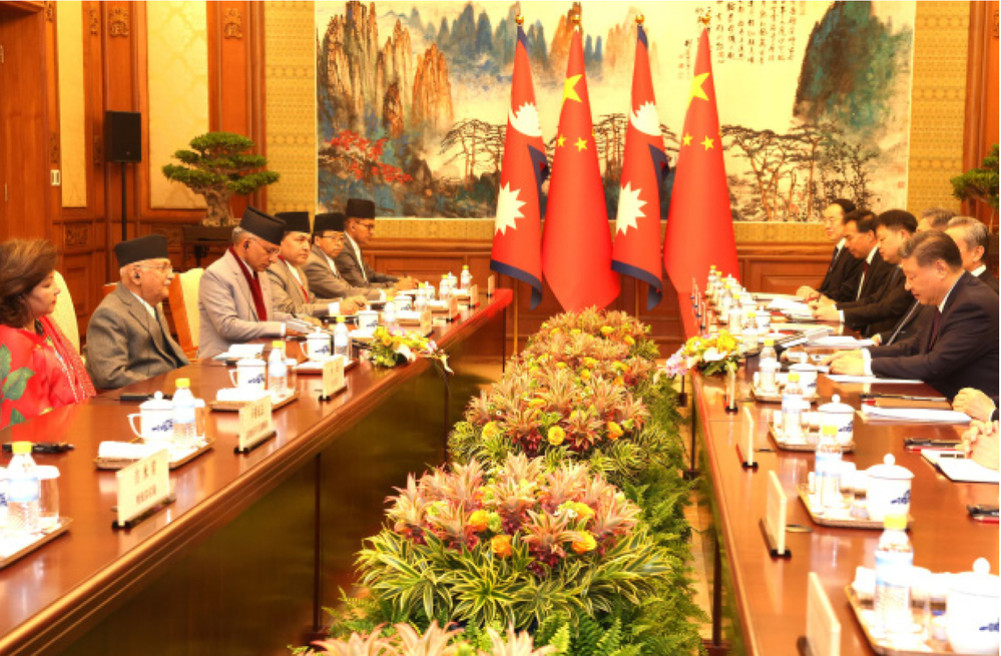
In the BRI agenda, Nepal sent a proposal for cooperation on 'grant', but China prepared a proposal that would be 'cooperation', the Nepalese side disagreed saying that 'cooperation' does not mean grant or loan, so the BRI could not be signed.
We use Google Cloud Translation Services. Google requires we provide the following disclaimer relating to use of this service:
This service may contain translations powered by Google. Google disclaims all warranties related to the translations, expressed or implied, including any warranties of accuracy, reliability, and any implied warranties of merchantability, fitness for a particular purpose, and noninfringement.
During Prime Minister KP Sharma Oli's visit to China, the 'Belt and Road Initiative' (BRI) cooperation document could not be signed. While before the start of the visit, there was an exchange of happiness between the ruling Congress and UML on the document related to BRI cooperation.
After the Chinese side disagreed at the last moment with Nepal's proposal to receive only subsidies under the BRI, the memorandum of understanding of the proposed 'Framework' could not be signed.
As the Chinese side disagreed to sign the 'framework' proposal prepared by the Nepali side BRI has not been signed. However, after the bilateral talks between Prime Minister Oli and Chinese Prime Minister Li Qiang, 9 agreements and memorandums of understanding have been signed in Nepal. According to the Nepali officials, the final exercise of signing the documents related to the implementation of BRI is still going on during the visit, which will continue until Thursday.
The Chinese authorities were interested in the documents related to the framework sent by Nepal. But the document prepared by us could not be signed after the Chinese side rewrote it," said a Nepalese official involved in the visit. "China is trying to negotiate and agree on the removed words and sign it during this visit."
According to that official, the project under BRI could not be signed due to the words related to the loan or grant.
In the draft prepared by showing the Chinese side after an agreement between Congress and UML, it was called 'Grant Financing Cooperation Modality'. It means grant-based assistance only," said the official, "but on Tuesday, the day it was supposed to be signed, they sent the draft by removing the word grant and mentioning only ``Instant Financing Modality''. Thinking that it means anything, loans and grants, we disagreed and asked to sign the agreement by adding the words 'Ad Assent Financing.' .
After that, officials involved in the visit said informally that it was said to be kept in the 'Framework on Belt and Road Cooperation' document and other new projects were created and agreements were signed. However, we are still trying to sign the framework. Our proposal is that the foreign secretaries of the two countries should sign on Wednesday," said the official, adding, "The Chinese side has sent a message that they are positive. The possibility of signing on Wednesday during the Prime Minister's visit has not been ruled out. There is also a possibility that both countries will mention the commitment that the signing will take place in the near future.
Experts point to this confusion as Nepal's weakness. Rajeshwar Acharya, Nepal's former ambassador to China, said that this result was due to politicization between sides and opposition before the visit.
'The issue of BRI was politicized by making speeches for and against, that was not right. Other countries do not take such important issues for granted, China should not take them for granted," he said. "It is necessary to pay attention when dealing with China. Because China's speech has meaning, even not speaking has meaning.'
Former Prime Minister Pushpa Kamal Dahal's Foreign Affairs Adviser Rupak Sapkota also commented that the serious issues of foreign affairs are the result of making noise at the social level.
The topic of 'loans or grants' became more popular. Which wasn't right. The prime minister had a month to decide what to do with China. But the BRI draft was finalized only on Friday evening, three days before the visit," he said. "After two days of vacation in China, they could see it only on Monday. Nepal's weakness is not to prepare on time for necessary issues.
Soon after Prime Minister Oli's visit to China was decided, experts and political parties in Nepal were polarized on BRI, loans and grants. In particular, the Congress had taken the stand that documents related to BRI should not be signed and if signed, only subsidies should be taken. China had sent a proposal of 'BRI Implementation Action Plan' to Nepal along with the loan.
Congress General Minister Gagan Thapa, Prime Minister's Chief Adviser and UML Deputy General Secretary Bishnu Rimal and Prime Minister's Economic and Development Adviser Yuvraj Khatiwada did their homework to reach agreement on the proposal sent by China and Nepal's interests. After several discussions with the officials of the Chinese Embassy in Nepal and Congress-UML leaders, an agreement was reached to sign the BRI 'Framework' based on grants.
After a long tug-of-war, instead of the title of 'BRI Implementation Action Plan' proposed by China, a common opinion was decided to make an agreement under the name of 'Framework on Belt and Road Cooperation'.
Foreign Minister Arju Rana Deuba, who was on a visit to China last week, informed the Chinese officials about the common perception and the words to be mentioned in it. According to a government official close to the Prime Minister, the leaders of the two parties, the Prime Minister and Congress Chairman Sher Bahadur Deuba, were excited to reach an agreement when the Chinese side also agreed After understanding the signal from the Chinese side, the Prime Minister made a public statement that there will be no loan agreement with China. "Looking at the background, there is no reason why there should not be an agreement on the BRI framework," he said.
12-point joint statement of Nepal-China
After Prime Minister Oli met with the Chinese Prime Minister and the President, Nepal and China issued a joint statement . It is mentioned in the statement that there was a conversation between the leaders of Nepal and China in a cordial and friendly atmosphere to strengthen and deepen the relationship between the two countries. In addition, it is also mentioned that international and regional issues of mutual interest were deeply discussed and a broad consensus was reached. In the
statement, it is mentioned that the 70th anniversary of the establishment of diplomatic relations between China and Nepal in 2025 has been discussed in detail by both sides.
"Both sides are ready to take advantage of this opportunity to further accelerate the implementation of the important common understanding between the leaders of the two countries, to maintain high-level exchanges, to strengthen political mutual trust and to deepen and expand cooperation for mutual benefit in various fields," in a joint statement. It has been said.
Both sides have re-committed their firm support to each other on issues involving their core interests and major concerns.
Referring to UN General Assembly resolution 2758, Nepal's government of China is the only legal government representing the whole of China. And, recognizing that Taiwan is an inalienable part of China's territory, reaffirmed its firm commitment to the One China Principle," the statement said. The Nepali side has reiterated that the Sijang issue is an internal matter of China and that no separatist activities against China will be allowed on Nepal's soil.
The Chinese side has praised the Nepalese government for its efforts to maintain political stability and promote economic and social development. In addition, it is mentioned in the joint statement that China wishes that the national aspiration of the Nepali people of 'Prosperous Nepal, Happy Nepali' will be realized soon.
Both sides have mentioned that they are ready to continue close bilateral engagement between the government, political parties, legislature and all spheres of life and exchange experience in good governance. In the statement, both sides praised the initiative to implement the agreement on the translation and publication of important historical books.
Both parties have agreed to ensure the timely and speedy implementation of the agreements, agreements and decisions made to carry out programs, projects and activities jointly run by the two countries. In order to transform Nepal from a landlocked country to a landlocked country, he has expressed commitment to strengthen connectivity between the two countries in areas such as ports, roads, railways, aviation, power grid and telecommunications.
It is mentioned in the statement that they have agreed to jointly advance the fourth phase of Araniko highway maintenance project, Hilsa-Simkot road project, implement the second phase of Kathmandu ring road improvement project and welcome the signing of the exchange letter with the help of China.
Tokha-Chhare tunnel has been approved for feasibility study and Syafrabensi-Rasuwagadhi highway maintenance project has been approved, both sides have agreed to remove the obstacles on the road and speed up the subsequent construction work. The statement states that these projects will increase the level of connectivity between the two countries.
Both sides have agreed to study the feasibility of China's cooperation in the development of three North-South corridors namely Koshi Economic Corridor, Gandaki Economic Corridor and Karnali Economic Corridor. Both sides agreed to strengthen the development of border ports, facilitate customs clearance and two-way travel, promote bilateral economic and trade cooperation, and promote the social and economic development of border areas.
"Both sides appreciated the smooth and orderly operation of Geelong/Kerung-Rasuwagadhi Port, Zhangmu-Kodari Port, Pulan-Yari Port and Liji-Nechung (Korla, Mustang) Port," the statement said. 14 which are important to promote trade and facilitate the livelihood of border dwellers of both countries He has welcomed the normal operation of the traditional China-Nepal border trade point.' It is mentioned that the Chinese side will facilitate the construction of an 'Inland Clearance' depot and an integrated check post with the help of China in Korla, Mustang.
Both sides have expressed their desire to continue the feasibility study of the Geelong-Kerung-Kathmandu cross-border railway. And, they have planned to organize the ninth working meeting with China-Nepal railway cooperation. It is mentioned that the Chinese side will continue to support Nepal in training those who work in the railway sector.
"Both sides appreciate the development of civil aviation relations between China and Nepal and support and encourage air transport enterprises of both sides to open air routes and flights between Chinese and Nepali cities such as Pokhara and Lumbini, keeping in mind the market demand. It will facilitate bilateral economic and trade relations and bilateral travel," the statement said.
Both sides will continue the platform of China-Nepal Energy Joint Implementation Mechanism, deepen cooperation in the energy sector and explore exchanges in new energy, it is mentioned in the statement.
It has been mentioned that both parties are ready to accelerate the feasibility study of Geelong-Kerung-Rasuwagadhi-Chilime 220 kV cross border power transmission line with the help of China. Both sides agreed to continue cooperation between telecommunication operators of the two countries and undertake maintenance and expansion projects related to cross-border land cables. In the
statement, the Nepali side has requested the Chinese side to further develop the Madan Bhandari University of Science and Technology and construct a sports stadium in Damak in Jhapa and a sports stadium in the Amargarhi City Hall Complex in Dadeldhura.
To promote common development, the two sides agreed to deepen practical cooperation in areas such as economy and trade, connectivity, infrastructure, investment, agriculture, industry, health, disaster relief and poverty alleviation.
The two sides have agreed to sign the China-Nepal Friendly Industry Park project development agreement as soon as possible and promote the initial work of construction and operation.
The Nepali side has praised China for giving zero tariff treatment to Nepal at 100 percent customs border. China welcomes Nepal to further expand the export of high-quality agricultural products such as Nepali grass, plant-based medicinal materials and tea, the statement said.
Both sides have agreed to intensify cooperation in agriculture, animal husbandry and fisheries between the two countries. Both sides agreed to strengthen exchanges and cooperation in the fields of forestry, wildlife conservation and biodiversity conservation and to convene the fifth meeting of the China-Nepal Forestry Working Group at an appropriate time.
The two sides have agreed to continue strengthening health and medical cooperation and to speed up the Bone Marrow Transplant Service Project with Chinese assistance at the BP Koirala Memorial Cancer Hospital in Nepal.
'Both parties will fully utilize China-aided hospitals in Nepal and support the Chinese medical team to establish a new medical service point at the Civil Service Hospital, Kathmandu. Both parties have also agreed to study the establishment of a new Kar-T cell laboratory with Chinese support at the Civil Service Hospital in Kathmandu for the treatment of cancer patients,'' the joint statement said, 'Both parties to renew the agreement on traditional medicine cooperation, establish the China-Nepal Traditional Medicine Cooperation Commission. and to provide free treatment, staff training and medical services in Nepal, China-Nepal has agreed to continue supporting traditional Chinese medicine center The Nepali side has praised the Chinese side for providing disaster relief. The Nepali side is ready to further strengthen cooperation with China in emergency management, disaster prevention, mitigation and relief by exchanging knowledge, information, technology and skills between the two countries.
The Chinese side will advance the technical assistance project on the information platform of the National Emergency Operation Center in Nepal and will make full use of the earthquake monitoring network project with China's support. Both sides have agreed to speed up the implementation of post-earthquake reconstruction projects. The
statement stated that both sides are ready to further expand exchanges and cooperation with a focus on poverty alleviation, development, livelihood improvement and rural revitalization. China is ready to assist Nepal in enhancing the capacity of workers in relevant fields, continuing poverty reduction demonstration projects, and improving people's livelihoods.
China-Nepal border has been demarcated for a long time and both sides are of the view that it acts as a bridge of friendship between the two countries. "Both sides agreed to jointly inspect the China-Nepal border and work for the early implementation of the China-Nepal border management system agreement," the statement said, "to establish a three-level border communication system to raise the level of border management and cooperation between the two countries." Both sides have agreed to continue consultations on the protocol.
China has stated that it is willing to provide assistance to Nepal according to its capabilities through training and assistance in police supplies. China welcomed the promotion activities of Visit Nepal Year 2025 in China and encouraged more Chinese tourists to visit Nepal, the statement said.
The two sides will continue the China Culture Center, Confucius Institute and Confucius Reading Classes in Nepal to promote cultural exchange and cooperation and support Chinese language education in Nepal. It has been said in the statement that China will welcome and encourage more excellent Nepalese students to study in China.