Prime Minister's preference for China's proposal to cooperate in at least four projects under BRI, plan and implementation agreement
We use Google Cloud Translation Services. Google requires we provide the following disclaimer relating to use of this service:
This service may contain translations powered by Google. Google disclaims all warranties related to the translations, expressed or implied, including any warranties of accuracy, reliability, and any implied warranties of merchantability, fitness for a particular purpose, and noninfringement.
The ruling Congress and UML have started discussions to set the agenda for Prime Minister KP Sharma Oli's upcoming visit to China. The Chinese side wants to give priority to the signing of the agreement on the "Belt and Road Initiative (BRI)" implementation plan during this visit, but there is no consensus between the ruling Congress and the UML.
According to foreign ministry sources, the Chinese side has already sent a proposal a few days ago with the desire to assist in at least four projects under the BRI. China has proposed to invest in Tokha-Khare tunnel, Rasuwagadhi-Kathmandu road upgrading, dry port at Korla crossing and a hydropower project. Prime Minister Oli is preparing to move forward by adding some projects with the request of canceling the loan for the construction of Pokhara Airport.
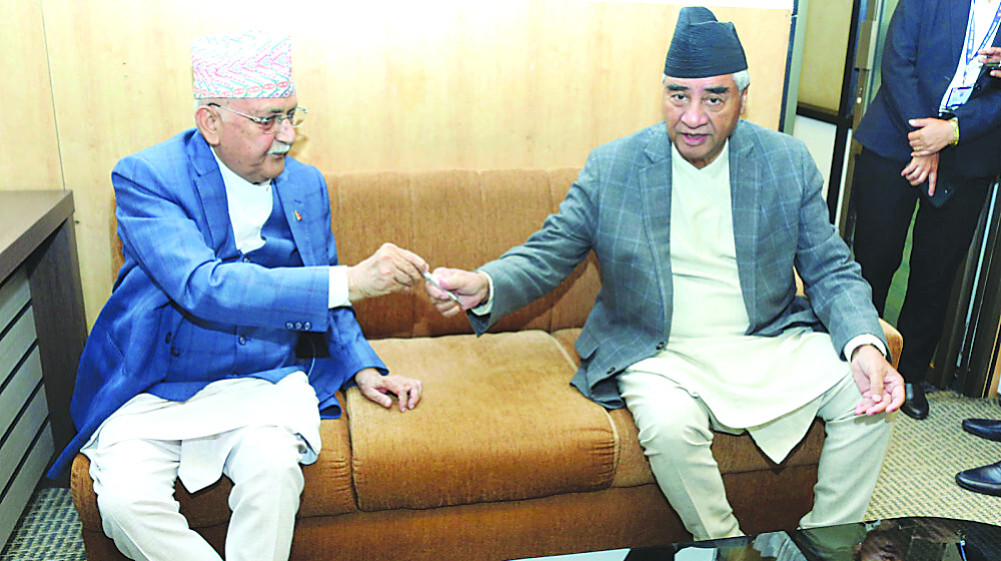
Prime Minister Oli discussed the proposal made by the Chinese side and the plan to be added by the Nepali side with the Congress leaders until late on Tuesday night. According to a leader of UML, Prime Minister Oli wants to move forward only by establishing an understanding with the ruling party Congress regarding BRI. "The Chinese side wants to proceed with the project only after signing the agreement on the BRI implementation plan, but the argument of the Congress is that the project can be proceeded without signing the implementation plan agreement," said the leader.
 While the Congress government was in power, the government led by Maoist President Pushpa Kamal Dahal had signed an agreement on BRI in 2017. After that, the Congress has taken an institutional decision that only subsidy schemes can be carried forward under BRI. Stating that other countries are moving forward with projects under BRI without signing the implementation plan, Congress President Sher Bahadur Deuba has been of the opinion that it would be better if Nepal also adopts the same 'model'.
According to Baluwatar sources, Prime Minister Oli is of the opinion that signing the implementation plan does not matter. "But the Congress leaders are saying that they can go ahead with the grant scheme under BRI without signing the implementation agreement," said the source, adding, "Some disagreements will be discussed again." Probably the next cabinet meeting will pass the agenda.'
An official of the Congress claimed that Prime Minister Oli will visit China only after maintaining a high level of understanding. "We can establish an understanding by discussing all aspects of the agenda, moving forward with what is agreed upon, and keeping the issues that are not agreed on for now," he said. He informed that the agenda of the Prime Minister's visit to China was also discussed in Baluwatar on Tuesday.
Prime Minister Oli called Tuesday's meeting through the two-party political 'mechanism' that was formed two weeks ago. Chairman Deuba, General Minister Gagan Kumar Thapa and Foreign Minister Arju Rana Deuba were present on behalf of the Congress, Deputy Prime Minister and Finance Minister Bishnu Paudel who is also the party vice president from UML along with Oli participated.
China has invited Prime Minister Oli to visit on December 2-5 (November 17-20). Although the government has not made a formal decision, China is preparing to visit on the date called. Oli received a visit invitation from China after he was appointed as the Prime Minister last June. This is the first invitation for Oli to visit abroad after becoming the Prime Minister for the fourth time. According to an official of the Ministry of Foreign Affairs, he was asked to make an official visit in the second week of October. However, Prime Minister Oli was scheduled to go to America to participate in the 79th General Assembly of the United Nations, so he could not visit China. Why is
complicated BRI?
In 2013, after becoming the President of China, Xi Jinping announced the 'One Belt One Road (OBOR)'. He said that it aims to strengthen China's relations with the world. In 2015, Xi renamed 'OBOR' as 'Belt and Road Initiative (BRI)'.
According to China, the BRI is Beijing's main international cooperation and economic strategy. China has said that it will work in the areas of connectivity, trade and economic growth. Within that, China works in the fields of airports, ports, power plants, railways, roads, bridges and information technology. According to Chinese government media, the BRI project has been carried forward in 138 countries, mainly in South, Southeast and Central Asia, Africa and the Middle East. 147 countries including Nepal are members of BRI.
Although it is said to be a strategy of developing road infrastructure connecting Central Asia to Europe by reviving the 'Silk Road' and connecting Africa, Latin America and other territories by sea, the definition of BRI seems different in the context of Nepal. Chinese Ambassador to Nepal Chen Song claims that BRI is not a geopolitical tool. In the BRI program organized by Friends of Silk Road Nepal on March 2, he said, 'BRI is completely open, inclusive and transparent. It is being misconstrued as a debt trap, which is wrong. BRI is for cooperation. It is not any geopolitical tool. BRI is expected to create a favorable environment for Chinese investment in Nepal.
Under the concept of BRI, the Memorandum of Understanding (MoU) on bilateral cooperation was signed between Nepal and China on May 12, 2017. So far no project under BRI has been started in Nepal. When Oli visited China in 2019 as the Prime Minister, he presented a list of 35 projects under the BRI project. But Beijing reduced the number to one digit and 9 projects were submitted to the Chinese side.
The 9 projects proposed by Nepal include Kerung-Kathmandu railway feasibility study, Rasuwagadhi-Kathmandu road upgrading, Kimathanka-Line road construction, Dipayal to Chinese border road, Tokha-Vidur road, Galchi-Rasuwagadhi-Kerung 400 KV transmission line, Tamor hydropower project. (756 MW), Phukot Karnali Hydro Project (480 MW) and Madan Bhandari University. Among these, an agreement has been made with Fukot Karnali Indian Company. When the then Prime Minister Pushpa Kamal Dahal visited China last year, an agreement was reached to revise the Galchi-Rasuwagadhi-Kerung 400 KV transmission line and reduce it to 220 KV. Currently, only the pre-feasibility study of the railway is being done.
Recently, China has been asking Nepal to sign an implementation plan to advance the BRI. However, due to Nepal's internal politics, it has not been signed yet. Especially between the ruling party UML and Congress, there is a different understanding about BRI.
During the then Prime Minister Pushpa Kamal Dahal's visit to China in September 2023, preparations were made to finalize the 'BRI Program Implementation Plan'. However, the agreement process was blocked when the then foreign minister NP Saud said that there should be a discussion between the planning commissions of the two countries to prepare the document. In the joint statement issued during Dahal's visit, it was mentioned that the two countries will soon sign the BRI implementation plan agreement.
In the meeting of the 16th Foreign Secretary-level Diplomatic Consultative Mechanism held in Kathmandu on June 11, homework was done to clear up the confusion of the 'BRI Program Implementation Plan'. However, the then Prime Minister Pushpa Kamal Dahal blocked the proposal sent by the Ministry of Foreign Affairs under the leadership of Narayankaji Shrestha of his own party. At that time there was a Maoist and Congress government. The foreign source said that the Nepali side stopped the proposal saying that more studies were needed at that time. The Chinese side is constantly pushing for the implementation of BRI. The Chinese used to bring up the BRI plan implementation agreement in every meeting. They kept asking when it would happen,” a former ambassador to China told Kantipur. In Nepal, the question of whether the project should be completed or not is being raised when the implementation plan is agreed upon.
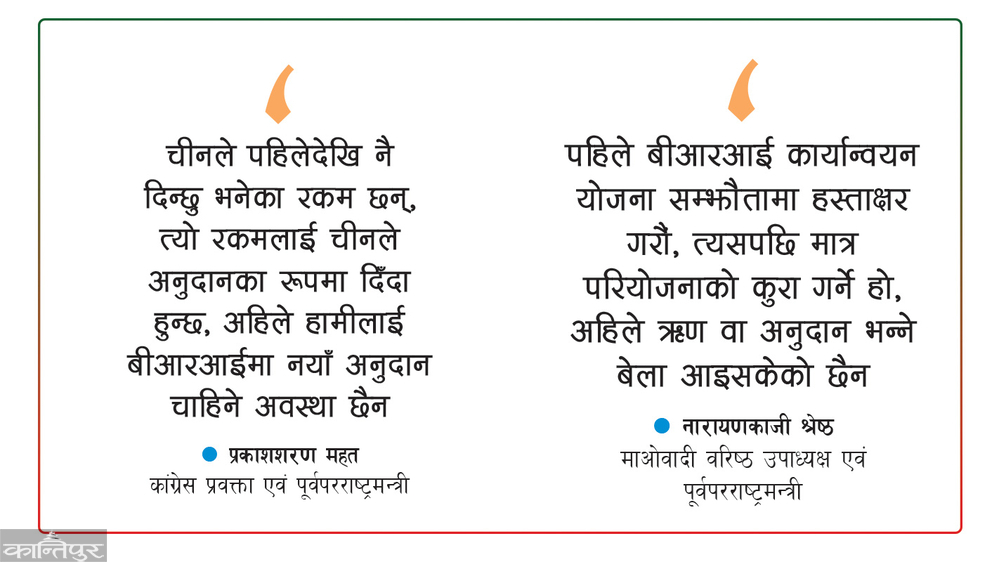
According to high political sources, Prime Minister KP Sharma Oli is in favor of proceeding with both the project grant and concessional loan through BRI. The Congress has decided that BRI can only be accepted as 'assistance or grant' from the meeting of party officials and ex-officers held on June 17. Congress spokesperson Prakasharan Mahat, who is also a former foreign minister, says that now they want to seek bilateral cooperation with China rather than the grant through BRI. "China has already promised to give us the amount. That amount is given by China as a subsidy. Now we don't need any new grant in BRI," he said. What this indicates is that the Congress will not accept the BRI even if it is subsidized.
The senior vice-president of the main opposition Maoist Center and former foreign minister Narayankaji Shrestha argues that BRI should not be understood only as a loan and that it has a wider dimension. After the signing of the BRI concept, the BRI implementation plan agreement is the second step. Let's first sign the BRI implementation plan agreement, then only in the third phase we will talk about the projects," he said. Now is not the time to call for loans or grants. After looking at the project, the decision is made accordingly.'
In a conversation with Kantipur on October 25, UML Deputy General Secretary and former Foreign Minister Pradeep Kumar Gyawali said that it is necessary to correct the perception that BRI is a loan. “BRI is a concept of development. Globalization promoted by Western countries benefited a certain group. Developing countries did not benefit enough. Under the new concept of globalization, this is a new concept of inclusive, green development and each country choosing its own plan to proceed. With this belief, more than 150 countries have joined the BRI in one way or another. The comment that is being made now that BRI is a debt trap is not confirmed from anywhere. Gyawali mentioned that Nepal takes loans from World Bank, Asian Development Bank, International Monetary Fund and European Development Bank. . After the earthquake, India gave a commitment of Rs. Initially, our understanding was that all grants. Later, there was talk of taking 25 billion grants and others from the Indian Exim Bank," he said.
Controversy over Pokhara Airport under 'BRI' Just before the inauguration of the airport on January 1, 2023, the Chinese Embassy in Kathmandu issued a statement and mentioned that Pokhara International Airport was built under BRI. At that time, it was said, "The new airport has been designed and built according to the standards of China and the International Civil Aviation Organization, which reflects the quality of Chinese projects." It is a symbol of Nepal's national pride. At the opening ceremony, China's Acting Ambassador to Nepal, Wang Xin, also expressed that Pokhara International Airport is a project under BRI.
The BRI concept proposed by Chinese President Xi Jinping in 2013 was signed by Nepal in 2017. The construction of Pokhara International Airport started in 2014. Therefore, after the idea that BRI has been implemented in Nepal with reference to Pokhara Airport from the Chinese side, many comments were raised. Nepal government itself had to make it clear that Pokhara airport construction is not under BRI.