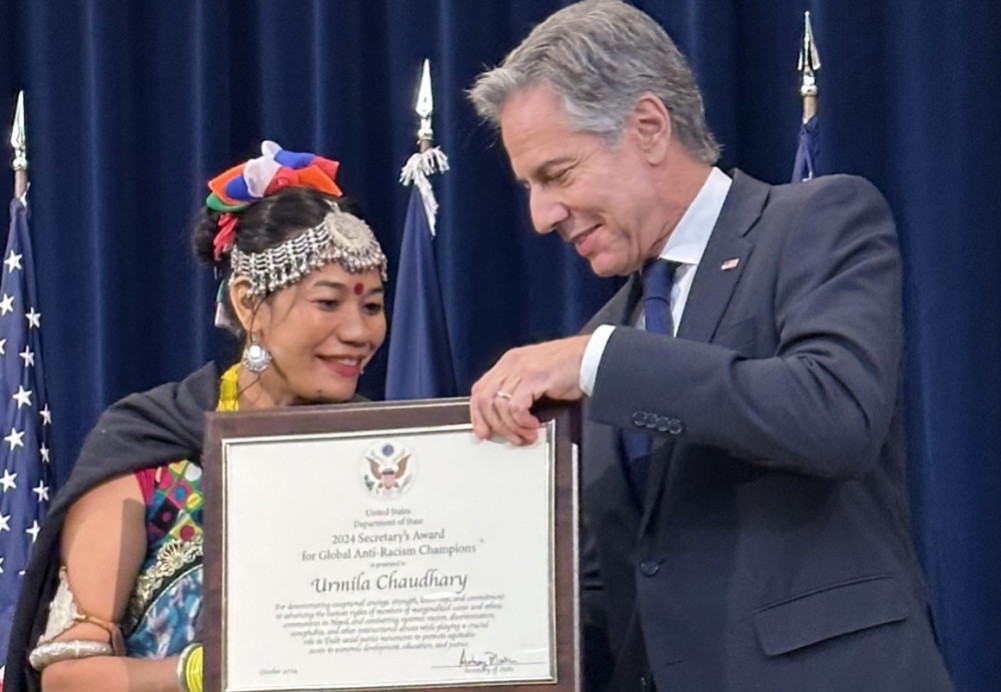
Dangki Chaudhary honored with 'Global Anti-Racism Champion-2024'
We use Google Cloud Translation Services. Google requires we provide the following disclaimer relating to use of this service:
This service may contain translations powered by Google. Google disclaims all warranties related to the translations, expressed or implied, including any warranties of accuracy, reliability, and any implied warranties of merchantability, fitness for a particular purpose, and noninfringement.
'Have you climbed Mount Everest?' American Secretary of State Antony Blinken asked Urmila Chaudhary as soon as they met. "I have not climbed, but I have read," Urmila said openly, "As many people think, Nepal is not a country of mountains, there are also many plains, because I was born in that plain, I have yet to climb the mountains."
In short, Blinken could not help but appreciate Urmila's eloquence in giving such a sweet answer. "He wondered how I would have known to do such a thing at your age," Urmila said in a phone conversation with Kantipur on Tuesday about the recent interesting meeting with the US Secretary of State, "and also praised me for being a brave girl." Soon after the
, the same Blinken declared Urmila the winner of 'Global Anti-Racism Champion-2024' in a grand ceremony held at the Ministry of Foreign Affairs in Washington and gave a certificate and congratulations on Monday. Before that, Blinken read a couple of letters about Urmila on how she came to deserve this prestigious honor. There was a story about how Urmila was forced to live in a slum since birth and how much progress she made after being freed from it as a teenager.
There is a long list of sorrows, shocks and successes and surprising achievements in Urmila's life, which Antony, in a short two-letter speech followed by a certificate, has served to inform people all over the world at once. Congratulations are coming to Urmila for being one of the first 6 winners in the world to receive this award established by the US government last year.
Hundreds of people from around the world were nominated for the award, which is given 'to honor those who have demonstrated extraordinary courage, strength, leadership, and commitment to advance the human rights of members of marginalized ethnic and tribal communities'. Among them, Urmila is the first winner not only from Nepal, but from all over Asia. He is joined by five rights holders from Ghana, North Macedonia, Mexico, Bolivia and the Netherlands.
'I have never been as happy as I am today,' she said in a phone conversation with Kantipur before going to another program of the Ministry of Foreign Affairs in Washington DC, the day after receiving the award, 'I never dreamed that I would come this far and that my life would be so valued.' When she was made a slave girl as a child and forced to live as a slave for 14 years of her life? The fun memories of playing as a child will remain in your life. However, there is no such moment in Urmila's memory.
"My baby tooth fell out in the house where I went to live," she says, "I only remember the children of that house playing with toys and when I touched them, they got angry and threw them away, I never got to play."
Dang's Gahuwa-6 Manpur Dang, Phulpat Chaudhary lived as a laborer for generations. As he went to live in the house where his father was working. When he grew old, his sons, wives and daughters-in-law lived in that house. The story of Phoolpat and his wife Khalsi's youngest daughter Urmila is different from others, Kamaiya became a kamalari in other villages, while Urmila was taken to Kathmandu. When he was taken to Kathmandu, his elder brother Hamraj carried him across the Rapti river, because there was no bridge there. Four or five years later, she was able to return to the village for a few days. At that time there was already a bridge.
When Kamalari lived in the elite Rana family of Kathmandu for 8 years and in the house of Phupu of the same family for 6 years, Urmila never put a shoe on her feet. 'It was home for them, hell for me,' says Urmila, 'they didn't let me go out of the house, I had to cook dal, rice, pickles and many vegetables for them in the morning and evening, but they used to feed me rice like feeding pigeons.'
Once As he worked, the glass broke. Even now, the owner's scolding that "you will not be able to repay the price of this glass by working all your life" still echoes in his ears. He should have appeared as soon as the
was called. Otherwise, she would inevitably be beaten. Once when he turned the pages of the newspaper that arrived in the morning, the scene of his mistress throwing him into the dustbin and reprimanding him for 'reading what has been touched by the workers', no matter how much he tried, he could not get out of his eyes. Even in such a hellish place, there was a girl of her age in that house who used to teach Urmila how to write ``a b'' when there was no one else.
Urmila, who managed to escape from her master's house after many struggles after seeing her brother on television one day, was able to wear slippers for the first time after years.
'I haven't even been able to ride a car since I came here,' she says, 'whether I should say the wages for working for 14 years or the money collected during Dasain etc., the owner gave me 800 rupees for the car rental. I met Baama once.''
Urmila soon understood that Maya was killed because she pretended that there was no one to work in the house. And, after the arrival of Maris's daughter, the tears caused by the mixture of joy and wonder made Urmila happy for the first time with the satisfaction of knowing that she has her own people in her life. It was Maghi day of 2063. Even though the government declared the Kamaiyas free in the year 2057, the system of keeping Kamalaris did not end. Seeing that girls like her in the village were protesting against it, Urmila also started an active movement. What she soon found out was that 13,000 camels had been rescued that year.
"Plan International made all of us participate in reading and writing by giving them a bridge course," she says, "Then I was enrolled in five classes at once." This intense intelligence of his soon became famous. 12 years ago, while she was studying English in Plus Two, she got the opportunity to visit the United States for the inauguration of the five-year campaign 'Balika Bawekile', which was about to be launched by the United Nations. After that, German documentary director Susan Gluth made a documentary on him, 'My Memory is My Power', which was awarded the best short film competition at the International Mountain Film Festival (KIMF) in Kathmandu in 2016.
'The nanny of the Rana family who taught me kakhra also came to see it, after seeing my life story on the screen, she regretted it and said that she had done it without knowing,' says Urmila, 'Nani has always treated me well. But no one else in that house ever treated me well, even when I called two/three times to pay the wages I had worked for, they reprimanded me badly. . She has been saying that she does not want to be publicly humiliated by the name of a member of an elite family who has tormented her in hellish life.
'My fight is not with individuals, but with the state's policy of enslaving a race,' she says, 'at that time, we and our ancestors were made slaves of all professions and ranks for generations, and the state should pay for it, not the individual.' So he is not angry with the housewives who do not pay wages. He wishes that the mistress who is famous for throwing the newspaper she touches into the dustbin lives long. 'This historic injustice cannot be compensated by the state,' says Urmila, who is on the verge of starting a lawyer's life, 'so I don't want to take revenge from them, although I am still afraid of them.' Urmila, who is studying, was selected for the award by the American ambassador in Nepal. Urmila got the news that she was in the list of final nominees towards the end of August.
Urmila was in the ICU ward of Kohalpur Medical College when she received a call from the embassy in Kathmandu saying 'Congratulations, you have been selected'. Her 81-year-old father was mauled by a bull and seriously injured, and she was rushed for treatment. In the ICU, she told her father that she had been nominated for an award by the US government. 'Even in such an injured state, he was smiling happily,' says Urmila, 'after you went to America, you told me to take a picture of the plane, but I couldn't show the picture, we couldn't save him.' Phulpat had given up his life a day earlier. Urmila had it in her mind that Babu Phoolpat, who had traveled farthest in his life to Kathmandu for the first and last time in his life to watch the documentary shown about him, would send the ship itself, not the photograph of the ship. "But, that remained in the mind of Dho", she remembered her father from America, "My son had to spend his entire life as a worker, and he was not the only one who was forced to suffer this injustice, the state will have to pay for it if not today, then tomorrow."