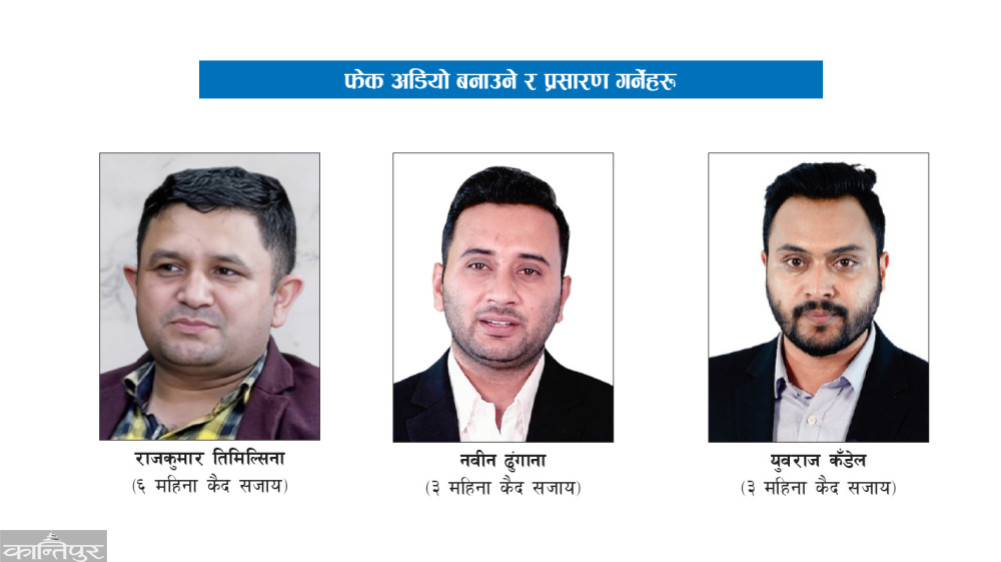
The court held that the material broadcast in Sidhakura was completely fictitious and false, the Dhungana and Kandel central jails were opened on Sunday.
We use Google Cloud Translation Services. Google requires we provide the following disclaimer relating to use of this service:
This service may contain translations powered by Google. Google disclaims all warranties related to the translations, expressed or implied, including any warranties of accuracy, reliability, and any implied warranties of merchantability, fitness for a particular purpose, and noninfringement.
The Supreme Court has ruled that the audio content broadcasted by 'Sidhakura.com' under the name of 'Dark File' is 'fake'. The 9-member full bench of the Supreme Court on Sunday sentenced the producers and broadcasters to imprisonment for contempt of court.
In the fake audio prepared by Sidhakura as 'sting operation', judges, lawyers, media entrepreneurs and even journalists were defamed.
Rajkumar Timilsina, who made the audio, which was proved to be 'fake' even in the laboratory test, was sentenced to 6 months imprisonment and Yuvraj Kandel and Naveen Dhungana of 'Sidhakura.com', who broadcast it, were sentenced to 3/3 months imprisonment. Likewise, it is mentioned in the verdict that 'Sidhakura' Online will be fined 5,000.
Chief Justice Vishwambhar Prasad Shrestha and judges Prakashman Singh Raut, Sapna Pradhan Malla, Prakash Kumar Dhungana, Hariprasad Phuyal, Nahkul Subedi, Vinod Sharma, Mahesh Sharma Paudel and Balkrishna Dhakal delivered the judgment on Sunday. According to the order of the court, Central Jail Jagannath Deval has been opened on Sunday.
Timilsina has been sentenced to 6 months imprisonment in accordance with sub-section (4) of section 17 of the Administration of Justice Act, 2073 for the offense of producing and broadcasting fictional content. In the process of the case proceedings, the Supreme Court has also ruled that Timilsina will not be pardoned, saying that 'as there is no sense of remorse or apology in him, the sentence of imprisonment will be carried out.'
In the case of Kandel and Dhungana, the Supreme Court has ordered that they will be imprisoned for 7 days and the rest of their imprisonment will be waived if they express an unconditional apology and a written commitment not to repeat such an act. "If they do not apologize or do not express a commitment not to repeat such actions, they will have to serve the full punishment and if they are found guilty of contempt of court in any other case in the future, they will also be sentenced to the currently suspended imprisonment," said the Supreme Court order.
Dhungana and Kandel have "spread confusion and created disloyalty towards the court by repeatedly publishing the material in their media without completing even the minimum process that any person involved in the mass media that must be checked for verification," is the opinion of the Supreme Court. It is mentioned in the judgment that such work is not 'a situation that can be considered as merely negligence or helchekraya' and that the circulated material spread rumors about the judge and the court. It has been decided that 'Sidhakura.com', an organization that broadcasts
content, will be fined five thousand rupees, but if it apologizes and corrects the mistake within three months, the fine will be waived. On May 14th, Sidhakura aired a series of audio and video content created on the basis of a sting operation involving judges of the Supreme Court to dismiss more than 400 corruption cases.
The then Assistant Spokesperson of the Supreme Court, Govinda Ghimire, filed a case against Timilsina, Kandel and Dhungana, claiming that it was contempt of court. While the proceedings of the same case were proceeding, it was confirmed that the audio was 'fake' in the authenticity test of the broadcast material ordered by the court. After that, a criminal case was filed against all three of them in the Kathmandu District Court for committing an offense under the Electronic Transactions Act, which is pending.
On May 30, the bench of Justices Kumar Chundal and Vinod Sharma ordered that the contempt case be submitted to a 9-member full bench. Accordingly, it was decided to decide the case on August 6, which was heard by the full bench from June 17. However, a decision could not be made that day. After that, the case was fixed for judgment twice on August 20 and October 10. Finally, the case was decided for the fourth time on Sunday.
In the 25-page judgment issued as 'brief', the full bench raised 6 questions and declared that there was contempt of court in the case. As the first three questions, the court considered what constitutes contempt, what is the boundary between freedom of the press and contempt of court, and whether the content in question is of a contemptible nature. The fourth question is about the procedure of contempt of court, while the fifth question is related to whether the principle of double jeopardy is attracted in the case against Sidhakura or not (since the criminal case is pending against all three persons in the Kathmandu District Court for the same offence). The final question relates to whether the defendants were guilty of contempt and whether they should be punished.
In relation to the first question about the circumstances of contempt of court, the court said that 'obstruction of the administration of justice may be material or immaterial such as damage to the credibility of the court or public faith'.
The Court is of the view that it is contempt if someone publishes or broadcasts misleading or false or self-conceived or self-created or rumourous-material in such a way as to create confusion among the public and undermine the public's faith in the court. In addition to that, it is explained by the full bench that it is contempt of court 'by speaking or writing or by spreading false or fabricated rumours'. "Actually, if someone acts in any way to undermine the public faith by spreading false information about the execution of justice by the court, such action should be considered as an act of contempt of the court because that kind of action creates an obstacle to justice," the judgment said.
Court has also presented a new principle in relation to contempt - 'Intent is not important in the court case and the claim that there is no intention is not a condition to be exempted from the liability of the contemptible act.' Similarly, in the judgment, the limit between the freedom of the press and the contempt of the court will be maintained as long as the truth content is broadcast and published mentioned. The court held that the content broadcast on
'Sidhakura' is 'completely fictitious' and 'false' and therefore contemptible. The procedure for contempt of court has been prescribed by the court itself. The court said that the same was done in this case and the principle of fair hearing was not violated. It is stated in the Supreme Court's order that they were convicted and sentenced in the contempt case as the criminal case against the defendants in the lower court is of a separate nature and the principle of double jeopardy is not attracted.