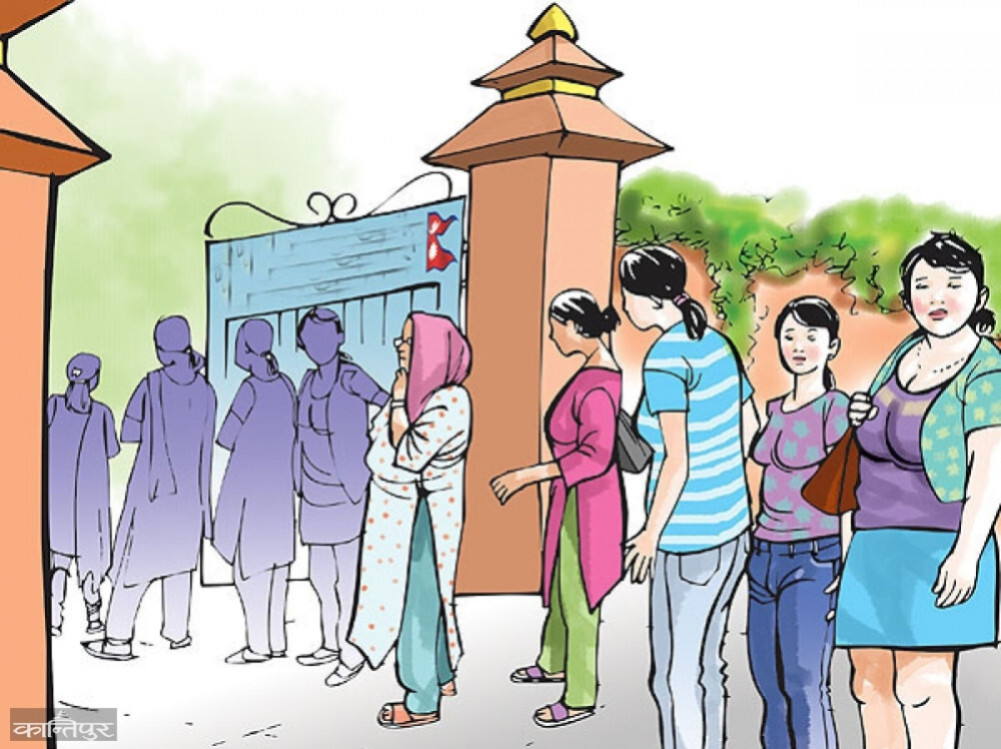
35 thousand in Kuwait, 20 thousand in Kurdistan of Iraq and 8 thousand Nepali domestic workers in Oman, 2361 women were returned from the airport in the last 6 months.
We use Google Cloud Translation Services. Google requires we provide the following disclaimer relating to use of this service:
This service may contain translations powered by Google. Google disclaims all warranties related to the translations, expressed or implied, including any warranties of accuracy, reliability, and any implied warranties of merchantability, fitness for a particular purpose, and noninfringement.
Due to the weak regulation of the government, Nepalese women going to Gulf countries for domestic workers (housemaids) are constantly increasing. It has been 8 years since the government banned the sending of domestic workers to the Gulf countries, but the number of Nepali women working as domestic workers in the banned countries has reached at least 60,000.
On the instructions of the International Relations and Labor Committee of the Parliament, the Ministry of Labour, Employment and Social Security had completely banned domestic workers from going to the Gulf countries on 20 Chait 2073. But the trend of Nepali women going to work as domestic workers in the United Arab Emirates, Kuwait, Oman, Iraq has not stopped.
According to the information sent by the related embassy to the Ministry of Foreign Affairs and Labor, 35,000 Nepalese women are working as domestic workers in Kuwait and 8,000 in Oman. The government of the United Arab Emirates (UAE), which has the largest number of domestic workers, has not provided the exact data of Nepalis. Another banned country is Kurdistan, an autonomous state of Iraq, where there are 20,000 Nepali women.
The airport immigration office had returned 2,361 women in the last six months saying they were going to take them as domestic workers. But only in cases where the 'setting' is damaged, immigration is accused of stopping women. According to Gautam Mishra, spokesperson of Human Trafficking Investigation Bureau of Nepal Police, brokers send poor women from rural areas to do domestic work at zero cost after completing the 'protocol' of the visit visa.
"There is an increasing trend of human traffickers sending women from Kuwait, Oman, Iraq to Syria by transiting Dubai," said Mishra, "Women who are taken in this way are being held hostage. After reaching the respective country, the number of women appealing for rescue is increasing. According to him, agents at different levels sell the women by bargaining after taking them to the destination country.
In the last four years, 52 men and 789 women filed complaints against 1,257 people in the bureau saying that they were victims of human trafficking. After the complaint, 716 people involved in human trafficking were arrested and prosecuted by the police. 552 people are absconding.
A woman who arrived in Kuwait via Dubai on a visit visa said that she was physically and mentally abused when she fell into the trap of human traffickers. She told that she was able to return to Nepal after paying Rs. I was taken to Dubai on a visit visa to be employed in a company in Dubai with a monthly salary of Rs 40,000. Another agent in Dubai received them and took them to the flat where they lived, took them hostage and forced them to do domestic work and subjected them to extreme labor exploitation. He again said that the salary is better in Kuwait than in Dubai,” she said. Based on the woman's application, the police arrested Jhayendra Kumar Adhikari of Khotang on August 2 and are investigating the case of human trafficking and trafficking.
In the last financial year alone, 613 people who arrived as domestic workers were rescued. The maximum number of people rescued was 390 from Kuwait, 179 from Oman, 18 from UAE and 26 from Saudi Arabia. There are now 50 women in shelters in Kuwait and 19 in Oman. Tara Vishwakarma of Chitwan, who arrived in Oman after transiting Dubai, said that she had to return to her country because she could not do domestic work. "Four of us went together. We could not work in the moneylender's house. Had to leave home and run away. "He broke his spine and legs when he jumped from the floor where he was held hostage," she said.
According to Deenbandhu Subedi, the Nepalese Labor Counselor for the UAE, there are currently only 397 of the 2,270 domestic workers who arrived there on labor permits before 2073. Before the ban was imposed by the parliamentary committee, domestic workers used to come to the UAE on an institutional basis. At that time, employers who wanted to hire domestic workers had to deposit a bond at the embassy. Currently, only 397 people have bail at the embassy. As the rest returned to Nepal, the creditor took back the bond in the presence of the related domestic workers,' he said, 'now the embassy does not have a record of how many workers are on visit visas.' Since the number of Nepali women is more than men, the UAE government has allowed the Nepali embassy to have a 'help desk' for women. The number of registered Nepalis is 15 thousand.
The Ministry of Labor had implemented the Directive, 2072 on sending domestic workers to 40 countries including the Gulf. Currently, this directive is only implemented in Jordan and Cyprus. Since 2073, the parliamentary committee has been taking the stand of not sending domestic workers unless there is a labor agreement regarding domestic workers with the destination country. According to that, the subject of labor agreement regarding domestic workers with Kuwait, Saudi Arabia, Oman, Qatar and Bahrain is limited to discussion.
The first bilateral meeting of Nepal and UAE held on 3-4 November 2019 after the labor agreement with UAE agreed to create a protocol related to domestic workers. The second bilateral meeting held on May 32 last year decided to give a minimum wage of 400 dollars (52 thousand rupees) for domestic workers in Nepal. Human trafficking is taking place when domestic workers are not released from Nepal. It was as if we were encouraging it," said Abdullah Ali Al Nuaimi, head of domestic workers' affairs in the UAE, who led the meeting. "The UAE has introduced a law on domestic workers in 2022. We want to supply domestic labor through legitimate process. The UAE takes responsibility for the safety of domestic workers. From when Nepal will send domestic workers, the date had to be fixed.
Nepal has not yet taken a decision on this. Last year, on August 26 and 27, the then Prime Minister Pushpa Kamal Dahal chaired a high-level meeting with ambassadors, and it was decided to manage domestic workers. In order to finalize the proposed draft for the 2072 revision of the Guidelines for Sending Domestic Workers to Foreign Employment in compliance with the directives of the Parliamentary Committee, the head of the relevant commission shall submit national standards within 15 days including national standards to protect domestic workers from domestic violence. The decision of the meeting was to start the process of sending domestic workers to the 'pilot base' only by adopting the objective conditions and safety measures of the concerned country and the Ministry of Labor, Employment and Social Security will initiate the labor agreement. The ambassadors have not submitted the criteria country wise.
Former Labor Secretary Kewal Prasad Bhandari says that trafficking of women in domestic labor will not stop until domestic workers are sent through legal means. "The only way to control women trafficking is to send domestic workers in an institutional manner," he said.
The National Human Rights Commission also sent a letter to the Prime Minister and Council of Ministers Office on Chait 29, 2079 asking them to implement 58 points for the safety of foreign workers. According to Tikaram Pokharel, the spokesperson of the Commission, the letter also suggested the issue of reducing the risk of female migrant workers. "The Commission is clear that special security measures should be implemented in Nepal as well as destination countries by removing the discriminatory preconditions issued for domestic workers going to foreign employment," he said. Through the delegation, action should be taken regarding their safety and human rights.' He said that measures should be taken to reduce sexual and mental violence.
'We are serious about the safety of domestic workers'
Sharatsingh Bhandari, Minister of Labor
I saw that there are different views and understandings regarding foreign employment, especially domestic workers. It is important to make one understanding. We have to understand where we are and what our role is in the current situation. The topic of domestic workers is being raised most in the parliamentary committee. To make it orderly, dignified, safe and reliable, the parliamentary team has repeatedly visited the Gulf region and submitted a report with suggestions to the relevant committee.
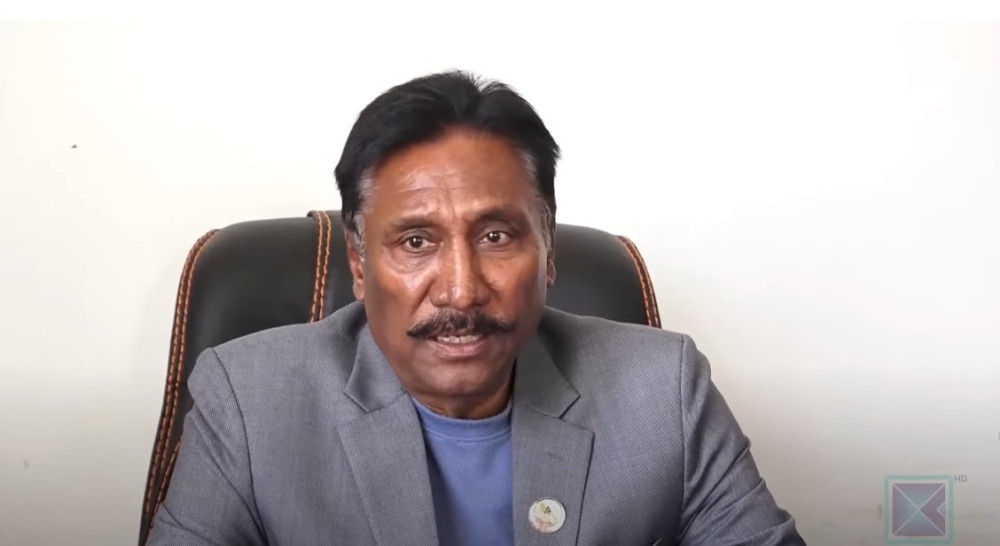 Based on the instructions received from the parliamentary committee, the Ministry of Labor is doing its homework, from making labor agreements with destination countries that have made separate laws on domestic workers, to creating a strong mechanism to implement them, to providing skills and language training to domestic workers. If our sisters are safe and the country of destination also ensures their safety, salary and medical treatment according to the law, there is no need to continue imposing restrictions. The Ministry is aware that women should be removed from the net of traffickers.