We use Google Cloud Translation Services. Google requires we provide the following disclaimer relating to use of this service:
This service may contain translations powered by Google. Google disclaims all warranties related to the translations, expressed or implied, including any warranties of accuracy, reliability, and any implied warranties of merchantability, fitness for a particular purpose, and noninfringement.
Prime Minister KP Sharma Oli has once again asked the Indian side to understand the report of the Enlightened Persons Group (EPG) formed to study the review of the 1950 Nepal-India Peace and Friendship Treaty, Nepal's water resources, transportation facilities, border problems, bilateral trade expansion, etc.
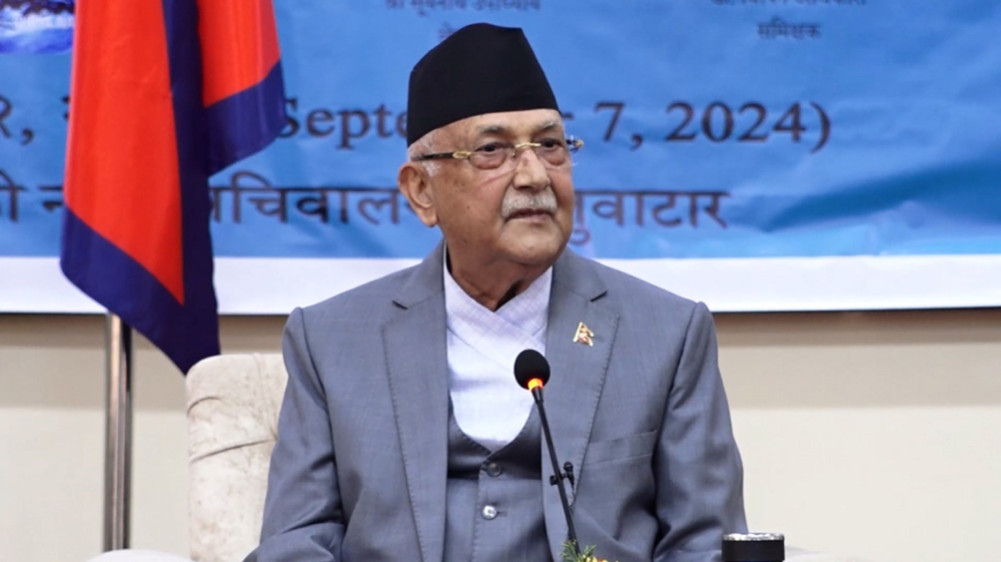
Releasing the book "International Water Flow Law: Approach of Nepal-India Cooperation" by EPG member and former administrator Suryanath Upadhyay at the Prime Minister's Residence, Baluwatar on Saturday, he once again urged India to understand the report.
When Oli became the Prime Minister for the first time, the enlightened group was formed in 2072 and started making reports. He reminded India for the second time to understand the EPG report on the occasion of becoming the Prime Minister for the third time. Earlier, on August 10, Prime Minister Oli had asked India to understand the EPG report while releasing former foreign minister Kamal Thapa's book 'Blockade and Geopolitics'.
Even after 6 years, India has refused to understand the report prepared by the enlightened group of the two countries. After India refused to understand the report, Oli repeated his statement about the EPG report on Sunday saying that there was a problem in implementing the suggestions pointed out by it and that there was no concrete progress in improving the relations between the two countries.
Oli said that since there are some problems between Nepal and India, EPG has been formed with the agreement of the Prime Ministers of both countries to solve them and after understanding the report prepared by the group, it will be easy to solve the problem. "The chance to understand and explain EPG's report has not yet been met. The Nepali side was not afraid to understand the report. It is thought that there will be time to understand the report of the Indian side as well. After understanding the report, it will be easy to discuss the current issues between the two countries," Prime Minister Oli said, "India is a neighbor and friend with a long culture. We have to talk openly with our neighbors . You can't blame geopolitics for not being able to keep things open. We should not do anything to gain and maintain power and we should not shut our mouths or shake our heads. Mentioning that the word geopolitics should not be used in favor of our interests, Prime Minister Oli said that we should discuss the interests of the country according to the treaty between the two countries. . "In the past, the foreign relations were based on the basis of how the strong can break. After the Second World War, many international treaties were signed, after that any country had to present its national interests in a logical and fair manner,'' he said. It should be done on the basis of agreement and discussion of both sides.
He said that the border disputes between the two countries can be resolved through further dialogue with the agreement of the top level between Nepal and India. "Requesting the Indian side to understand the report of the EPG, issues such as border disputes can be solved through dialogue," he said, "Since it is common to see problems between neighboring countries, these issues can be solved through open dialogue."
Nilambar Acharya, the former ambassador to India and a member of EPG at that time, said that the Prime Minister of India Narendra Modi, the foreign minister and other high officials would understand the report after arranging time, but he insisted that the relationship could not be strengthened due to the delay. "When I was in India as an ambassador, I talked to the Prime Minister and Foreign Minister about understanding the report. They are not saying they don't understand . He said that we would understand the report after completing the process, but it has been 6 years, and we have not been able to discuss the report based on it He said that work can be done in the interest of the country. "Currently the treaty of 1950 does not work now". We are going to expand our relationship according to the present time," he said, "It is in the interest of both countries to understand the report and discuss it. Our existing problems should be resolved through dialogue. The issues between the two countries will continue to grow more and more.'
The report prepared by eight people from the two countries after two years is like a stalemate at the moment. That report was not made only by the Nepalese team. Four people were appointed by the Government of Nepal and four by the Government of India and the report was prepared with the consent of all," he added, "We worked for two years to prepare the report. The report has been prepared after extensive study to strengthen the relationship between the two countries.
He also expressed his belief that this topic will be embodied in the meeting between Prime Minister Oli and Prime Minister of India. Rajan Bhattarai, a member of Prabuddha Group, said that it was surprising that India did not want to understand the report.
"According to the agreement reached at the level of the Prime Ministers of the two countries, the EPG spent two years and unanimously agreed on the important issues of the two countries," he said, "Why is India hesitating to understand the report?" That's amazing . It is in the interest of the two countries to quickly understand this report and find a solution based on the suggestions prepared in agreement. On the basis of the report, there is an opportunity for the two countries to take a step forward and improve relations.'
According to him, the report covers the review of the 1950 treaty, Nepal's water resources, transportation facilities, border problems, bilateral trade, etc. EPP was formed in January 2072 and started its work from March. Although the report was prepared by the group in June 2075, both countries have not understood the report after Indian Prime Minister Narendra Modi hesitated to understand it. It's like a standstill now.
EPG held its ninth meeting in Kathmandu on June 15 and 16, 2075 and finalized the joint report. At that time, the report was said to be submitted first to the Prime Minister of India and then to the Prime Minister of Nepal. However, 6 years after the report was prepared, Prime Minister Oli reminded India again.
In October 2068, during the then Prime Minister Baburam Bhattarai's visit to India, it was agreed to form the Enlightened Group. In the points 18 and 19 of the joint statement issued by the then Prime Minister Baburam Bhattarai and the Prime Minister of India, Manmohan Singh, there was an in-principle agreement to form a group of enlightened persons to discuss the 1950 Treaty etc. Shortly after that, when Modi visited Nepal in July 2071, there was discussion and discussion about EPG. A joint press release was issued by then Prime Minister Sushil Koirala and Indian counterpart Modi during the resulting visit. In point number 13 of the statement, it was mentioned that both the governments have agreed to form an enlightened group as an independent and non-governmental mechanism.
In 2072, when Oli was the Prime Minister, the EPG was formed to review the past bilateral treaties, agreements and agreements between the two countries and to suggest changes in view of the needs of the developed 21st century. The EPG was mandated to recommend ways to strengthen the relationship between the two countries by building a foundation of mutual trust, social, economic, cultural and political relations. On January 13, 2072, the Council of Ministers meeting finalized the names of the coordinators and members of the group of enlightened persons for Nepal.
Former foreign minister Bhesh Bahadur Thapa, former ambassador Nilambar Acharya, former administrator Suryanath Upadhyay and UML leader Rajan Bhattarai were on behalf of Nepal. From the Indian side, the coordinators were Bhagat Singh Kosiari, former Ambassador of India to Nepal Jayant Prasad, Professor BC Upreti and Mahendra P Lama.