Almost half of the students are ineligible for higher education
We use Google Cloud Translation Services. Google requires we provide the following disclaimer relating to use of this service:
This service may contain translations powered by Google. Google disclaims all warranties related to the translations, expressed or implied, including any warranties of accuracy, reliability, and any implied warranties of merchantability, fitness for a particular purpose, and noninfringement.
The result of class 12th examination is also seen as weak as that of SEE. Almost half of the students who participated in the examination failed.
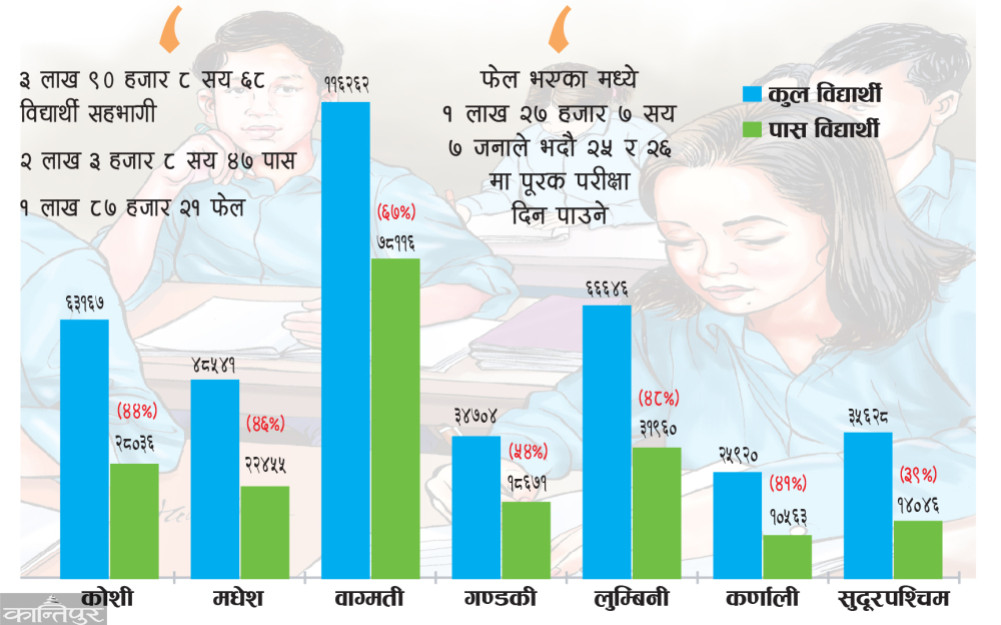
According to the results of the regular side announced by the National Examination Board on Friday, out of 390,868 students who participated, 23,847 (52.15 percent) passed and 1,87,21 (47.84 percent) failed. Among those who failed, 127,777 people will be able to take the supplementary exam on August 25 and 26.
SEE published last June and compared to the previous years' Class 12 results, there is only modest improvement. In SEE, 47.87 percent students passed and 52.13 percent students failed. Last year, 50.91 percent of the 372,637 students who participated in the class 12 exam, 189,711 students got grades and were deemed eligible for admission to higher education. The previous year, 48.10 percent of students had passed. As compared to last year, the number of students getting grades and the number of students getting higher grades are gradually increasing, the overall results are improving, said Mahashram Sharma, chairman of the board.
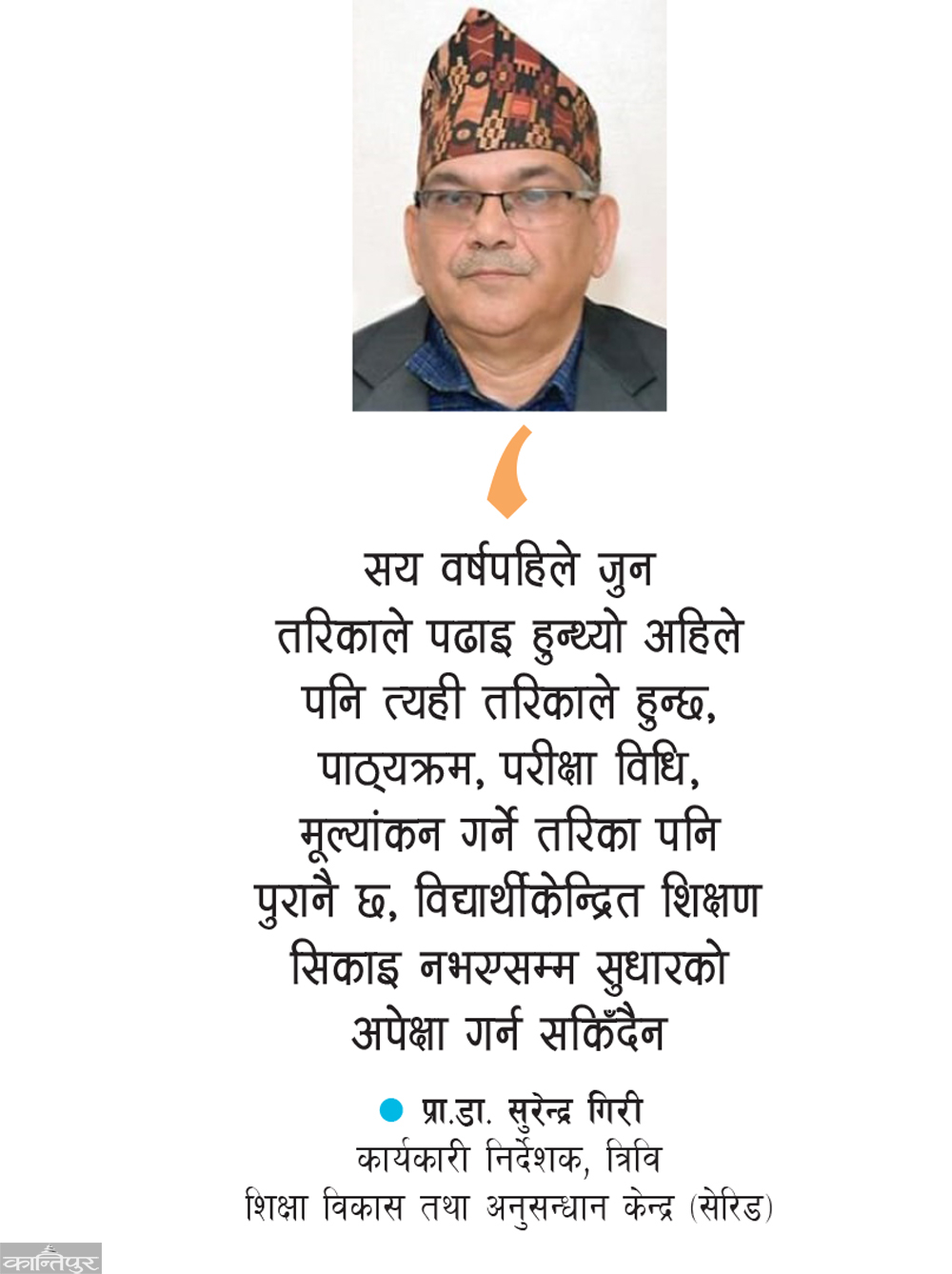
Although there is a modest improvement in the results of class 12, experts say that it should not be considered an achievement. Executive Director of Tribhuvan University Education Development and Research Center Prof. Dr. Surendra Giri commented that the results of the school level were poor because the teaching method could not be improved. He said that teaching and examination have been conducted by the same method for 100 years. "The same way teaching was done in Trichandra campus one hundred years ago is still done in the same way. The curriculum, examination method, evaluation method are also old,' he said, 'unless student-centered teaching and learning can be expected to improve.' He pointed out that since
teaching methods and policies and rules are old, reform is not possible. "Trichandra model is the teaching method of Rana period. The curriculum has been made as the teacher has been going since the time of Baje. The way of teaching is also the same. The Education Act is also old," he said. "Teachers are not appointed. The school is running on relief staff. There is no training for teachers.'
The number of students who obtained 3.61 to 4 GPA of upper level is 9 thousand 591. Most students have a 2.81 to 3.20 GPA. According to the board, 78 thousand 75 students have achieved this GPA. The number of students who obtained 2.41 to 2.80 GPA is 61 thousand 36. There are 46 thousand 893 who got 3.21 to 3.60 GPA. The number of students with 2.1 to 2.40 GPA is 8,240 and the lowest level is 12 students with 1.61 to 2 GPA.
Out of 187 thousand 21 non-grading students, 127 thousand 707 students are non-grading up to two subjects. According to the board, supplementary examination of students who are not grading in two subjects will be conducted on 25th and 26th of August. Sharma said that students who are absent for up to two subjects can also join the supplementary examination. Students who are not graded in more than two subjects will be allowed to take the grade increase exam only in the annual exam conducted next year. According to Sharma, most students are non-grading in English subject. Then the number of non-grading students in accounting and social subjects is more.
While 72 percent of students passed in English, there are 12,226 non-grading students. 51,000 students in social and 47,000 students in accounting are not graded. In SEE, many students failed in Maths, English and Science subjects. In class 12, the number of non-grading girls is more than that of male students. 1 lakh 87 thousand 21 students i.e. 47.84 percent of students are non-grading while 47 percent are male and 49 percent are female. The number of male students was less than that of female students. 194 thousand 319 students participated. Out of them 91 thousand 487 got NG and only 1 lakh 2832 got grade. 1 lakh 96 thousand 500 female students participated in the examination. 95 thousand 504 people got NG result and 1997 people got grade.
When comparing the results of class 12 by province, Sudurpaschim Province is seen as the weakest. After the Far West, Karnali, Koshi, Madhesh, Lumbini, Gandaki results are weak. Among the provinces, the best results were seen in Wagmati. Out of 35 thousand 628 students who took the exam in Far West, 14 thousand 46 (39.42 percent) managed to get the grade. 60.57 i.e. 21 thousand 582 people fell into non-grading. Out of 25 thousand 920 examinees of Karnali, 40.75 percent ie 10 thousand 563 were graded. According to the board, 15 thousand 357 i.e. 59.24 percent students are non-grading. In Madhesh, 53.74 percent of students were non-grading and 46.25 percent were grading. 45 thousand 541 people from Madhesh took the exam. Out of which 26 thousand 86 people are non-grading and 22 thousand 455 people are eligible for admission in graduation.
Similarly, out of 66 thousand 646 examinees of Lumbini province, 50.4 percent i.e. 34 thousand 686 were non-grading and 47.95 percent were graded. Analyzing the results, students grading in Sudurpaschim, Karnali, Madhesh and Lumbini provinces are behind the national average. In Gandaki, 53.80 percent i.e. 18 thousand 671 students were graded and 46.19 percent i.e. 16 thousand 33 students were not graded. There were 34 thousand 704 examinees from there. 67.80 percent i.e. 78 thousand 116 students have passed from Wagmati province which has seen the best results. 38 thousand 114 people (32.81) percent were not graded. The maximum number of 162,262 examinees participated from Vagmati. Karnali province had the lowest number of examinees.
Ambarraj Joshi, the former vice-chancellor of Sudurpaschim University, said that the results were not satisfactory as the condition of public schools in remote areas of the province including Sudurpaschim was poor. It has been 30 years since classes 11 and 12 started. The government has not given a single teacher post. The teachers who teach primary, secondary and secondary are teaching classes 11 and 12,” he said. Joshi pointed out that the results of schools in places where there are no qualified, efficient and capable teachers have not improved. In the Far West, apart from Kanchanpur and Kailali, the presence of private schools is not good. The schools of Far West are weak in terms of infrastructure, human resources, educational materials,' he asked, 'how can the results be good when there is no educational and material infrastructure?' He complained that not only schools but also universities in the Far West have not been able to build dynamic libraries.