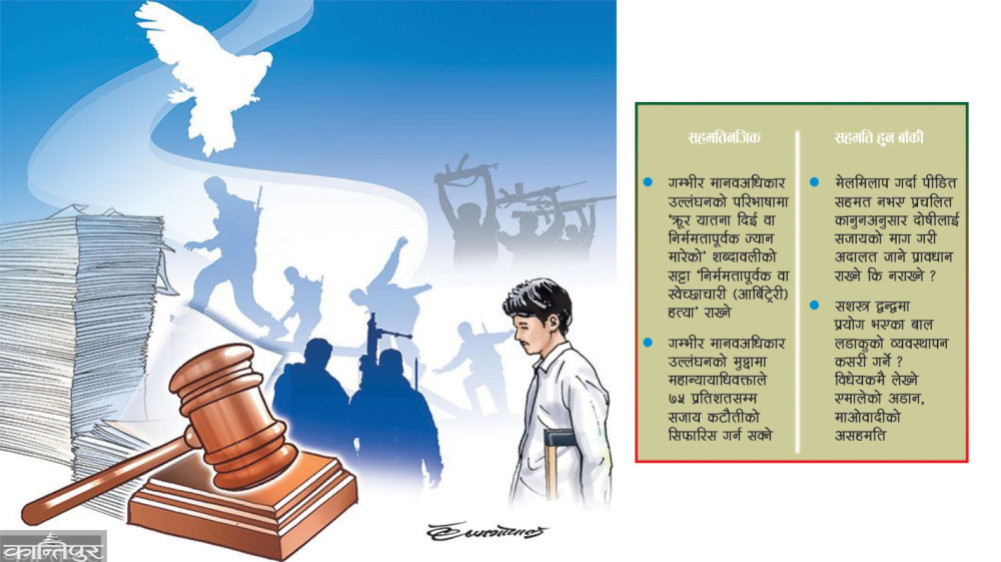
The UML has been maintaining a stand that there should not be too much relaxation in the punishment prescribed by the existing law, even if the Maoists were guilty during the war, they were adamant that the punishment should be less.
We use Google Cloud Translation Services. Google requires we provide the following disclaimer relating to use of this service:
This service may contain translations powered by Google. Google disclaims all warranties related to the translations, expressed or implied, including any warranties of accuracy, reliability, and any implied warranties of merchantability, fitness for a particular purpose, and noninfringement.
The political parties have come close to agreeing on a legal arrangement that will reduce the punishment for serious human rights violations during the armed conflict by up to 75 percent. In the meeting held on Tuesday of the working group formed to finalize the bill to amend the Commission for Investigation, Truth and Reconciliation Act, 2071, it was almost agreed that the Attorney General can recommend that the punishment be 25 to 30 percent according to the prevailing law. The working group meeting was held in the presence of Prime Minister KP Sharma Oli and Congress President Sher Bahadur Deuba.
There was a dispute between the UML and the Maoists about how much the punishment should be reduced. The UML has been maintaining a position that there should not be too much relaxation in the punishment prescribed by the existing law, while the Maoists have been insisting that the punishment should be less even if they are guilty during the conflict. "Based on the international experience of transitional justice, we have reached an agreement on the percentage of punishment," said Mahesh Bertaula, a member of the working group and chief whip of the ruling party.
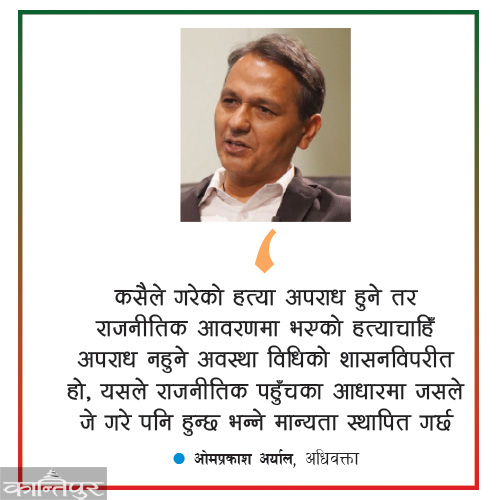
Human rights activists say that giving a lesser sentence for some people is against the international principles of human rights that should be punished according to the seriousness of the crime. "The situation where murder committed by someone is a crime and murder committed by someone under political cover is not a crime," Advocate Omprakash Aryal said, "This establishes the belief that whatever is done is based on political access." The working group has almost agreed on the definition of human rights violations. Section 5 of the Bill defines 'serious violations of human rights' as including 1) cruel torture or brutal killing, 2) forced labor, 3) forced disappearance of persons, 4) targeted or planned actions against unarmed persons or the population during an armed conflict. Inhuman or cruel torture is mentioned. The parties have come close to agreeing to replace the wording in the
bill with "brutal torture or brutal killing". There was also a difference between UML and Maoist. The UML was in favor of having the same wording as in the bill, while the Maoists were in the position of 'softly defining'. "Both parties have been flexible and finalized the definition of human rights violations," said a member of the working group.
If the victim does not agree during reconciliation, the task force has yet to decide whether to keep the provision to go to court and demand punishment for the guilty according to the existing law and the management of child fighters used in armed wars.
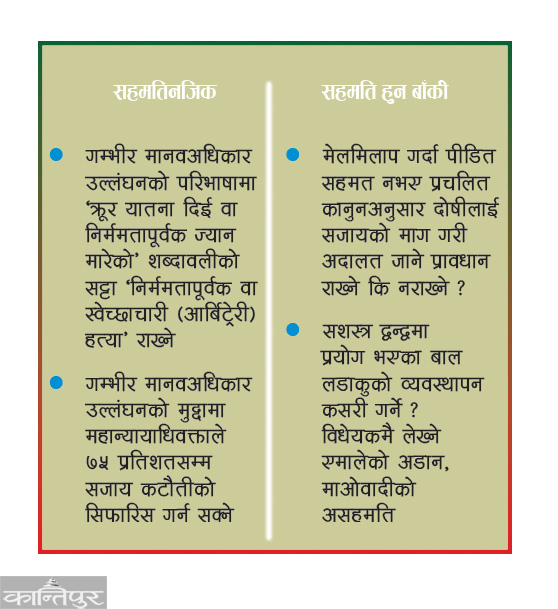
Article 9 of the law states that if the perpetrator or the victim submits an application for reconciliation to the commission, the commission can bring reconciliation between the perpetrator and the victim of human rights violations except for serious violations of human rights with the free consent of the victim. In this regard, UML has been taking a stand that if there is no agreement during reconciliation, they should be able to go to court and demand punishment according to the prevailing law. The Maoists have been denying it.
The UML demands that a provision should be added to the bill to provide compensation for those involved in the armed conflict, including the families of the security personnel killed during the armed conflict, who were removed from the combat camps before reaching the age of 18 years. Maoists are in favor of not having provisions that imply the use of child soldiers in armed conflicts. He is arguing that such fighters who leave the camp after completing certain procedures should be dealt with by other laws.
Working group member and Maoist Deputy General Secretary Janardan Sharma informed that the rest of the matter is ready to be finalized on Wednesday. "Controversial issues of the Transitional Justice Bill have moved towards consensus," he said. The working group member and Home Minister Ramesh Akhtar also said that the bill is about to be finalised. "Tuesday's discussion was very good," he said, "the ruling coalition is committed to not implementing transitional justice and peace process." In the meeting of the working group, Prime Minister Oli and Congress President Deuba pointed out the need to finalize the bill quickly and instructed them to agree on the next meeting. "Both top leaders have instructed to finalize the bill as soon as possible," said working group member Bertaulal, "The homework is being done to finalize the language and definition after discussing all the points."
The government led by Pushpa Kamal Dahal had registered a bill in the parliament on February 25, 2079, saying that making laws through political consensus would send a positive message as there was international interest in transitional justice. In February 2071, the Supreme Court ordered that a law should be made taking into account international law, saying that pardon should not be granted even if the victim has consented to serious human rights violations.
According to that, a bill has been introduced to amend the Investigation, Truth and Reconciliation Commission Act, 2071. The Law Committee formed an 11-member sub-committee (10 members after the death of Subas Nemwang) on May 5 last year for quarterly discussion on the bill. Regarding the
bill, the parties in the ruling coalition at that time, Congress, Maoist, Jaspa, United Samajwadi Party, were unanimous, while the main opposition party, UML, was holding a different opinion. In order to persuade UML, the then Prime Minister Dahal was holding a discussion saying that there should be a consensus among all the parties. After the UML-Maoist split last February, the bill became consensual. But at that time Congress had backed down.