Total revenue is 11 trillion 83 billion, uncollected revenue is 4 trillion 35 billion
We use Google Cloud Translation Services. Google requires we provide the following disclaimer relating to use of this service:
This service may contain translations powered by Google. Google disclaims all warranties related to the translations, expressed or implied, including any warranties of accuracy, reliability, and any implied warranties of merchantability, fitness for a particular purpose, and noninfringement.
Due to the increasing tendency of the government agencies to spend arbitrarily but not collect the income that should be received according to the law, the violence is increasing at a high rate. The trend of doing business without complying with the law, not keeping accounts, spending irregularly or unreasonable has reached 11 trillion 83 billion 26 billion rupees.
According to the 61st annual report of the Auditor General, compared to the financial year 078/79, the income of the last financial year has increased by about 23.28 percent. In the financial year 078/79, the balance was 9 trillion 59 billion 79 crores. This figure also increased by about 16 percent compared to the previous year. In the financial year 077/78, the total revenue was 8 trillion 29 billion.
The report based on the audit of all three levels of government agencies for the fiscal year 2079/80 was released by the Auditor General's Office on Sunday. The report pointed out that in the last fiscal year, the General Account audited 5,605 entities at all three levels, worth a total of 78 trillion 81 billion 600 million. According to which, the percentage of federal ministries and agencies is 1.89, provincial ministries and agencies 2.03, local level 2.72, federal institutions and committees 0.27 and provincial institutions and committees 2.24 percent.
Similarly, the updated amount of 5 trillion 13 billion 40 million 43 million rupees, which should be settled in time in relation to the federal and state government offices, local level, other committees and institutions, additional audit arrears, revenue arrears, foreign grants and loans to be received for research. is Out of this, the most arrears of revenue is 4 trillion 35 billion 42 crore rupees. The updated total of the action to be finalized is 5 trillion 13 billion 40 million 43 million rupees, while last year it was 3 trillion 72 billion 45 million 13 million rupees. The remaining amount has been added/adjusted last year as mentioned in the report. "The amount to be settled by taking action has reached 11 trillion 83.26 billion 82 million rupees by adding 6 trillion 69.86 billion 39 million rupees to 5 trillion 13 billion 40 million 43 million rupees," said the report. It seems that the main reason for this type of increase is revenue arrears and corruption.'
``Auditor General Toyam Raya said that recommendations were taken in eight different areas from the 61st report of the General Account. "Government management, public finance management, development management, public administration sudha and other areas have been tested, evaluated and analyzed and suggestions have been presented," said Raya, "suggestions have also been made in the areas of the overall economy of the country, management of public assets, information technology, good governance and other areas." '
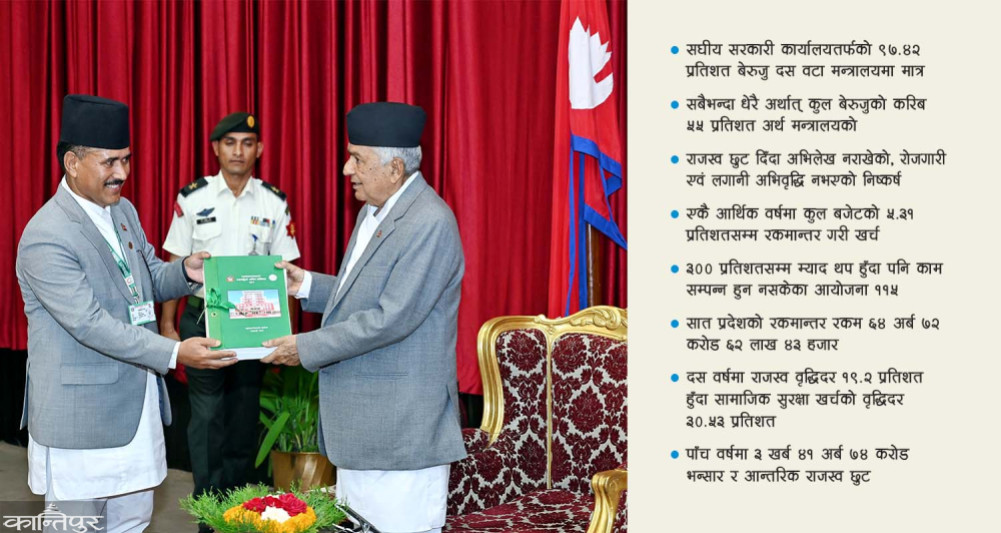
From a ministry perspective, the most confusion has been seen in the Ministry of Finance. Of the total disbursements to federal government offices, the disbursement of the Ministry of Finance is 25,474,900,000 (54.74 percent). Last financial year, the amount to be recovered is 3.55 billion 32 million and the amount to be regularized is 21.92 billion 1.5 million. After Finance, the Ministry of Physical Infrastructure and Transport has the highest amount of 12 billion 938 million (25.99 percent).
Similarly, the report mentions that the Ministry of Communication and Information Technology has 3.12 billion 43 million, the Ministry of Energy, Water Resources and Irrigation has 1.167 billion and the Ministry of Urban Development has 92.1 million. During the same period, 764.6 million of the Ministry of Water, 605.9 million of the Ministry of Land Management, Cooperative and Poverty Alleviation, 544.4 million of the Ministry of Home Affairs, 407.77 million of the Ministry of Culture, Tourism and Civil Aviation and 386.7 million of the Ministry of Foreign Affairs. It is mentioned in the report that only 97.42 percent of the federal government offices are in these ten ministries. Madhesh province is most affected by
province. As of the audit of the financial year 2079/80, the total revenue of Madhesh Province is equal to 8 billion 31 million 858 thousand. Looking at the situation of Beruju so far, it is equal to 5 billion 58 million 4 lakh 7 thousand of Koshi province, 4 billion 28 million 561 thousand of Wagmati, 2 billion 68 million 55 million 42 thousand of Gandaki. Similarly, Lumbini's 4 billion 29 million 69 thousand, Karnali's 3 billion 94 million 82 million 54 thousand and Sudurpaschim province's 2 billion 68 million 29 million 29 thousand, according to the Beruju report.
Similarly, the report has pointed out that the Ministry of Finance and its subordinate agencies have yet to recover 4 trillion 15 billion 30 million in revenue and interest on loans that exceed the budget. Out of that, the revenue arrears is 2 trillion 58 billion 85 crores and interest of loan investment is 1 trillion 56 billion 17 crores. It is said that the tax payers have gone to judicial appeal regarding 1 trillion 45 billion 7789 million (56.32 percent) of the remaining to be recovered, so a large part is under consideration by the judicial body.
Similarly, last year too, the government transferred 95 billion 29 crore 74 lakh rupees (5.31 percent) to the budget. Out of this, 23.10 billion 65 million was transferred in June and 13.81 billion 99 million was transferred in the last week of June in various headings/subheadings, the report said, "15 billion 49.9 million was transferred to 16 programs that were not provided in the initial budget. 8 billion 276 million has been spent on maintenance. Last year's budget item no. In 369, the budget allocated for national pride projects cannot be transferred elsewhere, according to the report, funds have been transferred to 51 other projects contrary to that provision.
In the Financial Procedures and Financial Responsibility Regulations, there is a provision that payment should be made at least one week before the end of the financial year and the account of withdrawals and expenses should be updated and the payment should be stopped. However, last year, the Ministry of Finance spent only 88 billion 667 million (6.24 percent) in the last week of June,'' the report said. Provincial governments have also been seen to be ahead in transferring budget funds. "This year, it was found that 64.72 billion 62 million 43 thousand was transferred out of the 3 trillion 6 billion 43 million 57 thousand originally allocated budget of the seven provinces," the report said, "Most of them seem to have been transferred only at the end of June."
Similarly, the Accountant General has also raised questions about not being able to list and distribute identity cards to farmers as per the target. Although the Ministry of Finance has allocated 41 billion 150 million for the subsidy, it is said that it has not been effectively distributed. "Though there are various subsidy programs in the agricultural sector from the three levels of government, due to the lack of coordination between the governments, the utilization, monitoring and evaluation of subsidies have not been effective," the report said, "therefore, the productivity and production of the agricultural sector has not been relatively increased."
Likewise, the growth rate of social security allowances has been higher than the growth rate of revenue in recent years. In the last 10 years, the growth rate of revenue in Nepal is 19.2 percent, the annual growth rate of beneficiaries receiving social security allowance is 10.42 percent and the annual growth rate of social security allowance is 30.53 percent, the report states. The Accounts General has raised questions saying that the Prime Minister's Employment Program was not effective last year as well. "This program has been running for the past four years with the aim of providing a minimum of one hundred days of employment to the listed unemployed," the report said, "up to now, 18.73 billion 4 lakhs have been spent on this program, and 712,658 people have participated in the program and an average of 48 days. have got employment.'
Similarly, the trend of construction projects not being completed on the specified date has been repeated last year as well. In the Public Procurement Act, if the work is not done on time, if it is left in the middle, there is a provision to pay compensation and put it on the blacklist, the report says, "Even if the deadline is extended up to 300% for the work to be done within the specified period, the 27 Divisions and Planning Offices under the Road Department have spent 12 billion 53 20.71 percent of the contract has been paid and only 20.71 percent of the contract has been paid out of 204 procurement contracts.' is However, last year, various offices and projects under the Ministry of Water Supply, Urban Development, Physical Infrastructure and Transport have requested proposals from the existing list and procured consultancy services worth 127.9 million 9000. "It is not appropriate to increase the dependence on consultants without proper management of departmental manpower," said the Accountant General.
Similarly, the economic growth rate target of the 15th Plan was 10.3 percent, but only 1.86 percent was achieved last year. The report pointed out that self-employment oriented environment for industrial production and self-sustainable economy development has not been created by including all the stakeholders in the operation of economic activities.
While Nepal's revenue collection is import-oriented, the share of revenue collected at customs points was 44.41 percent last year. Although the contribution of revenue to GDP reached 18.78 percent, the report pointed out that the new business and informal sector are not included in the calculation of GDP.
Similarly, the General Account has concluded that internal control system is not designed in all public bodies, internal audit is not timely and functionally independent and professional. "Every year the score of Beruzu is increasing, but the score of Farsyot is decreasing. This year, 46 billion 54 crores have not been allocated to the federal government,' the report said, 'There is a situation where the audit committee has not been formed at some local levels and the performance of the committee has not been effective.' The report suggests that there is a need to make the officials who conduct financial transactions and make decisions accountable. Weaknesses such as irregularity, delay and use of mediation in service delivery have not been minimized. Service delivery should be made according to people's expectations by adopting token system, circular system, help desk, less paper and faceless system,' the report says, 'resources and manpower cannot be managed based on workload and the measurement and quality of service delivery in the fields of education, health, and transportation. There is a situation where the price has not been determined.'
In accordance with the provisions of the Financial Procedures and Financial Responsibility Act, the Auditor General's Office defines the transactions that have been pointed out during the audit as those that have not been carried out in the manner that should be carried out according to the prevailing laws or that have not been maintained and that financial transactions have been conducted in an irregular or unreasonable manner. Beruju is classified into three categories: good, regular and pesky. The general ledger has included embezzlement and forgery, harm and other recoverable cases in the classification. The cases that need to be regularized are classified into four groups such as irregular, no proof documents submitted, no transfer of responsibility and no admission to research.