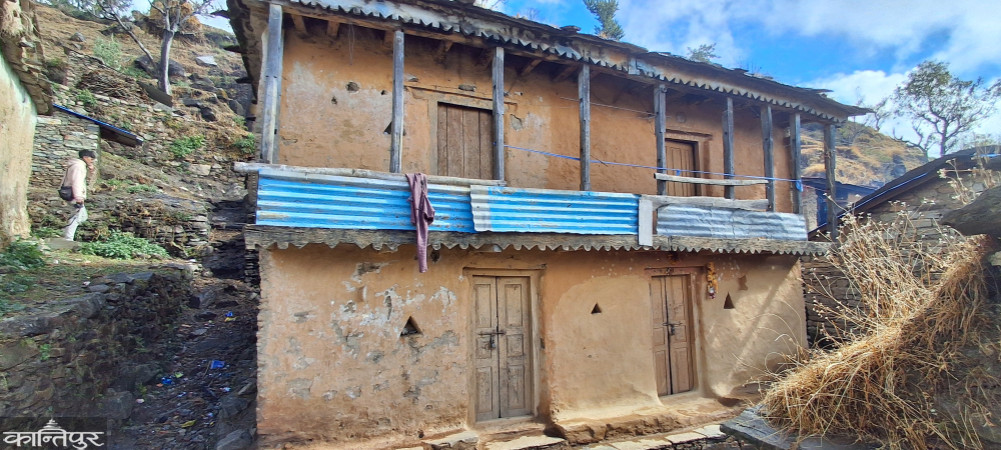
In Jarimtola Basti where 65 families live, not all family members can be found in one house. 11 out of 65 houses are locked. The number of houses occupied by only one person is 15. The condition of most of the settlements in Khaptad Chededah is like this.
We use Google Cloud Translation Services. Google requires we provide the following disclaimer relating to use of this service:
This service may contain translations powered by Google. Google disclaims all warranties related to the translations, expressed or implied, including any warranties of accuracy, reliability, and any implied warranties of merchantability, fitness for a particular purpose, and noninfringement.
After crossing Piuse River in Khaptad Chededah Rural Municipality-1, you will reach the hill of Dhameni village. A beautiful view of Kandagaon can be seen from this hill which is the center of the ward. When you enter the village and understand the locals, you will know that the village is not as beautiful as it looks. Because most of the people here are locked in their houses. In houses where the original doors are open, elderly parents seem to be waiting for someone.
Last week, an old man was found in the courtyard of the house after reaching Thalbara village via Choukhuna and after visiting four/five closed houses. He was basking in the sun with his head resting on the support of two hands, looking like a patient. He looked sick and was not in a condition to communicate.
Alik Paltir A woman was found standing on the khudkuli (stone steps leading into the house) of a house near the stream. His name is Mangli Rokaya. However, he did not know his age. After asking some questions, she said, 'What are you Dinya? Are you searching?'' The mother of three sons and one daughter told that all three sons and daughters have gone to India, including the youngest son who is 10 years old. If there is a house, the husband has also returned from a car accident while working in India 10 years ago. Mangli said that after all the children left the house, all the burdens of farming, livestock and household chores fell on her shoulders.
She was at a loss when her children were not with her and when she had to spend time with her husband who could not be relied upon. She said, ``Cheli (daughter) and grandson's jikkai (very loving) seems to Sourai. Gariple Sourai Manikan Kya Arnu? Sons are going to send 2-4 thousand in the hands of neighbors who return from Delhi in two-four months. After talking to Mangli and getting up a little, she met, 50-year-old Aju Rokaya. On the question of who is in the house, she said, 'Who is it, there are only two old people.'

Three of her two sons and two daughters are already married. Eldest son Padam lives in Delhi along with daughter-in-law and grandson. Younger son Kamal is studying in Dhangadhi while working at someone else's house. Husband Khadak is resting at home after bowel surgery. Aju herself was also injured after falling into the stream on January 1. She said, "Both of us will be disabled." Even the person who gives water when they are sick is not at home.'' Aju said that her neighbor sister helps them when they are sick. The sons and daughters-in-law have been in India for seven years.'
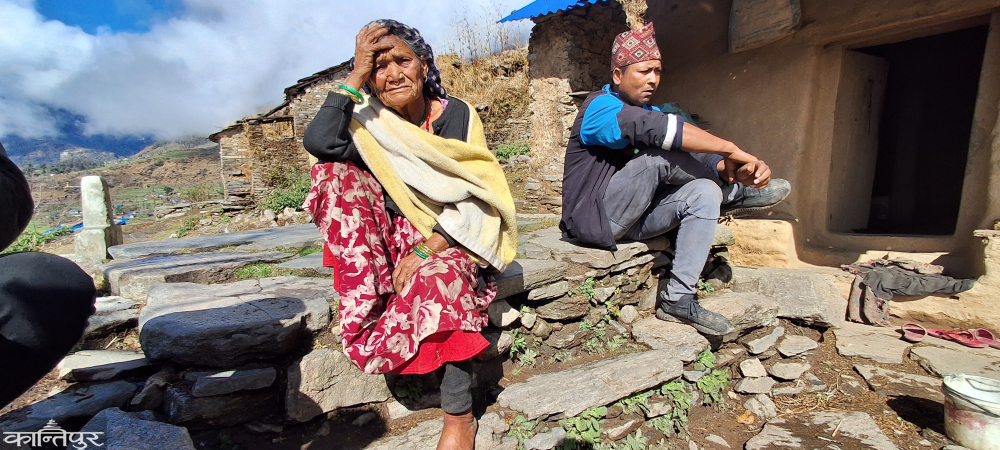
After walking for a while after cutting Aju's house, he arrived at the village of Jarimatola. An old woman was breathing heavily on a stone beside the path through the center of the settlement. She is a 70-year-old Nepalese woman. Despite having four sons, four daughters-in-law, 22 grandchildren and two great-grandchildren, she is alone in her old age. Where did that family go? She said in a sad voice, "Everyone's wings (feathers) flew away." Sons and grandchildren cut their wings. Now I feel short of breath even if I walk outside or inside.' All his life in India, he has been working as a janitor, washing dishes, cleaning houses, washing cars, and working in hotels. She said, 'Chakkar lager dhalya pan uthai dinya koi cheni.' Out of 65 houses, 11 are locked. When someone's house is destroyed,'' said the 55-year-old Puran Nepali, showing the houses where the families fled to India after locking themselves in the house. In the rest of the house there are only old people and small children. They also go to India after reaching the age of 12/13. He said that most of the villagers have gone to India to do the work and the old people at home have also succumbed to diseases. He said, 'If you want to see the pain that the parents will experience after the children go there, then it would be better if the locks were locked. There is a situation where people who live alone at home are not even known to be dead.'
Apart from this one in Sabikko Kanda gavis of Bajura, when he visited Talgaon, Singda Seragaon, Mailtola and other villages, as Puran said, all the family members were not found in any house. There were only children in the village, or only the elderly. It is difficult to find local youth here. If you see a youth, you will either be an employee or a businessman," said Chakra Budha, who runs a business near the ward office. "In the village, only old people and children can be found. If you want to meet the youth of Kanda, you have to go to Delhi.'
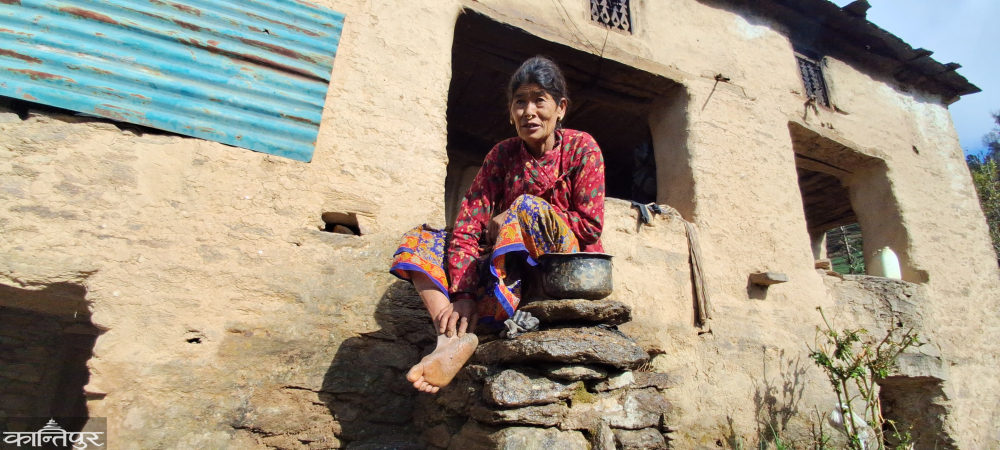
Women's health volunteer Nira Nepali said that after finding no alternative to earn money in the village, people who can earn have gone to India and the village is empty. She said, "The old people here are suffering because they have to live alone. Even the children have to leave their studies and go to Delhi. She said that it was like going to school while studying 7-8 classes so that the household expenses would be enough.
On his way back from the village, he met Kamal Sarki. He is 19 years old and has only been coming to the village for the past few weeks. After treatment in Delhi, Kamal Parsi, who came to take his sister home, was preparing to return to Delhi. He left school five years ago when he was studying in seventh standard and came to Delhi. He told the story of how he had to drop out of school while studying as there was no option to eat in the village and he had to go to Delhi and hit many hurdles. A dhawa (restaurant) owner hired me to pay 5000 per month. After working for four months, they fired me without paying me a single rupee,' he said, 'Even when I worked in other places, I was not paid according to the salary, I was scolded and beaten for not doing my job well.' Will they vacate and go to Delhi? Before the question could fall on the floor, Kamal said angrily, "It may have come." He had come for the restaurant before. When has the government come for us?' He did not stop there. He added, 'He has made his people rich. A government that remembers the poor like us will never come to this country.'
As Kamal said, Khaptad Chededah rural municipality has not implemented a program to stop the youth in the village, it has not kept the data of how many people left the village. There is no record of how many people have gone. Out of the 650 households in our ward, there is not a single house that has not gone to India. Ward president Bir Bahadur Rawal admitted that the elderly are sad when young people leave their homes. When there is no one at home, the old people will suffer.'' "People here will not be understood unless they go to India," he said, "No one wants to be happy in their own country." They share a thorn with Delhi. They say that there is such a facility there. How to make this unconcerned place like Delhi?'
The situation in other villages of Khaptad Chededah Rural Municipality is no different from that of Kanda. The condition of Atya Khet, Kurpe, Pipalgaon, Gajra, Gatada, Mayagada, Matesandhu of Ward No. 2 was similar. 64-year-old Prithvi Bamma of Kurpe village said that the youth are the soul of the village and argued that the village has become lifeless. He said, 'If you look for tannery, you will not find it in the whole village. The village is gone sir. Now there are no people to take them to the ghat after they die.
Bam, who cannot move both his legs due to paralysis, and his 60-year-old wife Padma are in charge of eight and four-year-old grandsons. His five sons and daughter-in-law are in Delhi. It had been months since they had had their contact. Said, 'Sometimes daughters come and help. We don't even know if the sons and daughters are dead.
Village Chairman Dil Bahadur Rawat says that the situation in all the seven wards of the municipality is the same and when the local residents started leaving the village for India, it started affecting different areas of the municipality. He said that some of the schools were closed and the number of students in some schools was very low after the locals started leaving the village with their families. "Some schools have reached the point of closure because there are no students," he said, "In the school that used to have 4-5 hundred students, now there are not even 150 students. After people leave the village, not only the school, but every area has been affected.
In a study conducted by the Ministry of Social Development of Sudurpaschim Province in 2078, it is mentioned that more than 266,000 people go to India from this province every year. According to the report, the age group of 17 to 45 years is the majority among those going to India. Of these, 19 percent of women and 81 percent of men are going to India.
It is mentioned in the report that Far Westerners go to Mumbai, New Delhi, Punjab, Hyderabad, Bangalore, Shimla and other places in India for work and 55 percent of them save 10,000 to 15,000 baht per month. 92 percent said that they use the money earned in India for household expenses. According to the study, two percent is spent on paying off debt and four percent on consolidating assets. According to the study report, the number of people living in India for more than three years is more than 14 percent.
'Village emptying out is ironic'
Prakash Madai, study on India-oriented immigration - researched
My study has shown that at least one person from 70% of the houses in Sudurpaschim Pradesh has gone to India. However, no government agency has the exact data of how many people are in India. If we want to reduce the number of people going to India, it is necessary to collect data. Programs can then be put in place to prevent them, and this burden can be reduced.
Nobody wants to leave the country. The number of people going to India can be reduced if programs based on skill and ability based partnership model are implemented. Government can create jobs in villages by teaching construction skills. By studying the potential of production based on the seeds, if we can implement programs such as teaching skills in partnership model for commercial agriculture, animal husbandry, herb cultivation, providing subsidies for doing business, supporting technology and guaranteeing the market for the products, more than half of them can stop in the villages. Even those who thought to do something in the village seem to have taken the path of India because of the failure of their products to find a market.
Locals were excited by the commitment made by Trilochan Bhatt, the first Chief Minister of Sudurpaschim Province, when he was sworn in. His resolve that 'no one will have to do the janitorial work of India anymore, the far westerners who went to India in search of work will be returned to their own homes within a year' was really commendable. However, the number of people going to India increased during his time. After that, even the leaders of the province are not able to stop the process of desertion.
After the advent of federalism, such problems should have been the first priority of all three levels of government. It was said that the government came to the village but could not reach the individual and the family. If the program could be decided on the basis of everyone's skills, abilities and qualifications, Far West would not have to suffer such a tragedy. The investment made by the government sector for doing various kinds of productive work and creating self-employment has also not reached the poor due to the tendency to provide facilities only depending on the complicated process and accessibility. Why should anyone stay in the country when only those with access can get it?