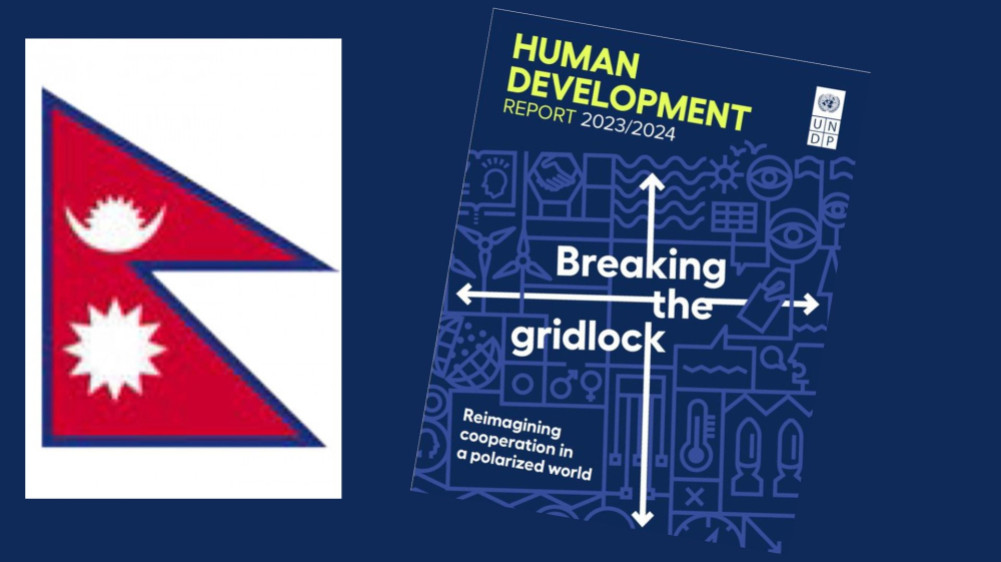
While rich countries are achieving human development goals, half of the poorest countries are lagging behind, the UNDP concluded
We use Google Cloud Translation Services. Google requires we provide the following disclaimer relating to use of this service:
This service may contain translations powered by Google. Google disclaims all warranties related to the translations, expressed or implied, including any warranties of accuracy, reliability, and any implied warranties of merchantability, fitness for a particular purpose, and noninfringement.
According to the Human Development Report released by the United Nations Federal Development Program (UNDP), Nepal has climbed three places. According to the report of 2023/024, Nepal has reached 146th place. Nepal was ranked 149 in the 2021 report.
According to UNDP's Global Public Human Development Report 2023/024, Nepal has progressed by zero point zero one.
'Nepal's human development index value is 0.601, according to which Nepal is in the medium human development category and ranks 146th among 193 countries and territories . In 2021, Nepal was ranked 149th. The report states, "Compared to 2021, Nepal's human development index has progressed by 0.010, which is more than the global average of 0.004".
Medium human development category means human development index value between 0.550 to 0.699 .
UNDP reports that between 1990 and 2022, Nepal's life expectancy at birth changed by 15.7 years, average years of schooling by 5.4 percent, and expected years of schooling by 2.1 years.
Nepal's per capita gross national income (GNI) changed by about 165.7 percent, the report states. In the year 2022, the human development index of women is 0.562 and that of men is 0.635, due to which the value of gender development index is 0.885.
'Although Nepal has made progress over the past 5 decades, post-Covid pandemic, this progress has come to a standstill - related to decent employment for youth, local and social inequality, economic growth, as well as trust in institutions . Cooperation between all three levels of government, but also with the private sector, civil society, the international community and the general public is indispensable," Resident Representative for Nepal, Aishani Medagangoda Labe said, "The federal government should pay more attention to transparency, accountability and integrity, provincial and local governments can increase planning and service delivery, and civil society organizations can further promote people's participation and voice to revive hope and confidence." In this way, everyone in the society will be benefited if they follow the path of multilateralism.
report states that inequality and political polarization are increasing at the global level, pushing the poorest people further back due to uneven development. The new Human Development Report emphasizes that the impasse must be resolved immediately through collective action.
The Human Development Report 2023/24, titled 'Ending the Impasse: Reimagining Cooperation in a Polarized World', shows that improvements in the global Human Development Index (HDI) have been partial, incomplete and uneven. It measures gross national income per capita, education and average life expectancy.'
The NDP notes that economic centralization has exacerbated global inequalities, stating that 40 percent of global trade in goods is concentrated in three or fewer countries, as noted in the report. In 2021, the market capitalization of each of the world's three largest technology companies will exceed the gross domestic product (GDP) of more than 90 percent of countries. "Despite the global interconnectedness of societies, we are failing. We need to strengthen our interdependence as well as our capacities to address the challenges identified in the report," said Akim Steiner, head of the United Nations Development Program (UNDP). May cause damage .
Not being able to work collectively in the areas of climate change, digitization or poverty and inequality has hindered human development. In addition, by intensifying the polarization, there is a danger that the trust in people and institutions around the world will become weaker.