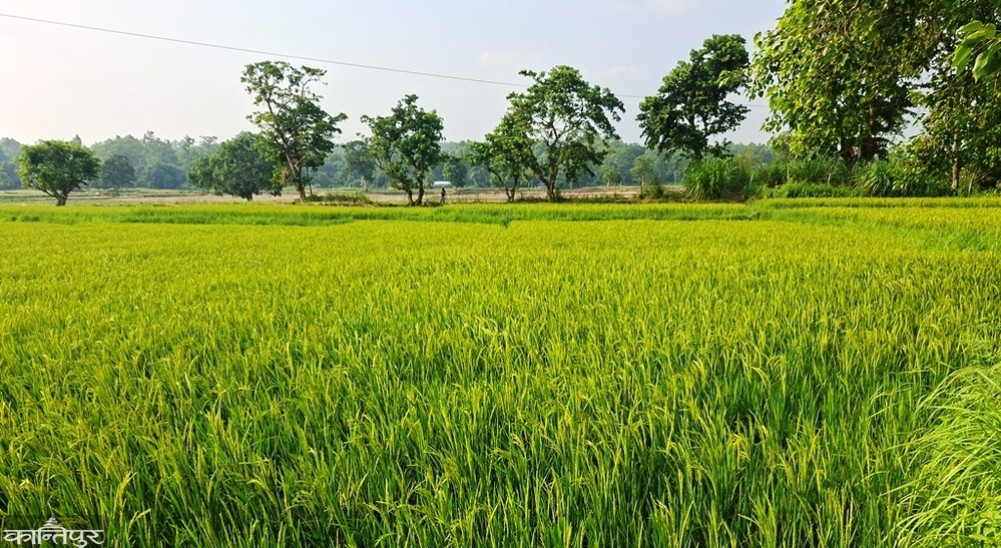
Due to the weak monsoon, farmers in Parsa have not been able to plant rice except in areas with irrigation facilities.
We use Google Cloud Translation Services. Google requires we provide the following disclaimer relating to use of this service:
This service may contain translations powered by Google. Google disclaims all warranties related to the translations, expressed or implied, including any warranties of accuracy, reliability, and any implied warranties of merchantability, fitness for a particular purpose, and noninfringement.
Due to insufficient monsoon rains, only 4 percent of paddy has been sown in Parsa so far. The Agricultural Knowledge Center has stated that the pace of sowing has slowed down in Parsa, a district in Madhesh Province, which is considered the country's grain storehouse.
According to Ramjivan Thakur, head of the Agricultural Knowledge Center Parsa, farmers in the district have sown paddy in only about 4 percent of the area so far.
According to him, Thori Rural Municipality and Parsagarhi Municipality have comparatively more paddy sowing due to the presence of canals and other irrigation facilities. 'Farmers have sown paddy in the areas with irrigation facilities,' he said, 'In most other places, farmers are still preparing paddy beds.'
It is estimated that this year, annual paddy will be cultivated in about 40,000 hectares in Parsa. Last year, paddy was cultivated in about the same area.
Paddy is being produced as the main food crop in all 14 local levels of the district. In the northern and western parts of the district, planting has progressed somewhat as irrigation is provided through natural streams and canals. However, most areas of the district are still dependent on rain, so planting has not been able to gain momentum until there is sufficient monsoon rain.
Although the Gandak Canal, which flows through the center of the district, provides irrigation facilities in some areas, it is not sufficient for the entire district. For this reason, planting, which begins in the hilly districts from Asad 15, continues until the end of Shrawan in Parsa and until the first week of Bhadra in some places.