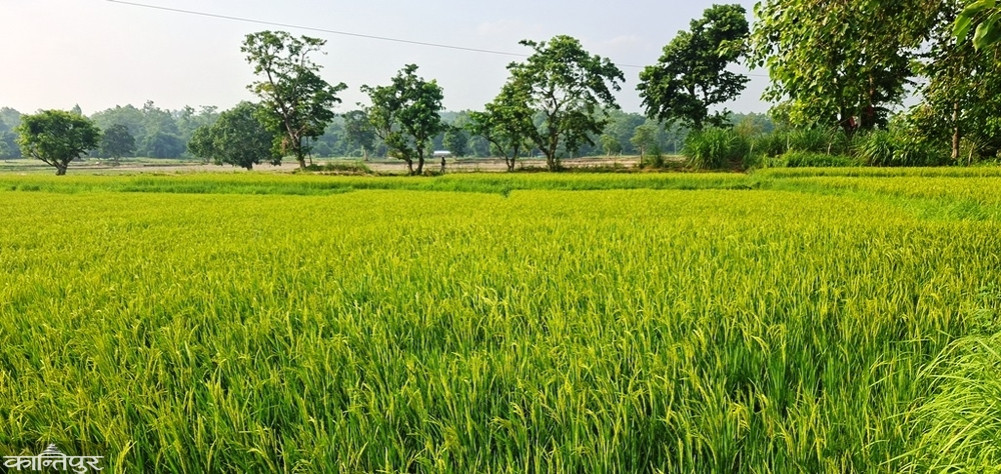
Farmers have demanded relief after a herd of elephants destroyed their rice crop in Shikaribas, Thori Rural Municipality-3, Parsa for five days.
We use Google Cloud Translation Services. Google requires we provide the following disclaimer relating to use of this service:
This service may contain translations powered by Google. Google disclaims all warranties related to the translations, expressed or implied, including any warranties of accuracy, reliability, and any implied warranties of merchantability, fitness for a particular purpose, and noninfringement.
The threat of wild elephants has increased in Shikaribas, Thori Rural Municipality-3, Parsa for the past five days. Local farmers have become worried after a herd of elephants started destroying the Chaite paddy crop that was being prepared for harvesting.
According to local Bambhola Mahato Tharu, a herd of 9 to 12 elephants has been entering the fields around the village at night and destroying the paddy crop. "It is time to harvest the paddy that was grown with pains, but elephants destroy it in a few moments," he said.
The paddy crop planted in an area of about two kaththas by farmers including Biga Chaudhary, Dilip Gauro, Sanjay Chaudhary has been destroyed. Tharu said that the elephants also destroyed the Asare paddy sowing of farmer Binod Yadav.
Another farmer Dukha Mahato said that it is difficult to maintain the farm every year due to the threat of wild animals. "Elephants come during the rice ripening season, while at other times, wild boars, chitals and monkeys damage the crops," he said. "Even half of the crops planted with much trouble are not saved."
Shikaribas is located on the border of Chitwan and Parsa National Parks. The 52 households here mainly depend on farming. However, locals complain that they have suffered huge losses in agricultural production due to regular attacks by wild animals.
The village can be reached only by crossing a forest path of about seven kilometers from the Birgunj-Thori Hulaki road. Locals are still deprived of basic services like roads, education and health. Since the road leading to the village passes through the Shikaribas River, movement is affected during the rainy season.
There is a school in the village that provides education up to grade five only. After that, students have to cycle about 24 kilometers daily for their studies. Even though there is a health post, locals say that they are forced to go out for treatment due to the lack of regular health workers and medicines. Locals have demanded that the concerned bodies conduct effective conservation and relief programs to minimize damage caused by wildlife.