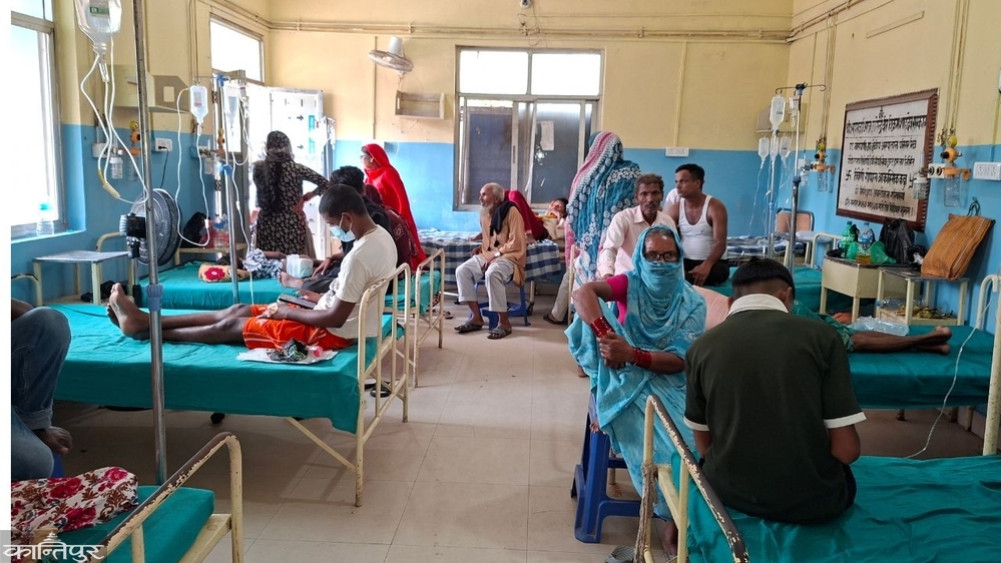
Those who were initially admitted to the hospital with diarrhea and returned after treatment are coming back with the same problem.
We use Google Cloud Translation Services. Google requires we provide the following disclaimer relating to use of this service:
This service may contain translations powered by Google. Google disclaims all warranties related to the translations, expressed or implied, including any warranties of accuracy, reliability, and any implied warranties of merchantability, fitness for a particular purpose, and noninfringement.
The citizens of Birgunj have become alarmed after the cholera infection, which has come under the control of the Gen-G movement, has started to increase.
According to the data released by the District Health Office on Sunday evening, the number of cholera infected in Parsa district has reached 238 in a month. Out of them, 220 were found in Birganj metropolitan area and 18 in Pokharia municipality. Currently, 2 cholera patients are undergoing treatment in different hospitals in Birgunj.
1,484 patients with diarrhea and cholera were admitted to various hospitals in the district during one month. 1,450 of them have returned home after treatment. 34 are still undergoing treatment.
In the early days, the local administration claimed that there was no death due to cholera in Birgunj. At the same time, a woman and a man died at Narayani Hospital and Birganj Health Care Hospital respectively due to all symptoms consistent with cholera. They were cremated without laboratory tests.
The then Prime Minister KP Sharma Oli informed the House of Representatives that three people had died due to cholera in Birgunj. But none of the government bodies in Birgunj has yet Officials have not confirmed a single death from cholera.
The source of cholera was not found
As the outbreak of cholera spread, there were various speculations about its source . Most of them initially guessed that the infection was in the water of the drinking water company or the water of the recently buried deep borings . But contrary to expectations, the laboratory tests conducted by any agency did not find cholera germs in the water.
Birgunj Metropolitan Municipality did not find the germs that spread diarrhea in the water test of the infected area by its own laboratory. The reports of all the samples taken from the streams of seven places of Ward No. 10, 11 and 12 of the cholera-affected metropolis were negative. The metropolis had collected and tested water samples from the streams of seven different places of cholera-affected wards No. 10, 11 and 12. Out of them, three borings and four drinking water institutes collected samples and tested them. In all seven samples, the E.coli bacteria that spread diarrhea was not found.
The test was conducted in a modern laboratory established in the drinking water treatment center in Ward No. 1 Chhapkaiya of the metropolis.
A month ago, the Janakpur Regional Office under the Federal Sewerage and Management Department took samples of the institute's water from different places in Birganj and tested it in its laboratory. Cholera infection was not found in the institute's water.
Two days before the Genji movement, the same department said that the World Health Organization and UNICEF Even after bringing a team of experts to conduct laboratory tests of drinking water from different places in Birganj, cholera germs were not found in any of the water .
Where did bacteria come from?
So far, most of the people are speculating that the water supply company responsible for the outbreak of cholera in the Birgunj metropolitan area or the water from deep borings buried during the recent drought has been proven wrong by the results of two laboratory tests.
Sanjiv Yadav, information officer and engineer of Birgunj branch of drinking water institute, says that a month ago, when the Janakpur regional office under the Federal Sewerage and Management Department took samples of the institute's water from different places in Birgunj and tested it in its laboratory, no cholera infection was found in the institute's water .
2 days before the Genji movement, the same department of the World Health Organization and UNICEF He said that even after bringing a team of experts and conducting laboratory tests of drinking water from different places in Birganj, no cholera bacteria was found in the water. When the team reached a correctional facility in Birgunj-15, they noticed that there was water stored in a dirty drum, and the team alerted them by pouring out the water.
In spite of frequent water testing, no cholera germs were found, Yadav speculates that the cholera infection may have spread through the dirty containers and mediums where the water is stored by the locals rather than in the water supply pipe system. He said that in the investigation conducted by the same team of the department in Murli, Chhapkaiya area of Birgunj, most of the local's houses were found to have waste water storage vessels.
Diarrhea patients are coming again and again. Those who were initially admitted to Narayani Hospital with diarrhea and returned after treatment are coming back with the same problem . The spokesperson of the hospital, Dr. Udayanarayan Singh, says that cholera and diarrhea patients have increased again since last week.
He said that in recent days, diarrhea and cholera patients come to the hospital from 12-15 to 20-22. According to him, diarrhea patients from Ward No. 12 and 11 of the metropolis, where the cholera infection started, have repeatedly started coming to the hospital. He said that there is a possibility that the problem is in the water they are drinking because those who have recovered once come back with diarrhea.
He said that it has been raining daily in Birganj since last week and there are still germs that spread cholera infection in the drains here. According to him, cholera germs usually survive in water for five days. He said that after it started raining, the water level of the canal increased and the germs in it started getting mixed with the water from the leakage of the water pipes in the canal and reaching the houses.
Spokesperson and officer of the District Health Office, Jaymod Thakur, says that cholera infection will not be controlled easily unless the locals themselves are alert and vigilant. He understands that many locals still do not show awareness about drinking water only after purifying it. He said that this problem would be solved to a large extent if the common people would boil their drinking water or add Piyush to drink it.
The chief district officer of Parsa Toynaryan Subedi claims that cholera and diarrhea infections are decreasing in the last few days. He said that even though the source of cholera spread has not been ascertained for the past few days, during the on-site monitoring, some places where drinking water is stored and the vessels have been found to be polluted, so purification measures have been adopted there .
Cholera and its sources have not yet been studied in detail, so he says that more studies are needed.