We use Google Cloud Translation Services. Google requires we provide the following disclaimer relating to use of this service:
This service may contain translations powered by Google. Google disclaims all warranties related to the translations, expressed or implied, including any warranties of accuracy, reliability, and any implied warranties of merchantability, fitness for a particular purpose, and noninfringement.
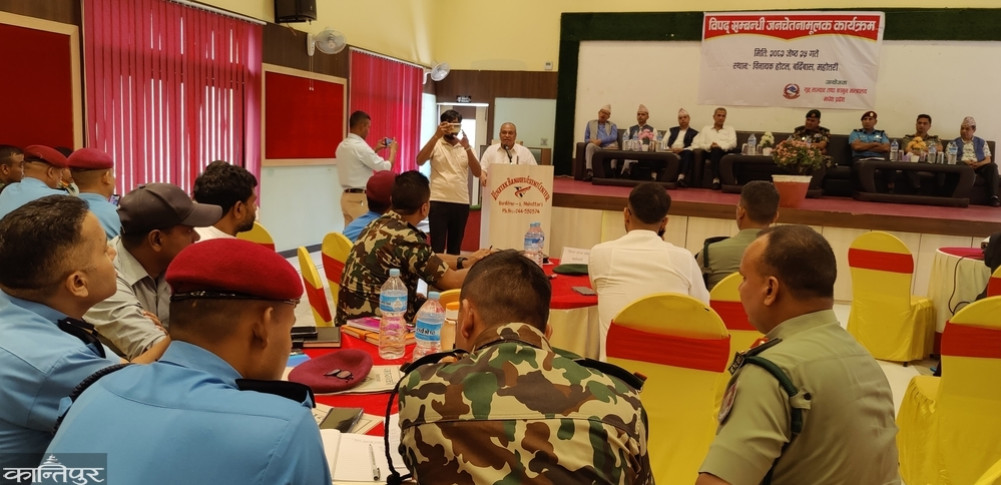
Stakeholders have said that it is important to adopt disaster sensitivity while implementing the development plan in Madhes. In the disaster awareness program held by the Madhesh government's Ministry of Home, Communications and Law on Sunday in Bardibas, Mahottari, the speaker expressed his concern that there was no development sensitivity in most of the settlements that were affected by flooding and erosion.
Narayan Prasad Risal, chief district officer of Mahottara, said that many settlements in Madhesh are at risk of flooding and erosion due to actions such as closing the drain, blocking the natural drainage of water, not managing the sewage, leaving the started development works and construction materials lying around. He pointed out that it is necessary to work with disaster sensitivity in coordination with all related parties and agencies during development. According to Risal, many settlements in 7 municipalities of Mahottari are still under the threat of flooding and erosion after the onset of monsoon.
According to the Madhesh Police Office, out of the total population of Madhesh of 61 lakh 26 thousand 228, 52 thousand 331 households of 28 thousand 687 civilians are at risk due to monsoon disaster. Stakeholders have said that it is difficult to make a more concrete plan for disaster response and preparedness when municipalities do not provide accurate data of people who may be at high risk from disasters.
UNDP's Dhan Bahadur Chand suggested that stakeholders should be careful to reduce the damage by immediately stopping the development work that is being done in a way that causes destruction. He said that there will be a serious crisis in the future if development plans proceed in such a way as to cause disasters, not only the destruction of ruins, the exploitation of natural resources, and the destruction of forests.
The chief district officer of Dhanusha, Shankarhari Acharya, said that the district disaster management committee has difficulty in working and preparing when the municipality-level disaster management committee works actively and does not provide the necessary reliable data. "It is necessary to correct the weaknesses of the municipality such as not providing accurate data, not attending the meeting of the district disaster management committee, and not helping to make plans," he said.
According to the provincial police office, 422 people have died in Madhesh in the current financial year due to disasters such as fire, flood, storm, lightning, drowning in ponds, animal attacks. During that period, 2,258 disaster incidents took place. According to the data, 900 people were injured in the disaster-affected province. According to the state police, there has been an economic loss of 566.7 million 24 thousand 212 in the current financial year due to the disaster.
The DIG of Madhesh Police Office, Uma Prasad Chaturvedi, emphasized that the municipalities should be more alert, active and sensitive to identify the dangerous places, purchase the necessary disaster response materials from the budget allocated by the municipality.
Krishna Dhakal, Deputy Inspector General of Police of Armed Police Force Chinnamasta Bahini, said that since they have to work with limited resources and means, all concerned should prepare properly to avoid disaster.
Home, Communications and Law Minister Rajkumar Lekhi says that due to the fact that the issues of disaster response and security have not yet been prioritized by the government, the work is being done with limited resources. 'The current government will work to reduce the potential risk of disasters by making plans in the policies and programs to be made,' he said.