To control the outbreak of armyworm infestation that has spread across various wards of Purbakhola Rural Municipality in Palpa, insecticides, spray machines, and technical teams have been deployed.
We use Google Cloud Translation Services. Google requires we provide the following disclaimer relating to use of this service:
This service may contain translations powered by Google. Google disclaims all warranties related to the translations, expressed or implied, including any warranties of accuracy, reliability, and any implied warranties of merchantability, fitness for a particular purpose, and noninfringement.
After an outbreak of the spiny rice hispa pest in the summer paddy fields of various areas of Purbakhola Rural Municipality in Palpa, the rural municipality has distributed pesticides to control it.
To prevent further damage to the recently planted paddy crops, the rural municipality mobilized a team including technicians through its agriculture branch to distribute pesticides in the affected areas. Spray machines, PPE sets, and other materials were also distributed, according to the rural municipality’s information officer Mohan Dhakal. “Agricultural technicians from the municipality have been deployed for on-site monitoring in areas affected by the pest,” he said. “Instructions have been given to distribute pesticides as needed.”
Assistant agricultural technician Shir Bahadur Budha from the agriculture branch said that the rice hispa pest has spread in the paddy fields of Ward No. 1 Siluwa, 2 Jalpa, 3 Ringnerah, 4 Devinagar, and 5 Birkot of Purbakhola Rural Municipality. In Alkichaur, Tamakhani, and other river areas of Ward 1, the pest has attacked the paddy crops. In various places of the Purbakhola field area, the paddy has turned yellow after being eaten by the pest.
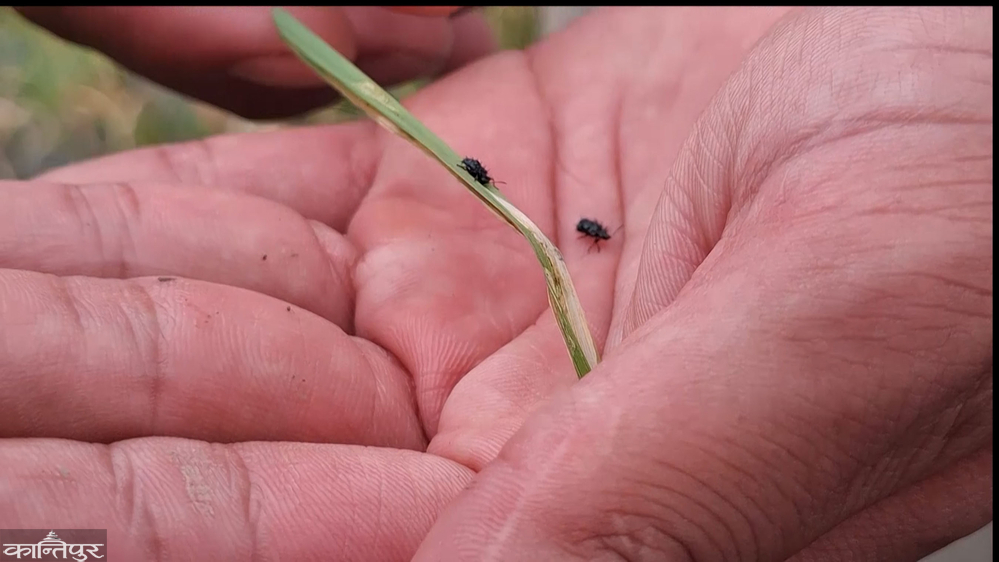
During monitoring, agricultural technicians have provided farmers with necessary technical information regarding pest identification, control measures, correct methods, dosage, timing for pesticide use, and fertilizer management. The rural municipality has distributed 7,500 milliliters of chemical pesticide containing 10 percent thiamethoxam and 5 percent lambda-cyhalothrin EC for use in areas with severe outbreaks. For areas with less severe outbreaks, 7,500 milliliters of organic pesticide containing 0.15 percent azadirachtin EC (1500 ppm) have also been distributed. Five complete sets of PPE and five electric and manual pesticide spray tanks have been distributed.
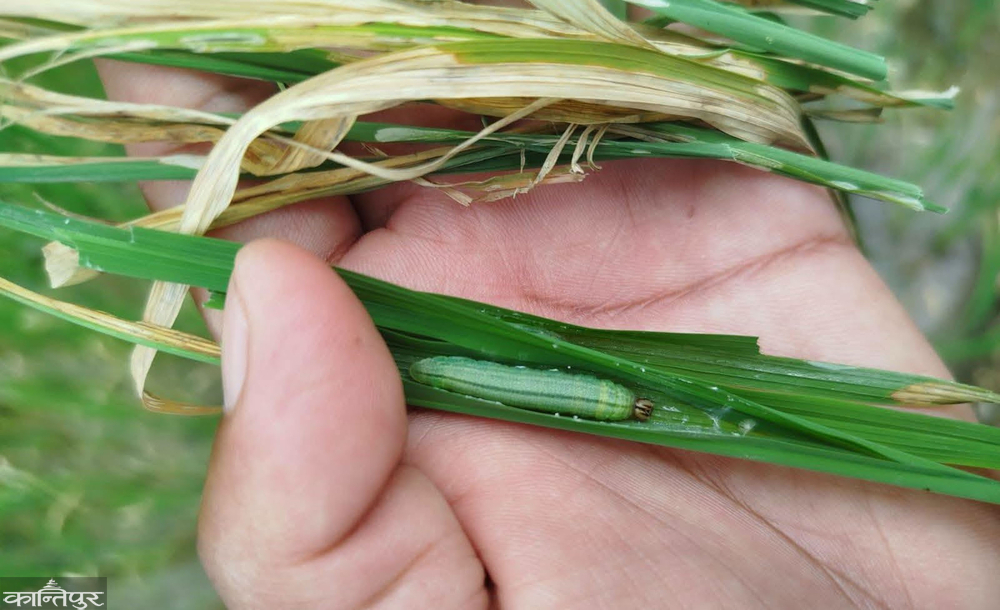
Vice-chairperson of the rural municipality, Bhagirathi Bhattarai, said that this problem can be effectively controlled through cooperation among farmers, agricultural technicians, and the local level. Outbreaks of the rice leaf folder pest have also been observed in some paddy fields of Siluwa, Purbakhola. This pest folds the leaves of the paddy crop. She said that farmers in affected areas have been made aware. During monitoring, the extent of damage to the paddy crop was assessed, and farmers were provided with information on the safe use of necessary pesticides, timely management, and integrated pest management to reduce the impact of the pest.
After the outbreak caused damage to the paddy crop, Member of the House of Representatives Sandeep Rana distributed additional pesticides through the Parliamentary Secretariat of Palpa Constituency No. 1. A team including agricultural technicians deployed by the Parliamentary Secretariat distributed pesticides along with necessary consultations to farmers of Rambha Rural Municipality and Purbakhola Rural Municipality to control the outbreak.
The MP’s Secretariat had previously distributed pesticides to farmers of Wards No. 2 and 3 who had planted paddy around Purbakhola. Secretariat member Jeevan Tiwari said that additional pesticides have now been provided for farmers in Ward No. 5 Furungdi, Ghurcis, and Muntung fields of Rambha Rural Municipality, as well as for areas of Purbakhola where there was a shortage.
According to agricultural technician Nirjal Pandey, the outbreak of rice hispa has been observed due to excessive use of urea, dense planting, high humidity, continuous damp conditions, and planting paddy immediately after caring for winter crops.

