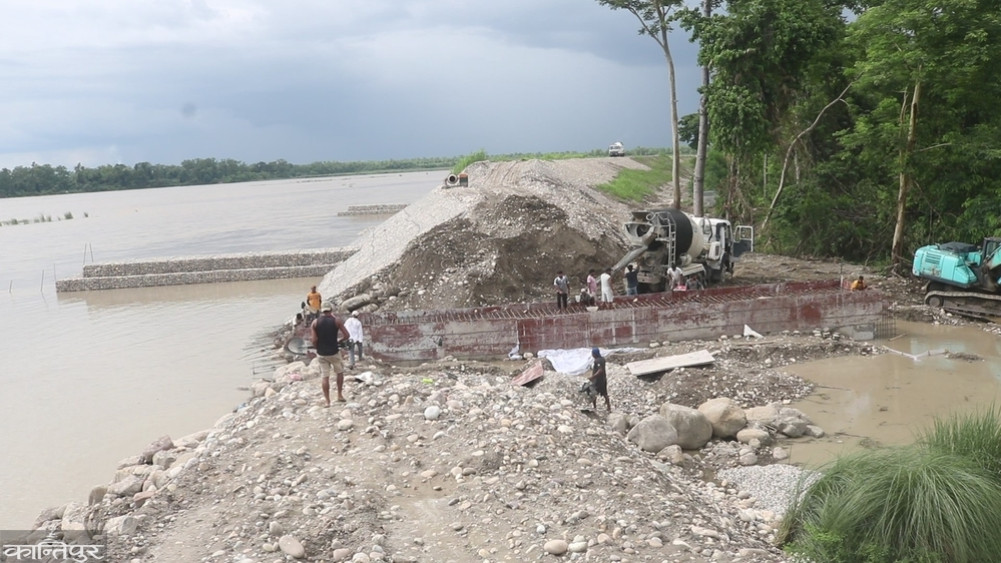
Of the 71 kilometers of Karnali River embankment in Bardiya, which was said to be completed in five years, only 22 kilometers have been constructed so far, leaving communities at risk of flooding and erosion still living in fear.
We use Google Cloud Translation Services. Google requires we provide the following disclaimer relating to use of this service:
This service may contain translations powered by Google. Google disclaims all warranties related to the translations, expressed or implied, including any warranties of accuracy, reliability, and any implied warranties of merchantability, fitness for a particular purpose, and noninfringement.
The goal to complete embankment control and flood prevention management work on the Karnali River within five years has not been achieved even after 12 years have passed.
Of the 71 kilometers of embankment that the former Karnali River Control Management Project, now the Rajapur Irrigation and Water Resources Management Project, was supposed to complete in five years, only about 22 kilometers have been constructed in 12 years.
On 15th Falgun 2071, then Irrigation Minister MP Saud inaugurated the project. According to the master plan, a budget of 12 billion 807.4 million rupees was approved to fully complete the embankment on the Karnali and its tributary, the Geruwa River.
The plan under the Karnali River Control Project to complete 71 kilometers of embankment within five years is progressing slowly. So far, about 25 percent of the embankment work has been completed. By Ashad 2083, about 22 kilometers of embankment have been constructed, according to the project.
The government had established the project office to construct embankments to protect arable land in this area from erosion and to prevent flooding. Due to delays in river control work, the erosion and flood-prone areas of Rajapur Municipality and Geruwa Rural Municipality remain at high risk. Hariprasad Tharu, a farmer from Rajapur-4, said that without the completion of the embankment, there is no sense of security during the monsoon.
He said that Rajapur and Geruwa municipalities suffer greatly from river erosion and flooding during the rainy season, and the risk persists because the plan has not been implemented as intended. So far, the project has constructed 168 spurs at a cost of over 2.8 billion rupees and built embankments at 27 locations for flood control. Dalighat in Rajapur-4 is considered the area most at risk from erosion and flooding by the Karnali River.
Project Chief Sudin Muktan said that the embankment work is progressing slowly due to a lack of budget. "The work could not proceed rapidly due to budget constraints," he said. "Based on the annual budget allocation for three or four years, only 80 to 90 million rupees have been disbursed, which is why the embankment work is progressing slowly."
Laxman Tharu of Rajapur-3 said that if there is a major flood during the monsoon, there is a risk that the freed Kamaiya settlement, Rajapur Bazaar, Sangharshanagar, and more than a dozen other settlements in the area could be inundated. "In addition, erosion on the west side of the Karnali Bridge at Sattighat could cut off access," he said. "If the state does not pay attention to this, flooding and erosion will cause devastation."
Settlements such as Rajipur in Geruwa Rural Municipality-2, as well as Banghusra and Tikulighat, are at high risk of flooding and erosion. Geruwa Rural Municipality Chairperson Jamansingh KC said that every year during the monsoon, dozens of settlements are inundated and residents are displaced. "As soon as the floodwaters enter, even the newly transplanted rice is submerged and damaged," he said. "The embankment construction has not been completed yet. During the monsoon, more than a dozen settlements in this area are at high risk from flooding."