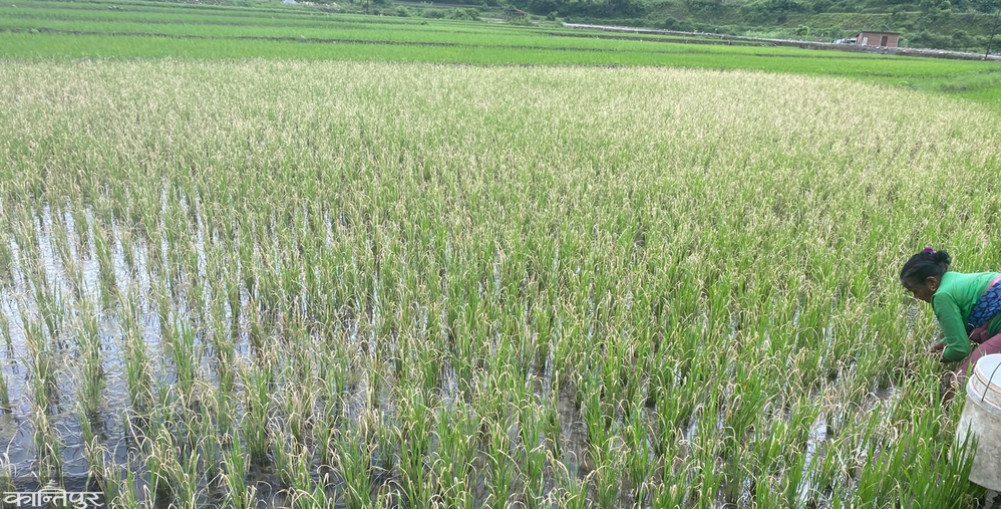
Farmers are worried as the rice plants have started turning yellow just a few weeks after transplanting.
We use Google Cloud Translation Services. Google requires we provide the following disclaimer relating to use of this service:
This service may contain translations powered by Google. Google disclaims all warranties related to the translations, expressed or implied, including any warranties of accuracy, reliability, and any implied warranties of merchantability, fitness for a particular purpose, and noninfringement.
In Jalpa Dadara, Purba Khola Rural Municipality–2, Palpa, the rice plants in Kamalraj Khanal’s field, planted in the second week of Asar, have turned yellow instead of green. He said that all the rice he planted on his 10-ropani plot has turned completely yellow.
A similar problem has appeared in the field of Khemkumari Ale of Jalpa Barmu, who has been farming on leased land. In the Purba Khola area, a spiny beetle pest has spread among the rice plants, causing white streaks and spots to appear on the leaves.
Locals reported that this pest infestation has been seen in rice fields from Labe to Khaireni, Mandidanda, Pul, Athbise, and the areas near Birta in Purba Khola. “From a distance, it looks like a weevil, and when you crush it in your hand, it stings. This is a problem we have never seen in rice before,” said farmer Pratiksha Nyaupane of Ringneraha, Purba Khola Rural Municipality–3. She said that the fields, which should have turned green 20 to 25 days after planting, are appearing yellow. According to Shir Bahadur Budha, Assistant Agriculture Technician of Purba Khola Rural Municipality, although no infection was seen in rice planted in the last week of Asar, most of the rice fields planted earlier have turned yellow.
When the fields turned yellow at a time when they should have been green, farmers in the area appealed to the local government for help in controlling the pest. Locals informed the agricultural technicians of Purba Khola Rural Municipality after seeing white streaks and spots on the rice plants. Assistant Agriculture Technician Budha said that upon field inspection, the same type of problem was observed everywhere. He said that the adult beetle found on the rice has blue-black spiny wings, and the leaves damaged by it show white streaks and spots.
He said that since it is the beginning of the fiscal year, the municipality has not been able to purchase and distribute pesticides for pest control. After inspecting the fields, farmers were advised on spraying methods and recommended pesticides. He said that some farmers have brought insecticides themselves and used them in their fields. Local farmers say that this pest, which has also been seen in rice planted in Chaitra, has attacked so heavily that the entire field appears white.
Santosh Chaudhary, head of the National Agricultural Modernization Project Implementation Unit, Palpa, said that this is not a disease but a pest that spreads when the environment is favorable. “This is not a pest that appears regularly,” he said. “It appears as soon as the conditions for its growth are met.” He said that since it eats the entire green part of the leaf, it turns the plant yellow. If the infestation is severe, the plant cannot photosynthesize. He said that if insecticides are sprayed, new shoots will emerge. Chief Chaudhary said that if it can be controlled, it will not significantly affect production.
After receiving only technical advice and no other support from the municipality for pest control, locals also appealed to Sandeep Rana, Member of the House of Representatives from Palpa Constituency No. 1. “When the rural municipality said there was no budget, we complained to MP Rana, and he provided 1,700 milliliters of insecticide, along with sprayers and masks,” said local farmer Meghraj Nyaupane. MP Rana said that he brought agricultural technicians from the municipality and agricultural experts from Rampur to try to solve the problem seen in the farmers’ fields.
Locals said that the pest has damaged local rice varieties such as Pokhareli Jethobudho, Jhinuwa, Kathe, as well as hybrid rice in the Purba Khola area. Ward member Basudev Nyaupane of Ringneraha, Purba Khola–3, said that this issue was also raised at the village assembly meeting held on Asar 29. In Palpa, rice is cultivated annually on 7,287 hectares of land.