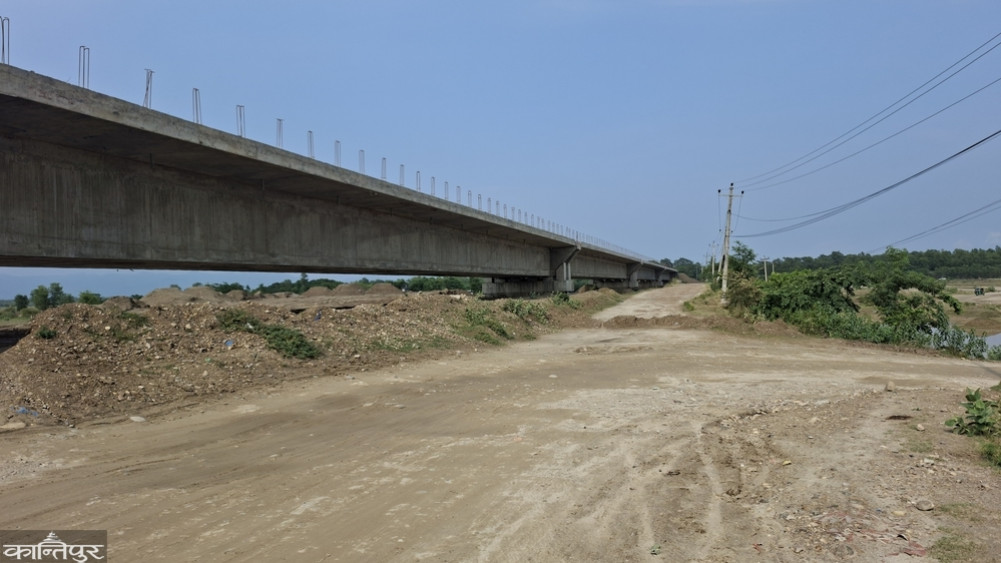
Local residents have been demanding that the river should not be narrowed, their arable land must be preserved, and, if necessary, they should receive appropriate compensation.
We use Google Cloud Translation Services. Google requires we provide the following disclaimer relating to use of this service:
This service may contain translations powered by Google. Google disclaims all warranties related to the translations, expressed or implied, including any warranties of accuracy, reliability, and any implied warranties of merchantability, fitness for a particular purpose, and noninfringement.
About 75 percent of the construction work on the bridge being built at Sidhaniya Ghat of the Rapti River in Banke has been completed. However, local residents are now demanding that the length of the bridge be 1,140 meters instead of 700 meters.
The total length of the bridge is 700 meters, while the length of the approach road connected to the bridge is 1,480 meters. The approach road is being constructed with 1,000 meters on the west side and 480 meters on the east side of the bridge.
So far, most of the bridge’s structure has been completed, and only the upper slab remains to be installed on two spans, that is, about 122 meters.
Pramod Kumar Sonkar, a local resident of Rapti Sonari Rural Municipality–6 in Banke, said that the bridge should be 1,140 meters long. He mentioned that the river flows through their land with land ownership certificates and said that the government’s planned river control program would affect their livelihoods. “Except for four months during the dry season, we manage to make a living by farming something or other on the riverbed,” he said.
Another local, Kashiram Yadav, said that if attention is not paid in time, villages such as Halkarapurwa, Sidhaniya, Balapur, and Kamdi would be affected.
“We have lived here for so many years; now we can also estimate where the river’s course will go. What we need now is a 1,140-meter bridge,” he said.
Former Lumbini Provincial Assembly member Krishna KC said that building a 1,140-meter bridge is much more necessary than river control. She claimed that if this is not done, not only will local residents be affected, but it will also create a new social problem.
Lilabahadur Bhandari, Chief of the Project Office, Nepalgunj, under the Postal Highway Directorate and District Engineer (CDE), said that along with the bridge construction, river control and embankment construction work is also being carried out in an area of about 4,600 meters.
Local residents have been demanding that the river should not be narrowed, their arable land should be protected, and that they should receive appropriate compensation if necessary.
District Engineer Bhandari said that discussions are ongoing with the concerned authorities on this issue and that some local residents have expressed concerns regarding the river control work. “Although the width of the Rapti River from one bank to the other is about 1,140 meters, based on technical studies, the state of water flow, and hydrological analysis, it was concluded that a 700-meter-long bridge would be sufficient,” he said. “This was not a decision made by one person; we have only implemented the law.”
Bhandari said that local residents have demanded the construction of a small bridge on the 440-meter approach road in the small stream area on the east side of the bridge.
He also said that there is a possibility that some private land will be affected for river control, and if such a situation arises, the issue of compensation will proceed according to departmental decisions. “We also have plans to construct river control structures in some areas to manage the river’s flow,” he said.
He stated that although the bridge’s design is technically appropriate, the social concerns and grievances of the locals cannot be ignored, and efforts are being made to find a solution in accordance with the law.
He said that in recent years, vegetable and watermelon farming has flourished in the sandy areas along the riverbank, so local residents want their arable land not to be affected, and the state should take necessary initiatives to address their concerns.
The bridge construction contract was signed on 4 Magh 2079 (January 18, 2023), and the target is to complete the bridge by 4 Ashoj 2084 (September 21, 2027).
The total cost of bridge construction, including VAT, is Rs 1.19 billion. So far, payments worth about Rs 900 million have been made. Since the bridge is being built in the deepest part of the river, the remaining work on the two spans could not be completed this year, and Bhandari said it is expected that the bridge will be fully operational by this time next year. The Postal Highway Directorate, Kathmandu, managed the contract and assigned the Project Office, Nepalgunj, the responsibility for implementation.