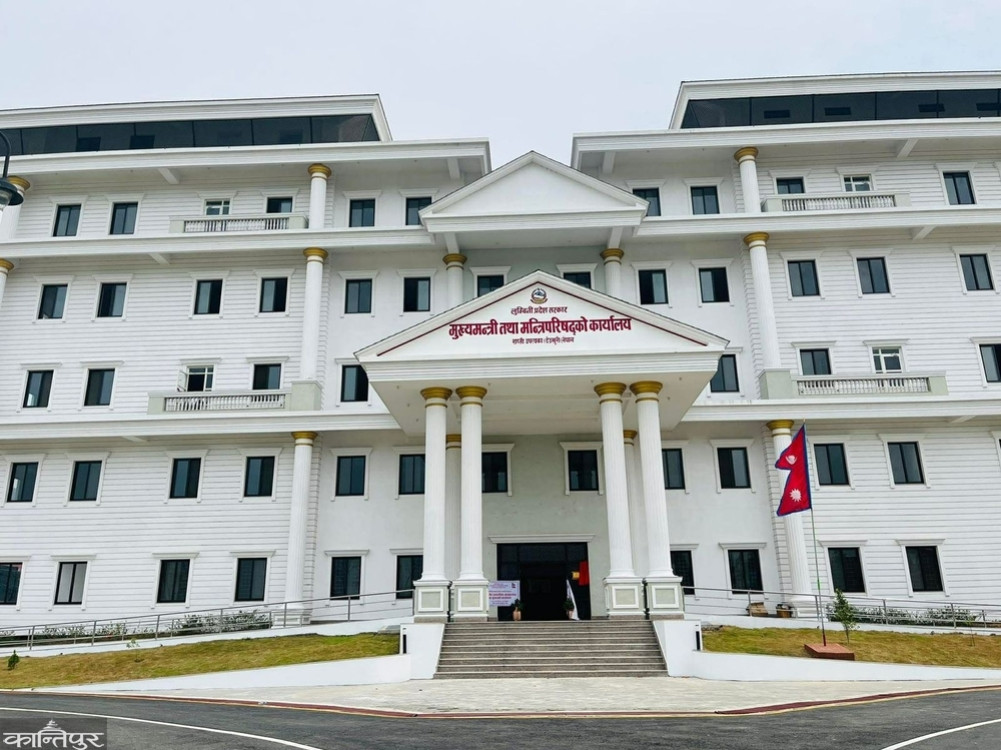
As per the decision of the Lumbini provincial government, the ministry is preparing to reduce its staff from 12 to 8, and a committee has been formed for implementation.
We use Google Cloud Translation Services. Google requires we provide the following disclaimer relating to use of this service:
This service may contain translations powered by Google. Google disclaims all warranties related to the translations, expressed or implied, including any warranties of accuracy, reliability, and any implied warranties of merchantability, fitness for a particular purpose, and noninfringement.
Preparations have begun to reduce ministries in Lumbini. The government's cabinet meeting on 16th Jestha had decided to reduce the 12 ministries of Lumbini Province to 8. The issue of reducing ministries was a priority in the government's policies and programs for the coming year.
An Organization and Management Survey (O&M) committee was formed under the coordination of the province's Chief Secretary Krishna Prasad Kapri to implement the government's decision. The committee was given the responsibility of preparing a report on the new structure of the ministry along with necessary amendments to the Provincial Government (Division of Work) Regulations, 2079 BS.
According to sources, the committee is preparing to merge the Ministry of Energy, Irrigation and Water Resources with the current Ministry of Urban Development and Drinking Water, separate the Ministry of Industry, Tourism and Transport from the Ministry of Industry and Transport and merge it with the Ministry of Internal Affairs and Law, and merge tourism with the Ministry of Forest and Environment. Similarly, preparations are underway to form a single ministry by merging the Ministry of Health and Social Development. Although there have been discussions on merging urban development with physical infrastructure, youth and sports with social development, and separating cooperatives from the Ministry of Agriculture, Land Management and Cooperatives and merging them with the Ministry of Economic Affairs and Planning, the committee has not reached a conclusion. 'The discussions are on making ministries and departments that are similar in nature as much as possible,' the source said, 'but no final conclusion has been reached.'
Secretary of the Office of the Chief Minister and Council of Ministers Shambhu Prasad Marasini said that the committee has already prepared a kind of blueprint after administrative and technical discussions. He said that the blueprint was prepared with discussions on ministries and departments under them rather than deciding which ministry should be merged with which. 'The committee has completed all the work to be done and prepared a blueprint as per the requirements,' he said. 'Since it is also a political issue, administrative preparations have been completed to the point where it can be implemented as soon as there is a political agreement.'
Lumbini currently has 12 ministries, including the Office of the Chief Minister and Council of Ministers. The ministries are Economic Affairs and Planning, Internal Affairs and Law, Physical Infrastructure, Urban Development and Drinking Water, Forest and Environment, Social Development, Energy, Water Resources and Irrigation, Agriculture, Land Management and Cooperatives, Youth and Sports, Health and Industry, Tourism and Transport. The government is preparing to eliminate four of them. According to sources, in the first phase, preparations are underway to remove Forest and Environment Minister Devkaran Kalwar and Internal Affairs and Law Minister Bhandari Lal Ahir and make them departmentless. Two other ministers will be removed in the second phase.
Chief Minister Chet Narayan Acharya said that although the government is preparing to reduce the ministry, the possibility of implementing the government's decision from July 1 is low as political developments have progressed differently. 'We are in a state of preparation to implement the government's decision,' he said, 'but since there are signs of some changes in the power equation, we have to wait a few days and find a political consensus.' He said that no matter what happens, the government's decision to reduce the ministry will be implemented within July.
When the provincial government was established in Lumbini, the then Chief Minister and UML General Secretary Shankar Pokharel started work with 6 ministries. When Pokharel first formed the government in Falgun, 2074 BS, he started work with a three-member cabinet. A month later, on Chaitra 2074 BS, he expanded the cabinet and formed a 6-member cabinet. The same 6-member cabinet worked on the establishment of the provincial government for more than three years.
But the NCP split during Chief Minister Pokharel's leadership. After his own party split, Pokharel fell into a minority. To preserve power, he expanded the cabinet to 10 members on Baisakh 21, 2078 BS by making Janata Samajwadi Party MPs and independent MPs ministers. But even that did not save the government. After the Pokharel-led government fell into a minority, the then Maoist Center leader Kul Prasad KC became the Chief Minister from an alliance other than the UML. Although he formed a seven-member cabinet on 28th Shrawan 2078, in order to maintain the power balance, his cabinet had increased to 17 members, including the Chief Minister, including 13 ministers and 4 ministers of state. That is the largest cabinet in Lumbini Province so far.
After the second election of the Provincial Assembly in 2079, UML leader Leela Giri became the Chief Minister. He initially formed a 10-member cabinet. Then the UML government fell and the Congress, in collaboration with the then Maoists, formed a 9-member cabinet led by Dilli Bahadur Chaudhary and later a 12-member cabinet led by Maoist leader Jokh Bahadur Mahara. In 2081 Shrawan, the current Chief Minister Chet Narayan Acharya, after taking oath, increased the number of ministries again to 12 members.
Although the current Chief Minister Acharya decided to reduce the number of ministries to 8 with the aim of controlling expenditure, administrative frugality and maintaining an effective governance system, challenges have been seen in implementation. "There is a challenge in implementing the decisions of the 8 ministries," he said, "but it will be implemented in my time." He said that implementation is necessary because failure to implement the decisions will further increase the tendency for the province's expenditure to exceed its income and increase public anger towards the province.