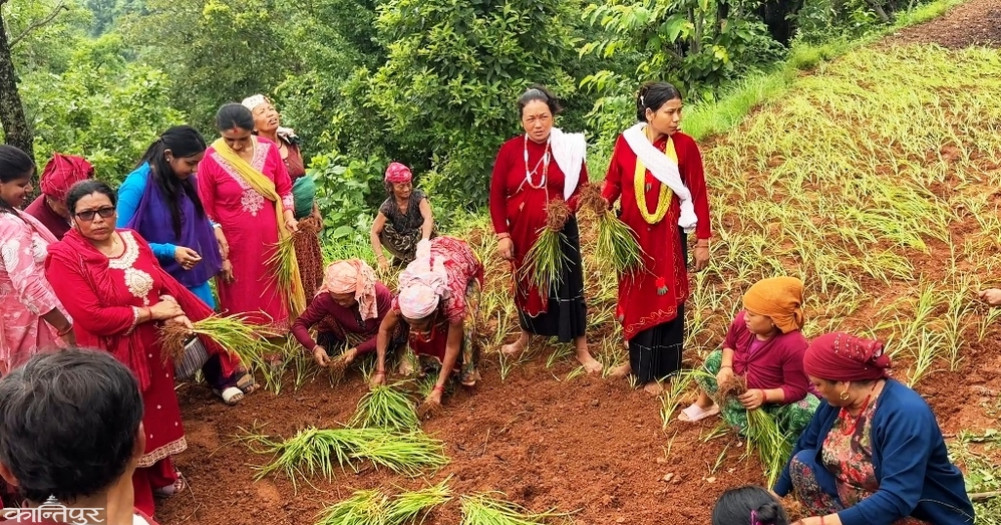
Following the continuous decline in millet cultivation, local levels have begun efforts to preserve the indigenous crop through grants, festivals, and publicity.
We use Google Cloud Translation Services. Google requires we provide the following disclaimer relating to use of this service:
This service may contain translations powered by Google. Google disclaims all warranties related to the translations, expressed or implied, including any warranties of accuracy, reliability, and any implied warranties of merchantability, fitness for a particular purpose, and noninfringement.
Due to migration, lack of young manpower, and increasing urban migration, the production of millet, a native crop, is decreasing every year.
Due to lack of manpower in the village, even those who used to plant millet are leaving every year, said Ward Chairman Krishna Bahadur Rayamajhi of Rambha Rural Municipality-4 Humin. ‘There is migration every year,’ he said, ‘There is no manpower to work in the village. That is why there is also a shortage of millet.’ A millet planting festival has been held in Humin since last year. Ward Chairman Rayamajhi said that a millet planting festival was held in Marsidanda of Humin last year and in Loreng village this year to promote, publicize, and explain the importance of millet.
Millet dishes were prepared and tasted at the festival. Participation was made from all the villages in the ward to plant millet. ‘The plan is mainly to publicize and promote millet,’ said Rural Municipality Chairman Bishnu Prasad Bhandari, ‘The municipality has made a plan to replace junk food by explaining the importance of millet as a local crop to all farmers.’ He said that after farmers stopped cultivating millet, which is considered a nutritious and healthy food crop, they have also arranged for subsidies in recent years. The Rural Municipality has been providing a subsidy of Rs 2,000 per plantation to farmers who grow millet.’
In places like Phoksingkot and Humin in Rambha Rural Municipality, millet cultivation has been practiced since ancient times. Gharti said that there is a tradition of growing it as another crop along with maize using local varieties of seeds in the traditional way. Milan Kafle of Humin in Rambha Rural Municipality-4 said that millet was used as flour, dhido, and roti for food earlier.
Farmers from more than 45 wards out of 81 wards in the district are cultivating millet. In Palpa, millet is cultivated in an area of 2,537 hectares. Last year, 3,762 metric tons were produced in Palpa. Millet is cultivated at altitudes ranging from 60 meters to 3,650 meters. In Palpa, millet was cultivated in an area of 2,363 hectares in the fiscal year 2080/081. According to the Agricultural Knowledge Center, it will be cultivated in an area of 2,349 hectares in the fiscal year 2081/082. Millet is cultivated in two municipalities and eight rural municipalities in the district.