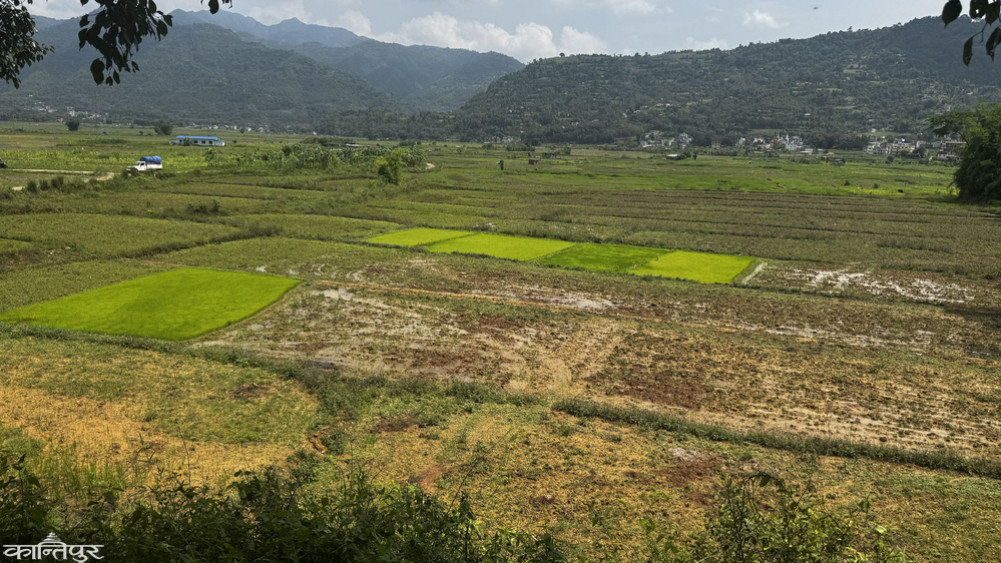
Farmers in Palpa complain that they are facing difficulties in planting due to lack of irrigation, quality seeds, and chemical fertilizers.
We use Google Cloud Translation Services. Google requires we provide the following disclaimer relating to use of this service:
This service may contain translations powered by Google. Google disclaims all warranties related to the translations, expressed or implied, including any warranties of accuracy, reliability, and any implied warranties of merchantability, fitness for a particular purpose, and noninfringement.
Janardan Basyal of Damkada Model Settlement, Tansen Municipality-9, was busy planting his fields after covering them with a blanket of rain that fell at night. As the seeds have started to sprout, he is forced to plant rice soon. He said that this year, due to the lack of rain, planting has been delayed. ‘We have to plant the fields with the trust of the sky,’ he said, ‘If there is no rain, we will be in trouble.’ But another problem is that if there is too much rain, the rice seedlings will be submerged. That is why in previous years, due to the timely rain, planting was done in the first week of Ashar, he said. Deepak Dhungana of Chirtungdhara, Baganaskali Rural Municipality-1 says that farmers are facing problems due to the lack of irrigation facilities, lack of chemical fertilizers, and the difficulty in finding seeds. He said that sometimes they have to sow twice because they cannot get good seeds. He said that his neighbor is now finally planting seeds. Half of the seeds he sowed earlier did not germinate. He said that after farmers stopped planting indigenous crops and old rice, they have to buy hybrid rice seeds every year. He said that sometimes when buying seeds, they do not germinate due to poor quality. According to the Agricultural Knowledge Center, 8,210 hectares of rice are cultivated in Palpa. Only 40 percent of farmers in the district have irrigation facilities. "It is not possible to plant the field until it rains and the roots sprout," said Rishiram Khanal, a farmer from Madiphant, Tansen Municipality-9. "I hope that after it rains at night, it will definitely be green later." Not only irrigation canals but also chemical fertilizers are in short supply every year. Since the government-provided fertilizer is not enough, it is forced to go to Rupandehi, Kapilvastu, and Nawalparasi to bring it.
While the National Paddy Day and Planting Festival are being celebrated on Monday with the slogans of climate-friendly technology, self-reliance in rice, and prosperity, farmers complain that they have not been able to plant due to lack of irrigation, fertilizer, and seeds. Beds are finally being placed in the eastern part of Palpa. Some have not even placed beds yet. According to Navin Gaire, agricultural extension officer of the Lumbini Province Agricultural Development Directorate, 20.8 percent of planting has been completed in Lumbini Province as of Asad 12.
Due to lack of rain, the monsoon rains were delayed compared to the previous year, so paddy planting in the province was less than the previous year. In the past, when there was timely rain, more than 50 percent of planting should have been done by now. "Rice planting has been reduced by a few percent this year due to the delay in water," he said. "Sowing is done by covering the sky with water, while in the Terai, there has been a delay in planting due to the lack of water in boring (shallow, deep tube well)." The directorate has stated that out of the 316,613 hectares of rice planting area in the 12 districts of the province, only 62,670 hectares have been planted so far.