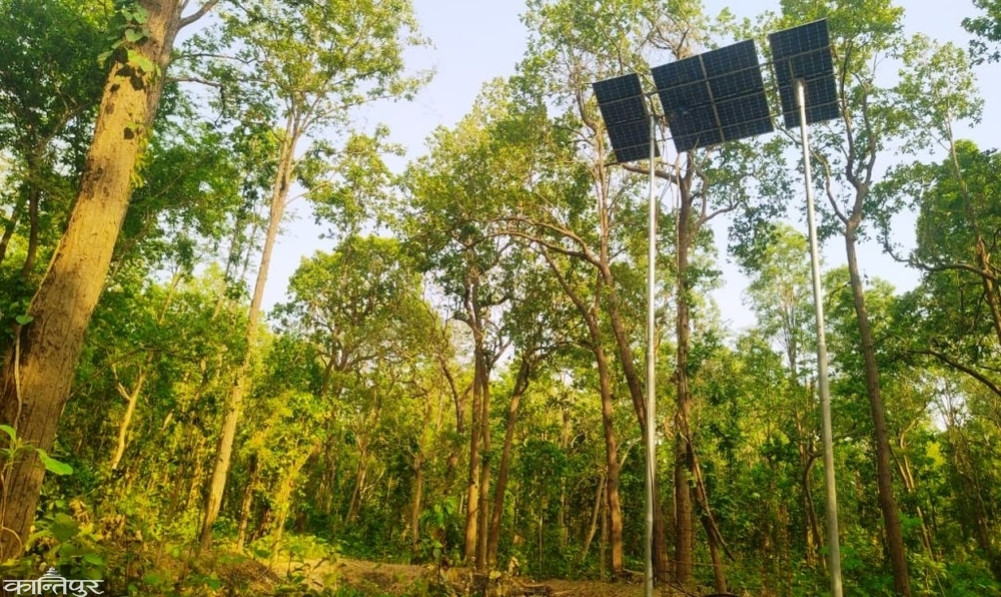
It is expected that after the construction of solar water ponds, wildlife will no longer have to go to settlements to find water and human-wildlife conflict will decrease.
We use Google Cloud Translation Services. Google requires we provide the following disclaimer relating to use of this service:
This service may contain translations powered by Google. Google disclaims all warranties related to the translations, expressed or implied, including any warranties of accuracy, reliability, and any implied warranties of merchantability, fitness for a particular purpose, and noninfringement.
To reduce the risk of human-wildlife conflict and attacks on wildlife when they reach wildlife settlements in search of water, a solar system has been installed to provide drinking water for wildlife.
A water pond with a solar pump has been constructed in the government-managed Shamserganj-Mathewas Chakla forest in Rapti Sonari Rural Municipality-8 of Banke.
A water pond with a 2-kilowatt capacity solar system has been constructed at a cost of about 1 million rupees. Shankar Prasad Gupta, Senior Divisional Forest Officer of the Divisional Forest Office, Banke, explained the construction of a water pond with a solar pump for wildlife on the Kamdi biological route. ‘This pond will provide relief in fire control as well as a habitat for wildlife,’ he said. ‘This pond, which is far from the settlements, will remain a model practice for biological route management.’
He said that water was extracted by drilling a 55-meter borehole with the financial support of the Nepal Climate Change Support Program (Eelam Project) in the Shamsergajanj-Mathewas Chakla forest.
Sushil Subedi, Senior Forest Officer of the Divisional Forest Office, Banke, said that after a long effort, they have succeeded in managing water for wildlife in the forest area through a solar system.
There had been incidents of wildlife drowning and dying when they went to the western main canal of the Sikta irrigation in search of water. Senior forest officer Subedi says that there are incidents of poachers attacking and killing wild animals that have been trapped in water and have reached the canal to drink water. He said that ponds have also been constructed in many places in community forests including Trishakti, Bhagwati, Madhu, Ashok, Janamukhi, Ramjanaki, Siddheshwari and Janakalyan in Banke to manage water for wild animals.