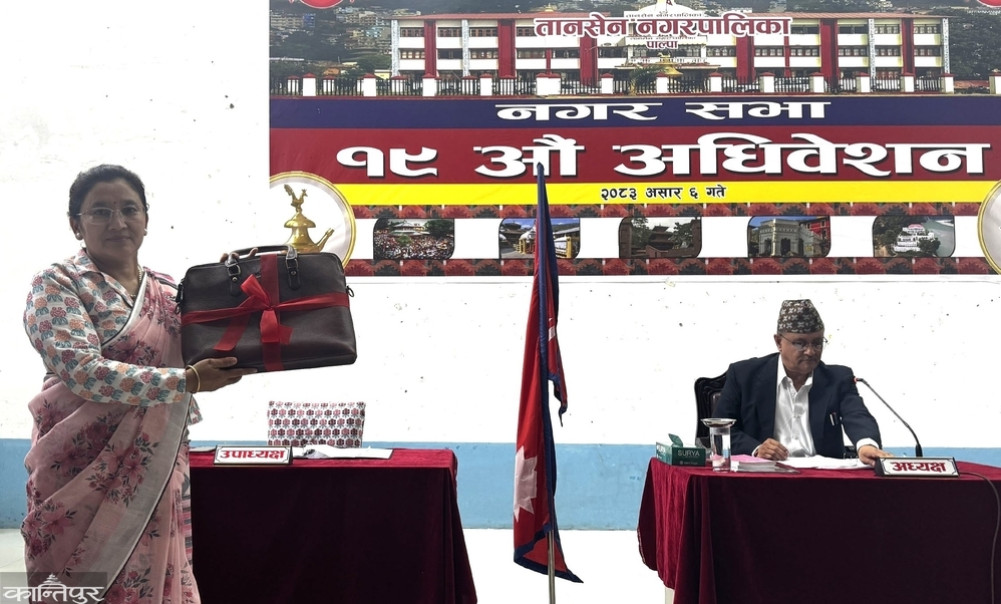
The budget prioritizes reducing poverty and improving living standards, and encouraging the public, private, and cooperative sectors to become partners in development.
We use Google Cloud Translation Services. Google requires we provide the following disclaimer relating to use of this service:
This service may contain translations powered by Google. Google disclaims all warranties related to the translations, expressed or implied, including any warranties of accuracy, reliability, and any implied warranties of merchantability, fitness for a particular purpose, and noninfringement.
The country's oldest municipality, Tansen, has unveiled a budget of Rs 1.694 billion for the fiscal year 2083/84. Last year, the municipality presented a budget of Rs 1.397 billion for the fiscal year 2082/83. Deputy Mayor Pratiksha Gaha Sinjali informed that Tansen Municipality has brought a budget of Rs 328 million less than the previous fiscal year. Presenting the budget at the 19th Municipal Assembly on Tuesday, Deputy Mayor Sinjali said that the internal revenue was estimated to be Rs 108 million, while the income was Rs 56 million. In the coming fiscal year, the current expenditure is Rs 685 million, including Rs 90 million.33 million, and the capital expenditure is Rs 384 million.12 million.
The budget for the coming year has prioritized the commercialization, marketing, modernization and tourism development of the agricultural sector, as well as qualitative development in education, income generation and self-employment, infrastructure development and capital formation. The priority has been given to reducing poverty and improving living standards, encouraging the public, private and cooperative sectors to become partners in development.
The budget aims to fulfill the minimum basic needs of the urban population, make maximum use of available resources and means, support the construction of a socialist-oriented, self-reliant society, align the budget, policies and programs with the sustainable development goals, and ensure transparency, thrift and accountability in public expenditure and maintain financial discipline and good governance.
Commercialization of the agricultural sector, marketing and modernization and tourism development, public service delivery and good governance, qualitative development in education, income generation and self-employment, infrastructure development and capital formation, human resource development, environmental protection and disaster management have been prioritized in the budget allocation for the coming year, Deputy Chief Sinjali said.
To encourage interested farmers, continuation of production on barren land, partnership with Heifer Project Nepal to promote agricultural business, and soil health improvement programs under the federal government's transferred program are priorities. A subsidy of Rs 3 per liter will be provided under the concessional program to dairy farmers to continue their production work. There is also an entrepreneur capacity development training program. The budget has been allocated for economic development, social development, physical infrastructure development, good governance and interrelated areas, office operations and administrative areas.
In the coming fiscal year, the current expenditure is 64.08 percent and the capital expenditure is 35.92 percent.
Although it is seen that self-reliance will be increased by increasing internal revenue and capacity development will be achieved, the tax rates including property tax, recommendation fee and other taxes have been maintained as they are. Deputy Chief Sinjali informed that the revenue-related laws, revenue system and revenue administration will be improved in line with the revenue reform plan to strengthen internal revenue.
A tax awareness training program will be included in collaboration with the Chamber of Commerce and Industry and the Trade Association to study the utilization of important tax sources such as business tax, property tax, rental tax, etc. Among the income sources to bear the expenses of the plans and programs allocated for the coming fiscal year, 155 million rupees from the federal government towards equalization grant, 50 million rupees towards complementary grant, and 423 million rupees towards conditional grant. Similarly, it has been informed that Rs 12.5 million has been received for capital, Rs 10 million for special grants and Rs 113.37 million for revenue sharing.
An equalization grant of Rs 18.86 million, a conditional grant of Rs 12.52 million, a complementary grant of Rs 12 million, and a revenue sharing of Rs 14.49 million have been received from the provincial government. Internal revenue is estimated at Rs 100 million.
The municipal development fund is estimated at Rs 49 million, public participation at Rs 10 million, and the balance for the upcoming fiscal year is estimated at Rs 177.61 million. The next meeting will be held on Asad 26 and the next year's budget, appropriation bill, and the report of the accounts committee will be discussed in the same meeting, said Mayor Santosh Lal Shrestha.