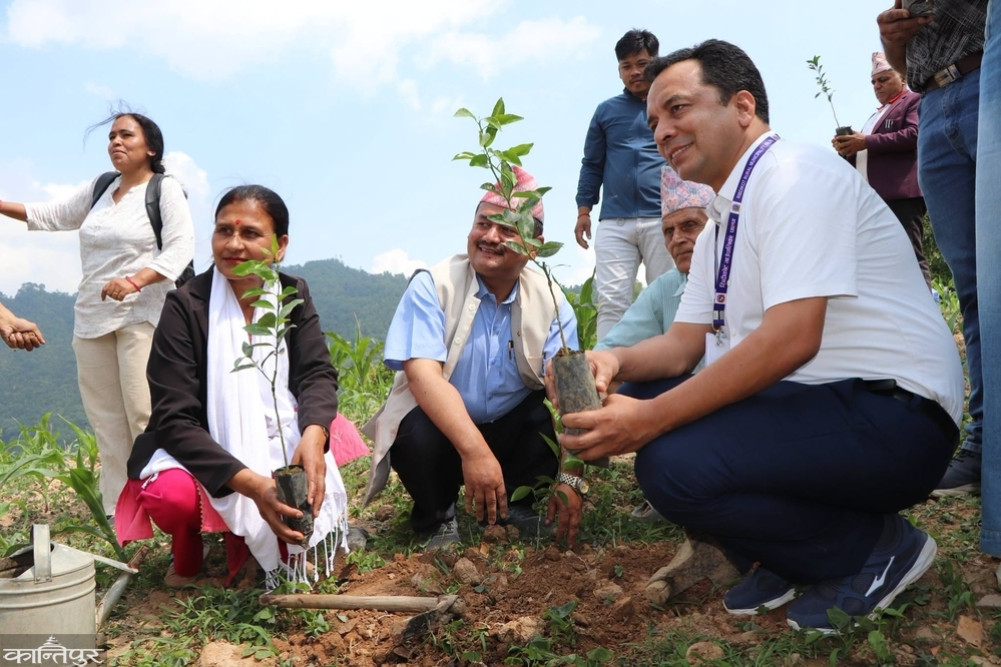
In Ribdikot Rural Municipality, 388 farmers have demanded more than 37,000 seedlings of orange, lemon, and coffee, among other plants, under the 'One Plant, One Hundred Notes' campaign.
We use Google Cloud Translation Services. Google requires we provide the following disclaimer relating to use of this service:
This service may contain translations powered by Google. Google disclaims all warranties related to the translations, expressed or implied, including any warranties of accuracy, reliability, and any implied warranties of merchantability, fitness for a particular purpose, and noninfringement.
Khimananda Pokharel, 81, of Deurali Chitpani, Ribdikot Rural Municipality-2, is preparing to plant 325 orange seedlings this year. He said that the pits for the seedlings have been dug and planting will begin as soon as the rains begin. He had planted more than 200 seedlings of oranges, lemons, and mausal last year. This year, he planted oranges under Ribdikot Rural Municipality's 'One Plant, One Hundred Notes' program. 'I had previously grown vegetables,' he said, 'I gave up because I was frustrated because wild boars, deer, rabbits, and deer caused me a lot of trouble.' Pokharel said that he had stopped growing vegetables two years ago and started planting fruits like oranges, lemons, and mausal last year. Pokharel has been a commercial vegetable farmer for 35 years. He has added more than 50 ropanis of land and a house by cultivating vegetables. He said that he stopped cultivating vegetables and started cultivating fruits due to age. He said that since he could not get seedlings in the village, he had to go to Chhahara Amlabas, Rainadevi Chhahara Rural Municipality-4 and bring them.
Anup Pokharel of Bhairavsthan Dhekuldanda, Ribdikot Rural Municipality-4 has demanded 1,800 coffee seedlings. He has dug more than 1,100 holes by the first week of Asad. He said, ‘Since there is a problem with wild animals, I have tried to plant them to see if there would be any benefit from planting coffee.’
Planting orange and coffee seedlings are just a few examples. Ribdikot Rural Municipality has run an incentive program for farmers with the aim of creating a model fruit garden in all eight wards.
In the current fiscal year, after the rural municipality introduced the 'One Plant for 100 Notes' program, 388 farmers demanded more than 37,000 fruit-bearing plants, said Ram Prasad Neupane, Market Development Facilitator of the Ribdikot Agriculture Project under the Rural Economic Development Association (REDA), which is responsible for community mobilization. 'This program has increased the enthusiasm of farmers since it will provide technical assistance under the direct supervision of the rural municipality for four years,' he said. 'Supporting organizations are also working to support the enthusiasm of farmers.' The rural municipality had allocated Rs 4 million for this program this year.
Village council chairman Narayan Bahadur Karki said that this program was also started from the garden of farmer Khimananda of Deurali Chitpani. He said that a campaign has been launched to build model fruit and herb gardens in every ward.
Rural Municipality Chairman Karki said that the campaign would be effective in ending the trend of keeping cultivable land barren and increasing farmers' income through fruit and herb production. He said that the rural municipality would provide cash assistance for four years to reduce the financial burden of farmers.
A minimum of 50 plants should be planted to participate in the campaign. Farmers will be provided with cash incentives of Rs 100 per plant in the first year, Rs 75 in the second year, Rs 50 in the third year and Rs 25 in the fourth year, said Suresh Bhusal, Chief Administrative Officer of the rural municipality.
The program was launched as part of a plan to elevate agriculture beyond the traditional subsistence-oriented style and make it commercial and production-oriented, said Kanta Adhikari, Vice President of the rural municipality. According to her, fruit farming is important to improve the economic condition of the locals.
The target of planting about 40,000 fruit and herb plants in 72 villages within the municipality was set as part of the campaign. According to the latest demand details, more than 37,000 seedlings have been demanded from 388 farmers from all 8 wards. Om Prasad Pokharel, Ward Chairman of Deurali, Ribdikot-2, said that this program was introduced to make full use of barren land, increase fruit production, protect the environment and increase the sustainable income of rural farmers. He said that the campaign will create an environment for farmers to benefit financially in the long term. Farmers are excited after being provided with technical supervision for four years. The procedure has been made to provide a small subsidy every year until the seedlings start producing. Although this program is ambitious, the rural municipality has a plan to make good use of barren land. Diwakar Aryal, a farmer from Kusumkhola, Ribdikot-5, said that the rural municipality meets farmers, tests the soil, provides technical knowledge and motivates the farmers by facilitating them.
The program has been facilitated by partner organizations Heifer Nepal and Rural Economic Development Association Palpa under the Ribdikot Agriculture Project.
The highest demand is for more than 18,700 orange seedlings, said Jaya Bahadur Bik, head of the Ribdikot Rural Municipality Agriculture Branch. He said that there is a demand for 5,566 lemon, 6,755 coffee, and 2,60 timur seedlings. In addition, there is a demand for 550 Buddhachitta, 425 cinnamon, 454 cardamom, and 475 kiwi seedlings. There is a demand for 980 avocados, 280 litchis, 524 sittalchini, 75 walnuts, and 300 dragon fruit. Farmers have demanded 275 peaches, 75 mangoes, 250 junar mausam, and 175 AAP seedlings.