Training by Anupam Shaw, Head of Anupam Heritage Lab, headquartered in Mumbai, India, and Senior Art Conservation Expert.
We use Google Cloud Translation Services. Google requires we provide the following disclaimer relating to use of this service:
This service may contain translations powered by Google. Google disclaims all warranties related to the translations, expressed or implied, including any warranties of accuracy, reliability, and any implied warranties of merchantability, fitness for a particular purpose, and noninfringement.
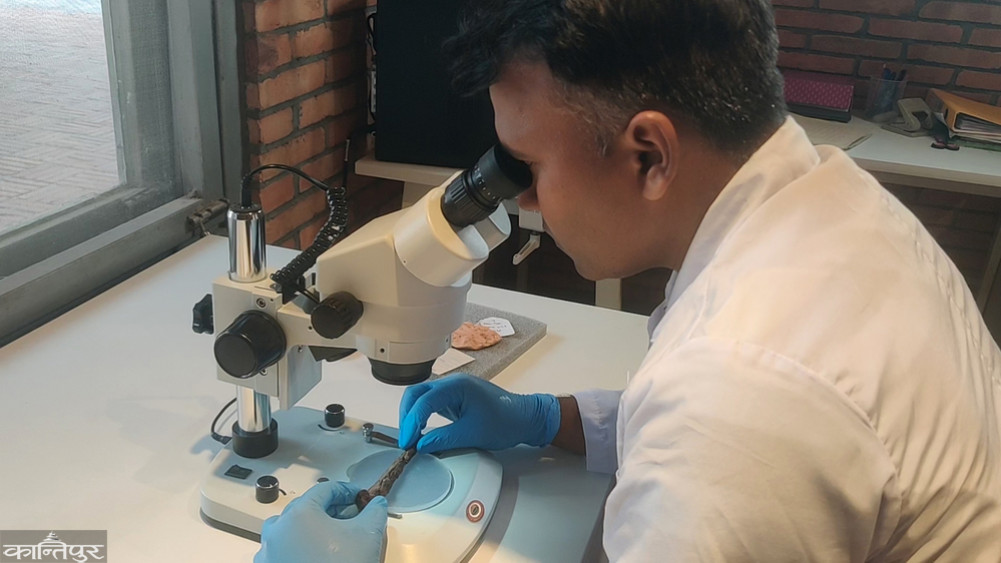
Trainee Chandra Prakash Pathak, wearing a clean apron, was focused on the objects placed on the table. His attention was slightly distracted, as if the natural form of the archaeological objects could not be preserved. Therefore, he focused on the conservation of those objects without looking left or right for a moment. ‘Initially, it is necessary to identify the problems for the conservation of archaeological objects,’ said Shanti Shermar, head and archaeology officer of the Kapilvastu Museum. ‘I am identifying the problems by placing the archaeological remains in front of a microscope.’
Having participated in excavations in Lumbini, Ramgram and Kapilvastu for a long time, she has learned about the conservation of archaeological objects from foreign experts. She learned skills while working with archaeologists from different countries. She is currently sharpening those skills. She says that she is currently learning how to preserve archaeological objects made of terracotta, stone and iron using scientific methods. She is also amazed when she puts what she has learned into practice and makes the archaeological objects in the museum safe. ‘Before, it was just bookish knowledge,’ she said, ‘now I am happy to put it into practice and work.’
10 people like her are learning to preserve objects of historical and archaeological importance with the help of modern technology according to archaeological values and norms. For the first time in Nepal, they were taught to conserve archaeological objects using modern technology. The training was given by Anupam Shaw, head of Anupam Heritage Lab headquartered in Mumbai, India, and a senior art conservation expert.
After preserving the archaeological objects, they were taught how to enter them into a computer and, if they were mechanical, how to maintain the methods and procedures. Similarly, they were taught to mention which chemical was used and in what quantity after chemical treatment. Himal Upreti, Chief Archaeology Officer of the Lumbini Development Trust Archaeology Division, said that they conserve by using manual and mechanical treatment as much as possible. ‘We have learned a lot of knowledge and skills,’ he said, ‘We will treat with chemicals if necessary.’ He said that even when treating with chemicals, they first do it on the back or in an invisible part of the archaeological object and then make further decisions based on the reaction.
He, who has been an archaeology officer of the trust for a long time, said that the training has taught him modern conservation work well. Trainee Pathak said that he also learned how to clean the object using chemicals and repair it if it is broken to make it whole, beautiful and safe. He said that he was more excited to do conservation work after learning new methods.
Such training has been organized to prepare manpower after the establishment of a state-of-the-art conservation lab at the Lumbini Museum with the support of the Buddha Foundation. In the four-week (April 18 to May 18) training organized by the Buddha Foundation with the support of the US Ambassador's Fund for Cultural Preservation Program at the Lumbini Museum, archaeologists, archaeological officers and archaeology students were taught knowledge, skills and techniques related to the conservation of archaeological objects. They were taught about the work and processes before and after the conservation of archaeological objects.
The laboratory (lab) has microscopes, photogrammetry equipment, endoscope cameras, ultrasonic ablators and state-of-the-art UV torch lights used for conservation work. There are photography materials, light meters, moisture meters, distilled water making machines, magnetic stirrers and other equipment.
The Lumbini Development Fund has entrusted the management and conservation of the museum built with the assistance of the Government of India to the Buddha Foundation. The Museum Foundation was given the responsibility for 35 years by signing an agreement on 1 September 2018. The participants in the training were first taught to take records of the archaeological objects to be conserved before starting the conservation work. Then, they were taught to take photographs from different angles and give new numbers to the objects to be conserved for identification. They were taught to use computers to identify problems with a microscope and, once the problems were identified, to consult in groups and decide what to do mechanically or chemically to treat them, and to work on the conservation process by providing knowledge.
If different types of fluorescent colors are applied to an archaeological object with ultraviolet light, it will be clear if someone tried to repair or make it new at some point. Similarly, they were also taught to identify information about what materials were new and old. They were taught to take photographs of archaeological objects. In this training, one hundred archaeological objects were conserved, including medieval iron shards, three clay ring wells, clay and stone statues of Shakyamuni and Goddess, found in the greater Lumbini area. Earlier, last year, a similar four-week training (August-September) was given in Lumbini for the first time. At that time, 70 archaeological objects were conserved in the Lumbini Museum.
The archaeological objects were conserved in the form of clay statues and utensils, stone statues, iron rods, copper wires, and gray ware clay bowls. The conserved objects are kept for display in the Lumbini and Kapilvastu Museums. Last year, 6 people participated in the training. The training increased the knowledge and skills of how to treat and preserve archaeological objects, said Hari Prasad Bhusal, Archaeology Officer of the Department of Archaeology.
There are more than 2,500-year-old cultural heritage sites in the greater Lumbini area. These contain valuable beliefs, stories, and legends. They are hidden. Like humans, archaeological objects also get sick. Like humans, these objects also try to blend into dust and soil. That is why if they are made of iron, they rust, if they are made of copper, they oxidize green. If they are made of paper, they become acidic and are destroyed, if they are made of wood, they rot, and if they are made of cloth, the threads come out and fray, and as important art objects are being destroyed, our old art objects are starting to disappear, so the conservation skills are important, said the instructor who came to Lumbini.
Just as a child with a rash on his body is cured by first correctly distinguishing whether it is measles, mumps, chickenpox, or mosquito bites, he said that effective restoration can only be achieved if we can identify and preserve archaeological objects properly. Since the eye cannot see what is inside the archaeological object to be preserved and how to treat it, X-rays are initially performed. If the problem is not detected even through that, he said, CT scans are performed to identify the problem and treat it.
Although X-rays and CT scans are not available in Nepal, he shared his experience of preserving archaeological objects in Egypt using CT scans. Shaw is one of the world's most renowned art conservators. He has worked on conservation work in many places with the Ministry of Culture of the Government of India, the World Bank, UNESCO, Tata Trusts, and Aga Khan Trust.