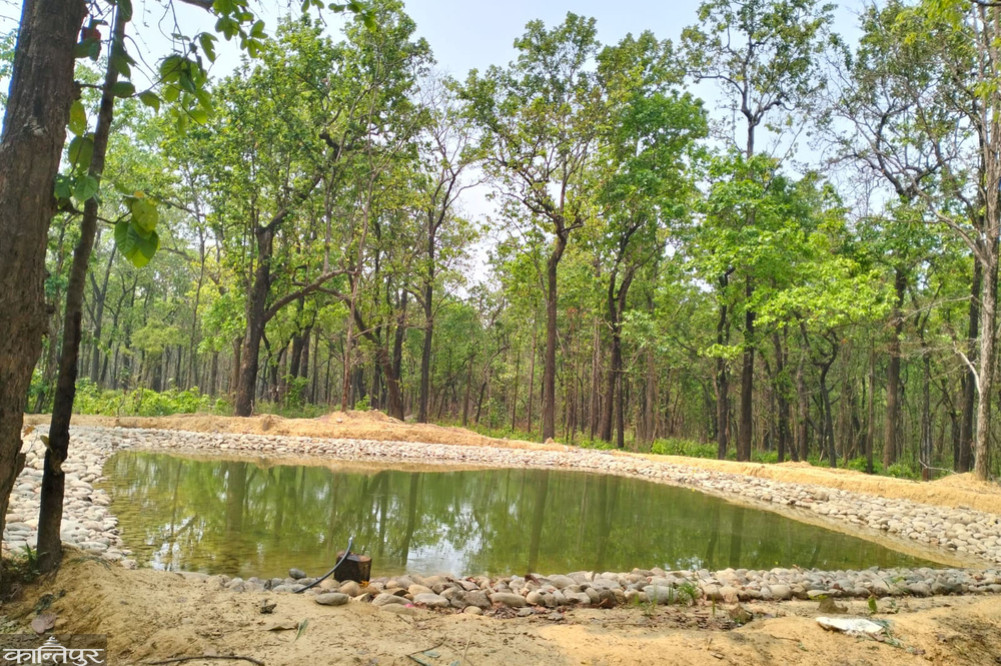
Ponds built in the Gaide Community Forest in Arghakhanchi for wildlife conservation and ecological balance will provide water to wild animals, birds, and local fauna throughout the year.
We use Google Cloud Translation Services. Google requires we provide the following disclaimer relating to use of this service:
This service may contain translations powered by Google. Google disclaims all warranties related to the translations, expressed or implied, including any warranties of accuracy, reliability, and any implied warranties of merchantability, fitness for a particular purpose, and noninfringement.
Two wildlife-friendly natural ponds have been built in Gaide Community Forest in Shitaganga Municipality-11, which is a wildlife corridor area. The ponds are made of stones and mud in the middle of the forest. The ponds are constructed so that wildlife and domestic animals can easily drink water.
Local consumers have built the ponds with the income generated from selling wood and firewood in the forest. The ponds are 10 meters long, 8 meters wide and 1.5 meters deep. The ponds were designed by the Division Forest Office Arghakhanchi, with technical assistance including estimates, and cost the Gaide Community Forest Rs. 368,000.
The recharge ponds were built in the middle of the forest with the aim of controlling fires and providing water to wild animals, said Keshar Khadka, Information Officer of the Division Forest Office. ‘Ponds are wildlife-friendly,’ he said, ‘wild animals can easily drink water even at night. It plays a big role in protecting the environment and maintaining balance.’ He said that since water sources are running out, groundwater will also recharge the forest area.’ According to him, to make the pond, a pit was first dug and the soil was pitched. Then small stones were placed, and then soil was placed again. Water remains in this pond for twelve months.’
‘This is an important area for wildlife,’ Khadka said, ‘It is a corridor area where wildlife moves from Kailali to Bardiya, Dang, Shitaganga in Arghakhanchi, Kapilvastu and Rupandehi.’ The road construction and market expansion in between have affected it.’
He said that now, Saljhandi-Kapilvastu-Shitganga in Rupandehi is a short-distance corridor for wildlife to Dang’s Dhankhola.
‘Some time ago, a tiger was seen on a CC camera in the Raziya forest,’ Khadka said, ‘In the forest, animals such as leopards, deer, wild boars, deer and 200 species of birds including pheasants, jackals, wild chickens and vultures are found here.’ Since this forest area borders Kapilvastu and is in the central Terai, all the wild animals found in the Terai and hills visit the forests of Kapilvastu-Arghakhanchi.’
On the occasion of World Environment Day on Friday, Chief District Officer Toyanarayan Subedi and others planted saplings in the area around the pond.
Secretary of Gaide Community Forest Sita Belbase said that preparations are being made to beautify the constructed pond and place plants and fruits around it. She said that it will be made into a beautiful and picturesque destination by making TikToks and shooting videos in the afternoon. ‘We will make it a tourist area,’ she said, ‘We have created a natural pond for the survival of wildlife and birds in the forest, along with timber production, conservation, and protection from forest fires. Domestic animals also drink water from the same pond in the afternoon.’ Water is brought to the pond through pipes from a source about 600 meters away.
Last year, a plastic pond was built in Dharampani in the middle of the forest. The plastic was removed from it and covered with cow dung soil and lime to make it natural. She said that a wildlife-friendly pond was built in Sitapokhari this year.
The area of the forest with 823 users is It is 338.98 hectares. A fireline has been made in the forest to prevent the fire from spreading throughout the forest in the event of a fire.
‘We have created a natural pond so that wild animals do not have to run far away when they get thirsty,’ said Juddha Bahadur Sunar, chairman of the forest department. ‘Only by protecting wild animals and birds can humans survive.’
Watchmen have also been kept in the forest. Sunar, who has two watchmen on a monthly salary, said: ‘We have kept them in case someone misbehaves, kills birds with stones and slingshots, sets traps or kills wild animals in other ways,’ he said. ‘All expenses will be met from the income from the sale of forest firewood.’