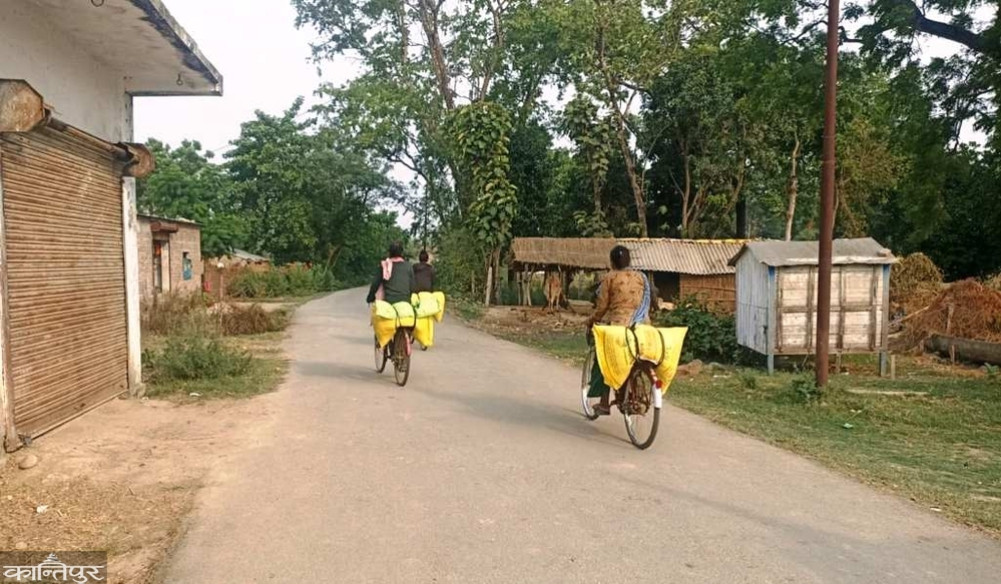
Farmers are returning home empty-handed due to lack of fertilizer in the district and restrictions on border areas.
We use Google Cloud Translation Services. Google requires we provide the following disclaimer relating to use of this service:
This service may contain translations powered by Google. Google disclaims all warranties related to the translations, expressed or implied, including any warranties of accuracy, reliability, and any implied warranties of merchantability, fitness for a particular purpose, and noninfringement.
Mohan Tharu of Barbardiya Municipality-5 reaches Dashgaja in Thapuwa, Gulariya-8, on the Indian border after not receiving fertilizer from the cooperative society in Bardiya. Farmers return home empty-handed due to the lack of fertilizer in the district and the restrictions imposed on the border area.
Fatte Tharu, who came with him, also returns home disappointed after not receiving fertilizer at the Indian border. ‘It is too late to plant rice seeds,’ he said. ‘How can we cultivate rice by planting rice beds in the absence of fertilizer?’ Like him, Krishna Tharu of Gulariya-10 has the same pain. ‘Although there has been a shortage of fertilizer in Bardiya for the past few years, no permanent solution has been found by any government,’ he said. ‘If we don’t cultivate, we won’t have enough to eat. Leaders promise to solve the fertilizer problem only during elections.’
Even though farmers reach the border market, including Chitlahawa, at the border checkpoint every morning, they have not been able to get enough fertilizer. Indian citizens who are black marketers of fertilizers say that they have not been able to bring them for a few days due to the strictness of the SSB.
Indian middleman Shamsuddin Manihar said that the SSB did not allow them to bring them due to the shortage of fertilizers in India. The situation of Dubar Tharu of Gulariya-9 is similar. He said that if the government does not provide adequate fertilizers on time, rice production will decrease. A bag of urea is sold at Rs 1,700 on the Indian border. Paddy is cultivated in an area of 50,200 hectares in Bardiya.
Ram Singh Tharu, a farmer of Gulariya-8, complained that even though the cooperative society gave him a bag of fertilizer, it was not enough as it was like a handful of seeds.
There has been no fertilizer supply to the Agricultural Materials Company, Bardiya. The company's acting head Krishna Bahadur Thapa said that the urea fertilizer is expected to arrive by the last week of Jestha. ‘This year we have demanded 5,200 metric tons,’ he said, ‘We need about 8,000 metric tons of urea fertilizer for the whole year.’ Fertilizer is distributed to cooperatives through the municipality. The company has stated that fertilizer is distributed based on the cultivable land and farmers.’
The company has fixed the price of urea per bag (50 kg) at Rs 894.50. Similarly, DAP is priced at Rs 2,344.50 and potash at Rs 1,744.50.