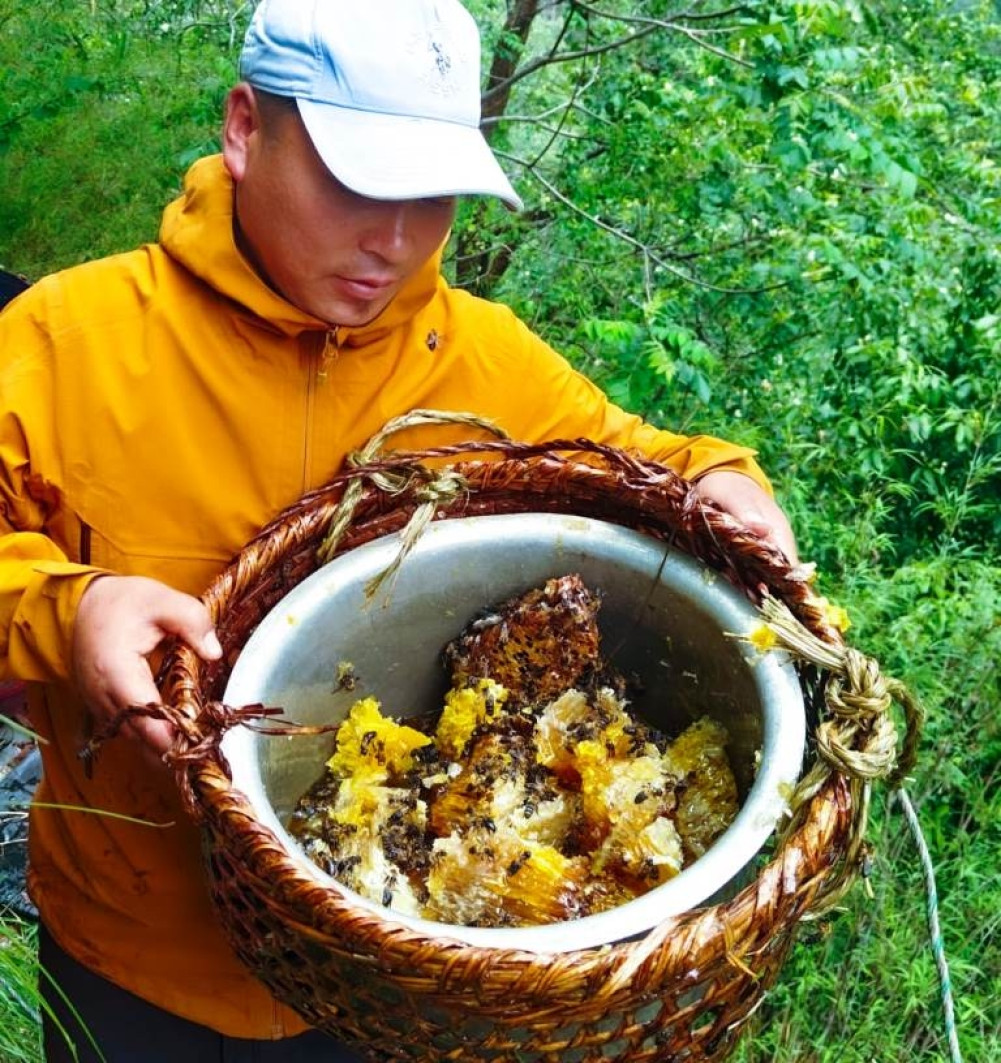
With climate change, deforestation, and declining interest among the younger generation, the Bhir Mauri honey hunting tradition in Jailbang is at increasing risk of disappearing.
We use Google Cloud Translation Services. Google requires we provide the following disclaimer relating to use of this service:
This service may contain translations powered by Google. Google disclaims all warranties related to the translations, expressed or implied, including any warranties of accuracy, reliability, and any implied warranties of merchantability, fitness for a particular purpose, and noninfringement.
The demand and discussion of Bhir Mairi, found in the Jelbang area of the district, is everywhere. Bhir Mairi honey, which is produced from the juice of various herbs, is very popular. Locals climb high cliffs at risk of their lives to extract honey. Locals call honey hunting .
Local and tourism entrepreneur Balkuram Pun said that the traditional style of honey hunting is still alive, although it is very risky. 'This traditional profession of honey extraction has gained further attraction after it was linked to the 'Mad Honey' product, which is now gaining international attention,' he said.
A jar of honey collected by hunting for honey in the cliffs is worth 7,000 rupees. 80 jars of honey are extracted from the cliffs here in a year . Honey is found only in the cliffs in the upper part of Jelbang village.
Honey made by Apis dorsata laboriosa, a bee species, in the high hills is called ‘Mad Honey’ or ‘Red Honey’. Locals have experienced that the honey contains a chemical called ‘Grayanotoxin’ that is naturally found in the honey, which makes it feel slightly intoxicated when consumed.
Locals extract honey by hanging from high cliffs with the help of traditional ropes, bamboo ladders and smoke. Locals have a custom of worshiping the Sime-Bhume deity before honey hunting. Locals say that people even come from outside the district to watch the honey hunting.
According to locals, honey from Bhir bees is considered to have medicinal properties. Honey from Bhir bees is sought after from local to national and international levels. Locals say that since honey hunting is very risky, there is a risk of falling from cliffs, being attacked by bees and serious health effects from excessive consumption of honey.
On the other hand, Balkuram says that there is also growing concern that the Bhiramuri hunting tradition is in danger due to climate change, deforestation, and the new generation's declining interest in this risky profession. Local leaders have demanded that the state pay special attention to the protection of this original culture and natural heritage.